Kraft Heinz Beats On Timing And Tax While The Promised Share Turnaround Slips To 2027
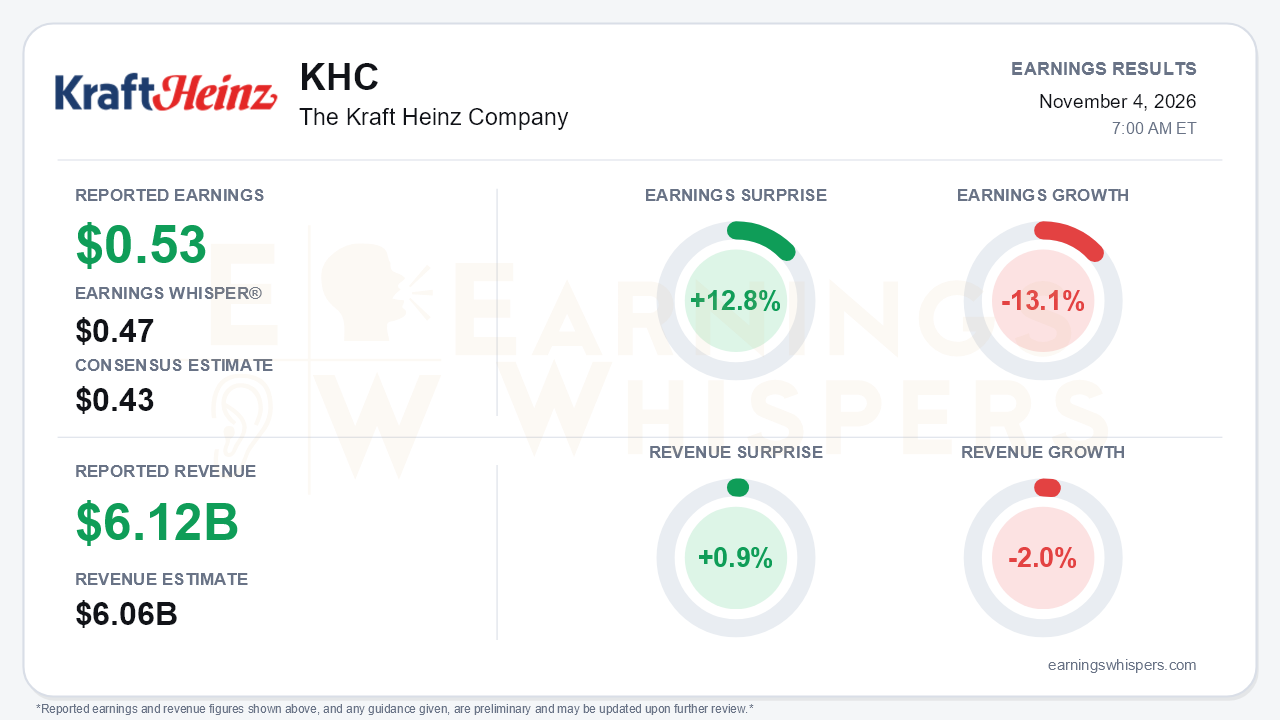
Kraft Heinz cleared a low bar comfortably. Third-quarter adjusted EPS of $0.53 topped the $0.43 consensus by 12.8% and beat the $0.47 Earnings Whisper number. Revenue of $6.115 billion came in 0.9% above estimates. Even so, earnings fell 13.1% year over year, revenue declined 2.0%, and the company held its full-year operating-profit outlook in place. The quality of the beat deserves scrutiny. Management acknowledged that trade and marketing timing flattered third-quarter operating profit by roughly 450 basis points, and that benefit reverses in the fourth quarter. A lower tax rate on adjusted earnings, helped by discrete deferred tax adjustments, also contributed. The headline surprise was real, but much of it was borrowed from the next quarter.
The underlying numbers tell a weaker story. Organic net sales fell 1.1%, with price flat and volume/mix down 1.1 points. Management attributed about 80 basis points of the volume drag to inventory pulled forward into the second quarter. North America remains the problem: organic sales fell 3.2% on declines in meats, sauces and refreshment beverages, and segment adjusted operating income dropped 10.5%. Europe and Pacific Developed Markets was worse on profit, with segment earnings down 32.8%. Emerging Markets was the lone bright spot, delivering 15.6% organic growth and a 35.6% constant-currency jump in segment profit. Adjusted gross margin slipped 40 basis points to 31.9%. Rising procurement and logistics inflation, higher incentive compensation, heavier advertising and a 24% increase in corporate expenses all pushed adjusted operating income down 15.2%. GAAP EPS of $0.46 fell 11.5%, partly reflecting $72 million in impairments.
The guidance revision follows the same pattern. Kraft Heinz raised the low end of its organic sales range to a decline of 0.5% to 1.25%, from a prior decline of 0.5% to 2%. It also lifted adjusted EPS guidance to $2.07-$2.13 from $2.03-$2.09. However, the constant-currency adjusted operating income outlook stayed at a decline of 16% to 18%, and gross margin is now expected at the low end of its range. The EPS raise traces to a tax rate cut to roughly 23.5% from 24.5% and slightly more other income, not to better operations. Nine-month adjusted EPS of $1.67 implies a fourth quarter of roughly $0.40-$0.46, consistent with the timing benefit unwinding.
The conference call is where the setup shifted. Earlier this year, management promised to bend the share trend in the second half of 2026. Now it describes share as having "leveled out," with the next push tied to spring 2027 shelf resets. Several other developments disappointed:
- U.S. retail categories in the portfolio softened about 50 basis points.
- Retailer destocking ran worse than the roughly 80-basis-point headwind flagged last quarter.
- Price investments in Philadelphia cream cheese failed, gaining share while losing consumption to cottage cheese and protein alternatives.
- Management now expects 2027 inflation slightly above 5%, up from 4-5%, and said price increases will "for sure" be needed next year. That sits awkwardly with a turnaround built on volume and affordability.
Analysts questioned whether 2026 is truly the margin trough, given a higher 2027 tax rate and the wrap of $700 million in incremental investment. Management deferred that question to next week's investor meeting. Bears have legitimate ammunition here.
There is a credible offset. The share of U.S. revenue gaining share rose to 28% from about 25% in the first half. Away-from-home and Canada grew again. The company agreed to sell its North American coffee business to One Rock while retaining a 30% stake, and it signaled that further portfolio reshaping, including a review of Oscar Mayer, remains on the table. R&D spending is up 20%. KD Ramen, which sold three months of inventory in a week in Canada, heads to the U.S. in 2027. Cash generation remains solid: free cash flow conversion reached 120% year to date, and the company repaid nearly $4 billion of debt. The release also notes that work on the planned separation remains paused, leaving that strategic question open.
Investors entered the report skeptical but less so than before. Sentiment remained negative but improved meaningfully, to -0.14 from -0.26. Shares have struggled since the August report, falling 9.1% from that day's $26.97 open to $24.52. The stock peaked at $27.05 on the August report day, then hit an inter-earnings low of $21.76 on October 6. Before this report it had rebounded 12.7% off that low and sat just 2.7% above its 200-day moving average. Price trend readings remain negative even as AVWAP has turned positive, reflecting a stock that has stabilized without regaining its post-August level.
The bottom line is that Kraft Heinz delivered a headline beat and a nominal guidance raise, but both rest heavily on timing and tax rather than operating improvement. The more consequential news was the delay of the share inflection to 2027, a higher inflation outlook and a likely return to pricing. Next week's investor meeting now carries the burden of proving that 2026 marks the bottom.
Read our earnings preview for The Kraft Heinz Company: https://www.earningswhispers.com/article/KHC/21711
This earnings review was originally published on Earnings Whispers.
This article is for informational purposes only and is not investment advice. Earnings Whispers and its staff may hold positions in the securities mentioned. It is AI-assisted, based on proprietary Earnings Whispers data and company reports, and edited by Earnings Whispers staff.
Mentioned In This Article
Latest News
| 4 hours | |
| 5 hours | |
| 5 hours | |
| 6 hours | |
| 8 hours | |
| 9 hours | |
| 9 hours | |
| 10 hours | |
| 10 hours | |
| 11 hours | |
| 12 hours | |
| 12 hours | |
| 12 hours | |
| 13 hours | |
| 13 hours |
