ConocoPhillips Beats On Price, Not Barrels, As A Dividend Hike And Post-2029 Cash Pitch Meet Souring Sentiment
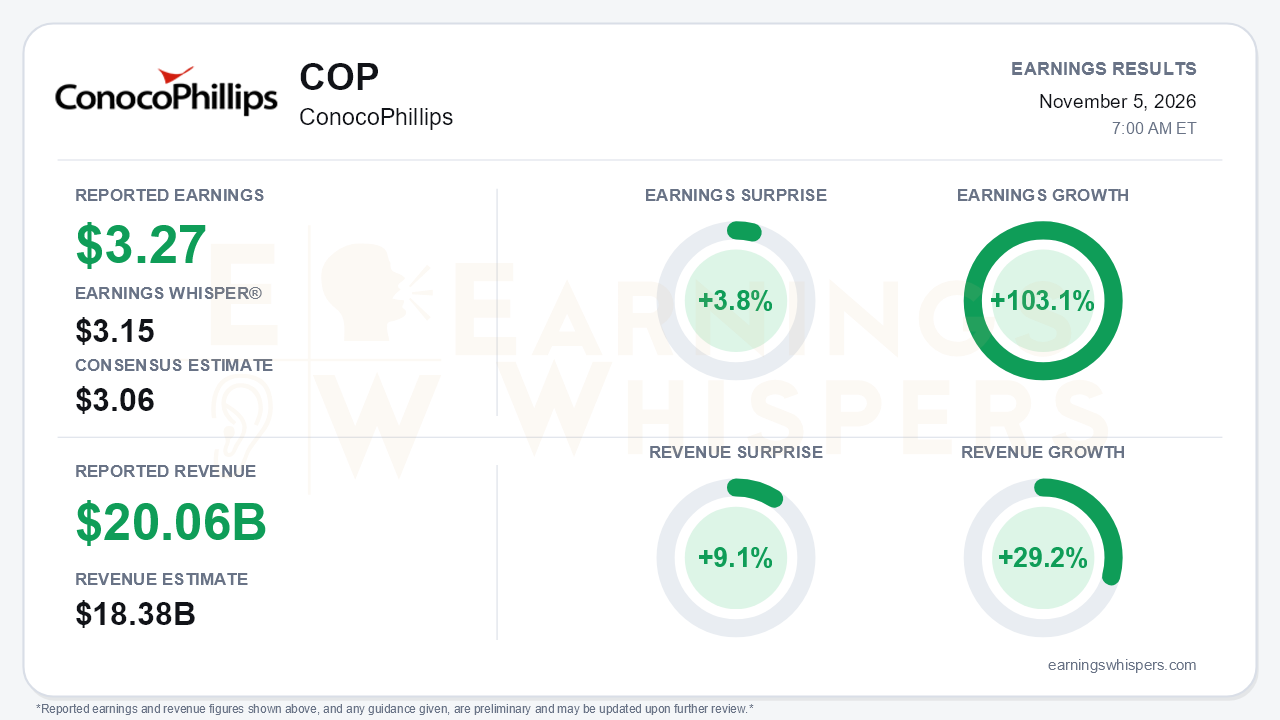
ConocoPhillips delivered a clean beat in Andy O'Brien's first quarter as CEO. Adjusted earnings of $3.27 per share topped the $3.06 consensus by 3.8% and cleared the $3.15 Earnings Whisper number. Revenue of $20.057 billion beat the $18.38 billion consensus by 9.1%. Year over year, earnings grew 103.1% and revenue rose 29.2%. The central tension is that commodity prices drove the doubling in profit, while volumes moved the other way. The company's average realized price jumped 32% to $61.40 per BOE. Underlying production, adjusted for acquisitions and dispositions, fell 2% from a year ago. Management credited higher prices for the earnings gain, partially offset by lower volumes.
The quality of the beat deserves some scrutiny. GAAP EPS of $3.34 ran ahead of the adjusted figure mainly because of the reversal of a tax reserve, so the adjusted number is the right one to focus on. Sequentially, the earnings surge has largely played out. Adjusted EPS of $3.27 was only marginally above Q2's $3.24, after a steep climb from $1.89 in Q1. Free cash flow of roughly $4.0 billion slipped from $4.2 billion in Q2 as capital spending edged up to $3.1 billion. Revenue beat consensus by more than twice the margin of the earnings beat. That gap suggests some of the price windfall was absorbed by cost and volume headwinds. Management acknowledged low single-digit inflation tied to the Middle East conflict, with fuel, logistics and chemicals up double digits in some categories.
The operating story beneath the headline is sturdier than the year-over-year volume decline implies. Reported production of 2,302 MBOED rose from 2,248 MBOED in Q2. Fourth-quarter production guidance of 2.32 to 2.36 million BOE per day sits above the prior quarter's guide. Lower 48 output reached 1,517 MBOED. The Permian posted record completion efficiency, with 15% more pumping hours than the 2025 average and a 20% improvement in stimulated footage per day. The Surmont 104W-B pad came online ahead of schedule and under budget. The drag is concentrated in Qatar, which remains below pre-conflict levels, and in higher Surmont royalties. Management deliberately set a wide Q4 range to cover potential Qatar outcomes. Full-year capital and operating cost guidance was held rather than raised.
The forward-looking pieces were the call's real substance. The preliminary 2027 framework calls for:
- modestly lower capital spending than the $12 billion to $12.5 billion 2026 guide;
- low single-digit underlying production growth;
- lower unit operating costs despite inflation;
- a continued 45% return of cash from operations to shareholders.
Management also extended the free cash flow story beyond the targeted $7 billion inflection by 2029. It expects the reinvestment rate to fall from roughly 60% at $70 WTI to well below 50% in the 2030s, and the free cash flow breakeven to drop from the mid-$40s to the low-$30s. Willow module fabrication is more than 75% complete, with first oil still slated for early 2029. Commercial LNG offtake grew to 13 MTPA, from roughly 10 MTPA at the end of 2025. Management noted that TTF gas near $30 compares with the $10 assumption underpinning the 2029 target. Bears have legitimate ammunition as well:
- North Field East has slipped to the first half of 2027;
- Lower 48 service capacity is tightening, with super-spec rigs above 90% utilization;
- an unsolicited offer for the cash-generative Norway business is now public;
- Middle East exposure is expanding into Iraq, Syria and Libya.
Capital returns are accelerating regardless. Buybacks rose to $2.4 billion from $2.0 billion in Q2 and $1.0 billion in Q1. Total distributions reached $3.4 billion. The quarterly dividend rises 11% to $0.93. Management signaled that Q4 repurchases will trend higher to reach the full-year 45% target. With the $5 billion divestment program complete, cash and short-term investments climbed to $10.4 billion and net debt stands at 0.5 times cash from operations.
The market setup is more complicated than the surprise implies. Investor sentiment swung from slightly positive at 0.06 after the prior report to a clearly negative -0.23 heading into this one. Price action helps explain why. Shares hit a 52-week high of $154.28 on October 30, then retreated to $136.94 by the eve of the report, 11.2% below that peak. The stock is still up 14.1% since the open following the August report and sits 12.4% above its 200-day moving average. Most Earnings Whispers trend readings remain positive, though sequential growth is neutral, consistent with the flattening quarter-to-quarter earnings.
The bottom line is that ConocoPhillips beat because oil and gas prices were high, not because it produced more, and the earnings acceleration is now leveling off sequentially. What the call added was durability: rising buybacks, an 11% dividend increase, a leaner 2027 spending plan, and a credible case for cash flow growth beyond 2029. Investors who turned cautious after the late-October run-up are weighing that against Qatar uncertainty, cost inflation and portfolio questions such as the Norway offer.
Read our earnings preview for ConocoPhillips: https://www.earningswhispers.com/article/COP/22074
This earnings review was originally published on Earnings Whispers.
This article is for informational purposes only and is not investment advice. Earnings Whispers and its staff may hold positions in the securities mentioned. It is AI-assisted, based on proprietary Earnings Whispers data and company reports, and edited by Earnings Whispers staff.
Mentioned In This Article
Latest News
| 10 min | |
| 3 hours | |
| 7 hours | |
| 7 hours | |
| 8 hours | |
| 9 hours | |
| 9 hours | |
| 10 hours | |
| 10 hours | |
| Nov-02 | |
| Nov-02 | |
| Nov-02 | |
| Oct-30 | |
| Oct-29 | |
| Oct-28 |
