Moderna Swings To A Profit And Lifts Its Revenue Outlook, But A Stock Up More Than 300% Leaves Little Room For Error
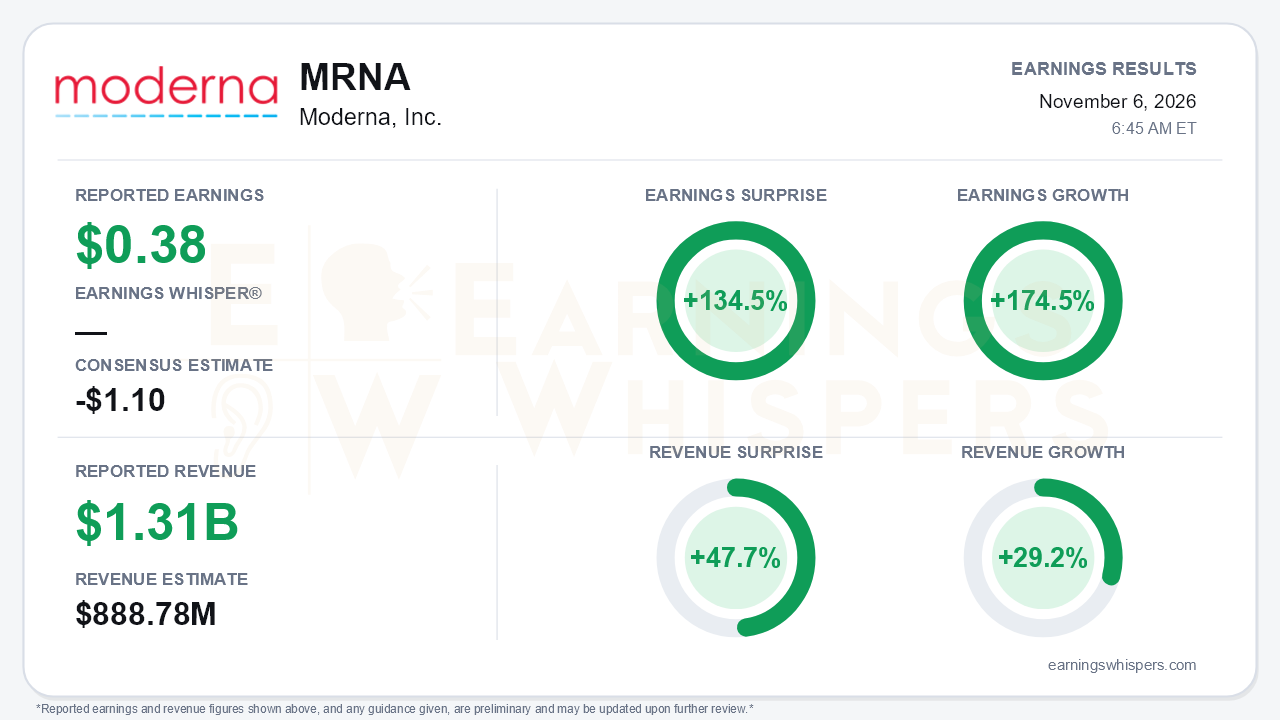
Moderna delivered the kind of quarter that skeptics of its post-pandemic story were not positioned for. The company earned $0.38 per share on revenue of $1.313 billion, against a consensus estimate of a $1.10 loss on $888.78 million in revenue. That is a 134.5% earnings surprise and a 47.7% revenue beat. Earnings grew 174.5% year over year, a swing from a $0.51 loss a year earlier. Revenue rose 29.2%. Net income of $162 million compares with a $200 million loss in the prior-year quarter and a $782 million loss in the second quarter. Management also raised its 2026 revenue growth framework to 15%-25%, well above the "up to 10%" it had repeated for three straight quarters. The central tension is that the fundamental inflection is real, but the stock had already more than quadrupled heading into the print.
The quality of the beat deserves scrutiny. International COVID vaccine deliveries under long-term government partnerships drove the top line. International revenue totaled $533 million in the quarter, and the call noted international revenue of roughly $900 million year to date, already about $200 million above all of 2025. The profit, however, owed as much to cost cuts as to sales. R&D fell 27% to $583 million as late-stage infectious disease studies wound down. Cost of sales rose 54% to $318 million, faster than revenue. Cash conversion also lags reported earnings. Accounts receivable jumped to $1.37 billion from $184 million at year-end, and the company said most third-quarter sales remained uncollected. Nine-month operating cash burn was still $2.7 billion. Management acknowledged that part of the third-quarter strength reflects shipment timing between the third and fourth quarters, so investors should not simply extrapolate this run rate.
The forward framework improved on nearly every line. R&D guidance fell to about $2.7 billion from $2.9 billion, extending a steady progression down from $3.0 billion earlier in the year. Cash-cost guidance dropped to $3.8 billion, GAAP operating expenses excluding litigation fell to $4.5 billion, and capex was narrowed to about $200 million. Year-end cash is now projected at $8.1-$8.3 billion. That figure is flattered by $2.6 billion in net proceeds from a $3 billion 0% convertible note. Excluding the convert, the outlook is $5.5-$5.7 billion, which is still a genuine improvement from the prior $4.7-$5.2 billion. One inconsistency is worth noting: the CEO cited 15%-20% growth in closing remarks, below the top of the published 15%-25% range.
The pipeline is where the investment setup changed most. INTerpath-001, the Phase 3 trial of intismeran with KEYTRUDA, produced positive results:
- a 0.58 hazard ratio for recurrence or death in the intention-to-treat population (0.51 in the mITT population);
- two-year recurrence-free survival of 82.2% versus 70%;
- a stronger benefit after the six-month immunization regimen.
On the call, management said it is targeting a BLA submission with Merck this year. Last quarter, this readout was still an uncertain interim analysis. The FDA approved mFLUSIVA after an earlier refusal-to-file setback, though the launch is limited because approval came after the contracting cycle. The October GSK settlement also removed a patent overhang.
Bears still have legitimate ammunition:
- The norovirus program has effectively stalled, with management reversing its second-quarter plan to enroll an additional cohort.
- The U.S. path for the flu/COVID combination vaccine remains undefined.
- The methylmalonic acidemia pivotal decision is deferred.
- Up to $1.3 billion in contingent Section 1498 litigation exposure remains.
- The convertible adds potential dilution, partly offset by capped calls; diluted shares were already 430 million against 401 million basic.
The call was also internally mixed on U.S. COVID demand. Volumes were cited as up 3% through October, while vaccinations were also described as trending slightly behind the prior year.
The market setup is more complicated than the surprise implies. Shares rose 317.4% from the $57.85 open after the July report to $241.46. They sit 167.5% above the 200-day moving average and about 7.5% below a $261 52-week high set the day before earnings. Yet investor sentiment remains negative, improving only modestly from -0.18 to -0.13. Investors have bid the stock aggressively without fully embracing the story, which suggests skepticism about durability rather than outright pessimism. With an Analyst Day on November 12, much of the near-term reaction may hinge on longer-range targets.
The bottom line is that Moderna produced a credible inflection: a large beat, a return to profitability, a meaningful guidance raise, steadily falling costs and a positive Phase 3 oncology readout. The profit leans heavily on R&D cuts, receivables and possible shipment timing, while the stock's extraordinary run has already absorbed much of the good news. Execution on intismeran filings, fourth-quarter collections and the Analyst Day outlook now matters more than this quarter's headline beat.
Read our earnings preview for Moderna, Inc.: https://www.earningswhispers.com/article/MRNA/22493
This earnings review was originally published on Earnings Whispers.
This article is for informational purposes only and is not investment advice. Earnings Whispers and its staff may hold positions in the securities mentioned. It is AI-assisted, based on proprietary Earnings Whispers data and company reports, and edited by Earnings Whispers staff.
Mentioned In This Article
Latest News
| 35 min | |
| 47 min |
Moderna Hits Five-Year High On Sales Beat; But The Real Story Is Still Its Cancer Vaccine
MRNA +7.59%
Investor's Business Daily
|
| 2 hours | |
| 3 hours | |
| 3 hours | |
| 3 hours | |
| 4 hours | |
| 5 hours | |
| 5 hours | |
| 5 hours | |
| 6 hours | |
| 6 hours | |
| 7 hours | |
| 7 hours | |
| 7 hours |
