AI Stocks Plunge: Buy, Sell or Hold?
It has been a brutal week for some of the hottest stocks in the market, particularly those tied to artificial intelligence, semiconductors and the enormous infrastructure build-out supporting the industry.
On Thursday, the Philadelphia Semiconductor Index plunged more than 12%, its second-worst day on record, while the Nasdaq fell 5.5% and the S&P 500 dropped 4.4%. The selling was widespread, with some of the market's biggest winners suffering extraordinary one-day losses.
And all of this came just days after the midterm elections delivered a sweeping victory for Democrats, raising concerns about the future of AI infrastructure investment.
Today, technology and semiconductor stocks are bouncing sharply, offering some relief after the dramatic selloff. But investors are left with a difficult question: Is this an opportunity to buy the dip, or the beginning of the end for the AI bull market?
I certainly can't say for sure, but the evidence doesn't suggest the AI boom is over. In fact, I think there are some compelling opportunities emerging, though investors need to be selective.
Below, I will lay out the current setup and share why I think Bloom Energy (BE), Skyworks Solutions (SWKS) and Quanta Services (PWR) stand out.
What Really Caused the AI Stock Selloff?
The prevailing explanation for this week's selling is fairly straightforward. Democrats swept the midterm elections, the party is viewed as less friendly toward AI infrastructure development, and investors are suddenly concerned that tighter regulations could slow the build-out.
There is certainly some truth to that narrative. Opposition to data centers has been growing, particularly around electricity costs and the strain that new facilities place on local power systems.
However, I think the more important explanation is positioning.
The AI trade had become incredibly crowded, with enormous amounts of capital, much of it leveraged, concentrated in a relatively narrow group of companies.
When those positions begin moving against investors, selling can quickly become self-reinforcing. Losses force funds to reduce exposure, which drives prices lower and creates even more selling.
There is growing evidence that this is exactly what happened. Several hedge funds have suffered severe losses, with reports of managers cutting risk and reducing investment teams.
And importantly, the cracks were appearing well before the election.
Memory stocks began showing signs of weakness over the summer, while the Nasdaq had been gradually slipping since early October. The election may have been the catalyst that accelerated the selling, but I don't think it was the underlying cause.
Is the AI Bull Market Actually Over?
Despite the sharp deterioration in stock prices, I remain constructive on the broader outlook.
The economy continues to show considerable strength, and the bull market has been broadening beyond the handful of technology giants that initially drove the advance.
Meanwhile, the latest earnings season has been overwhelmingly positive. Earnings growth has been spreading across sectors, and corporate fundamentals generally remain healthy.
Most importantly, the AI infrastructure build-out continues to represent an enormous source of economic activity.
The hyperscalers have committed extraordinary sums of capital to data centers, semiconductors, networking equipment and electrical infrastructure. Current spending plans continue to point toward another substantial year of investment in 2027.
Of course, political risks shouldn't be dismissed. New restrictions on data center construction could delay projects and increase costs, particularly in states where opposition has intensified.
But I have a difficult time believing that Washington can simply bring this build-out to a halt. There are powerful economic and strategic incentives behind AI development, and plenty of states will welcome the investment, employment and tax revenue that comes with these projects.
The bigger risk, in my view, would be a meaningful deterioration in the economics of AI itself, followed by cuts to capital spending and earnings expectations.
So far, we haven't seen convincing evidence of that.
AI Stocks: Buy, Sell or Hold?
For investors who have held through this drawdown, I don't see a compelling reason to abandon fundamentally sound positions simply because prices have fallen sharply.
Selling after a violent deleveraging event is often a poor decision, particularly when the underlying earnings outlook remains intact. For investors who were underweight the sector or trimmed exposure during the rally, I think opportunities are beginning to emerge.
However, I am certainly not calling Thursday the bottom. Markets can remain volatile after this kind of liquidation, and some of the hardest-hit stocks may need considerable time to recover.
Micron Technology (MU) is a good example. While I remain constructive on the company's longer-term outlook, the stock has broken down from a large consolidation pattern. That is not the kind of technical setup I want to chase.
I would rather wait for Micron to establish a new base before considering an entry.
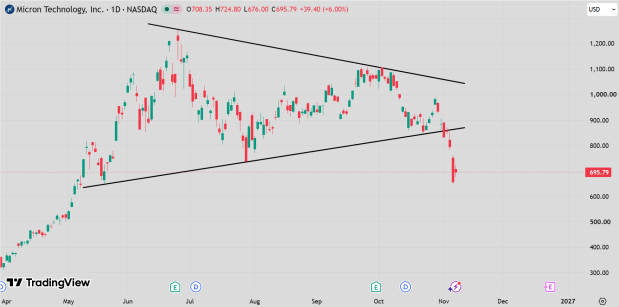
Image Source: TradingView
Instead, I'm looking for stocks with improving earnings estimates and technical setups that are holding up relatively well.
Bloom Energy Stock: A Direct Play on AI Power Demand
Bloom Energy manufactures fuel-cell systems that generate electricity on-site, allowing customers to secure power without relying entirely on the traditional electrical grid.
Its technology is particularly attractive to data centers, utilities and industrial customers that need substantial amounts of reliable electricity, often on accelerated timelines.
Energy has become one of the most important constraints on the AI infrastructure boom.
And I suspect an increasing share of data center electricity demand will need to be met through dedicated generation rather than simply adding more strain to public power systems. Bloom is one of the most direct ways to invest in that shift.
The fundamental outlook is exceptionally strong.
Bloom currently holds a Zacks Rank #2 (Buy), with earnings estimates rising dramatically over the last month. Current quarter estimates have increased 39%, while full year estimates are up 23.3% and next-year estimates have risen 13.35%.
Revenue is projected to grow 125% this year and another 63% next year. Earnings growth is even more impressive, with expectations for increases of 338% and 70.9%, respectively.
At roughly 50x forward earnings, the valuation is certainly demanding, but I think the growth outlook goes a long way toward justifying that premium.
More importantly, the technical setup is attractive.
Following the recent selloff, Bloom has pulled back toward a key support level around $160, which has held so far.
That gives investors a relatively clear level to manage risk against. A sustained break below $160 would weaken the setup considerably, but as long as support holds, I think the risk/reward favors buyers.
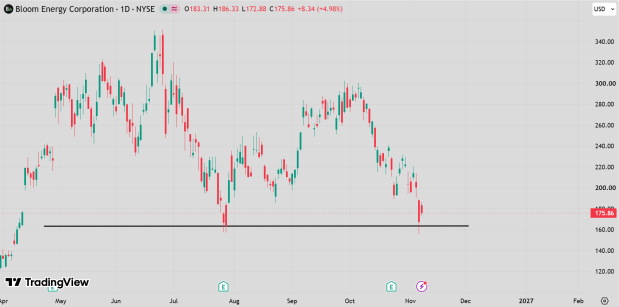
Image Source: TradingView
Quanta Services Stock: The Infrastructure Builder
Quanta Services offers a somewhat different way to participate in the AI infrastructure boom.
The company is one of North America's largest specialty infrastructure contractors, building and maintaining electrical transmission lines, substations, grid connections and other essential power infrastructure.
And its business extends well beyond AI, with exposure to utilities, renewable energy, underground infrastructure and communications.
Whether electricity comes from the public grid or dedicated generation, somebody has to build the infrastructure required to deliver it. Quanta is exceptionally well positioned to benefit from that demand.
The numbers are impressive.
Quanta carries a Zacks Rank #1 (Strong Buy), with nearly unanimous upward earnings revisions. Current year estimates have increased 6.45%, while next year estimates are up 7.7%, including upgrades within the last week.
Revenue is expected to grow 43.4% this year and 18% next year, while earnings are projected to increase 62.7% and 18.4%, respectively.
Its latest quarterly results reinforced that momentum, with management reporting a record $63.7 billion backlog and raising its full-year outlook.
Shares trade around 29.1x forward earnings, which is not especially cheap, but reasonable considering the growth outlook and visibility into future demand.
Of the three stocks discussed here, Quanta may have the cleanest technical setup.
Shares have pulled back toward the bottom of a declining channel, creating an attractive potential entry point with a clearly defined risk level.
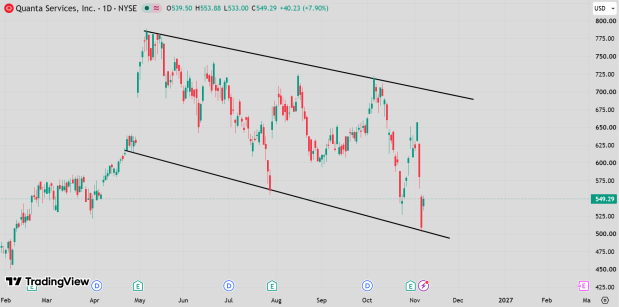
Image Source: TradingView
Skyworks Solutions Stock: A Semiconductor Recovery Play
Finally, Skyworks Solutions offers an opportunity that extends beyond the AI infrastructure trade.
Skyworks develops analog, radio-frequency and mixed-signal semiconductors used across smartphones, automotive systems, communications equipment and industrial applications.
The company recently completed its combination with Qorvo, creating a much larger semiconductor business with expanded exposure to defense, automotive, infrastructure and emerging physical AI applications.
I've been highlighting the developing recovery in analog semiconductors for the last couple of months.
Unlike some of the more speculative AI infrastructure names, analog chip companies benefit from a broader improvement in industrial activity and economic growth.
And that diversification is especially appealing in the current environment.
Skyworks also has some interesting AI-specific opportunities. In its November 3 earnings release, management highlighted new timing design wins in AI data center networking and the beginning of shipments of high-performance clocks for hyperscaler systems.
The company reported standalone quarterly revenue of $1.046 billion and adjusted earnings of $1.28 per share.
Meanwhile, earnings estimates have been moving higher, with unanimous upward revisions, including some within the last seven days. Shares currently carry a Zacks Rank #1 (Strong Buy).
The combination of improving semiconductor demand, merger synergies and expanding exposure to AI infrastructure makes Skyworks an attractive way to participate in the next phase of the cycle without relying exclusively on hyperscaler capital spending.
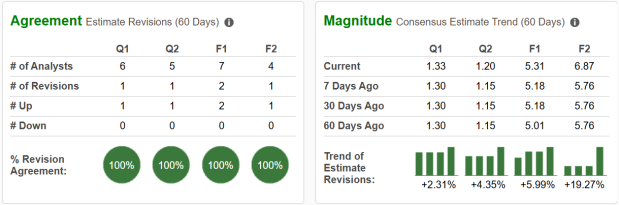
Image Source: Zacks Investment Research
What’s Next for AI Stocks?
This week's selloff was extraordinary, but I don't see enough evidence to conclude that the underlying AI investment cycle has fundamentally changed.
However, I do think this correction raises an important question about what the next phase of the AI bull market might look like.
We are already roughly four years into this boom, and much of the early gains have been concentrated in the companies building the infrastructure behind AI. Those businesses should continue to benefit from substantial investment, but that doesn't necessarily mean they will remain the biggest winners in the stock market.
After all, AI is a paradigm-shifting technology that will eventually be integrated throughout virtually every corner of the economy. As adoption spreads, the investment opportunities are likely to evolve as well, potentially shifting toward the companies putting that infrastructure to productive use.
In other words, the stocks that led the market over the last several years may not be the same ones that lead over the next several.
I will be watching closely for signs of that transition, particularly in earnings estimates and the Zacks Rank. If revisions begin deteriorating across the infrastructure leaders while improving elsewhere, that could provide an early indication that market leadership is shifting.
For now, I remain constructive on the broader AI outlook and view this week's selling primarily as a positioning washout. But I also think investors need to remain flexible. The long-term opportunity is enormous, though the best way to participate in it through the stock market may look quite different in the years ahead.
Want the latest recommendations from Zacks Investment Research? Today, you can download 7 Best Stocks for the Next 30 Days. Click to get this free report
Quanta Services, Inc. (PWR): Free Stock Analysis Report
Micron Technology, Inc. (MU): Free Stock Analysis Report
Skyworks Solutions, Inc. (SWKS): Free Stock Analysis Report
Bloom Energy Corporation (BE): Free Stock Analysis Report
This article originally published on Zacks Investment Research (zacks.com).
Mentioned In This Article
Latest News
| 10 min | |
| 12 min | |
| 13 min |
Stocks See Slight Rebound After Thursday's Rout But Remain Well Below Highs
MU +5.12%
International Business Times
|
| 18 min | |
| 1 hour | |
| 1 hour | |
| 4 hours | |
| 4 hours | |
| 5 hours | |
| 6 hours | |
| 7 hours | |
| 8 hours | |
| 8 hours | |
| 8 hours | |
| 9 hours |
