Provident Financial Services (NYSE:PFS) Exceeds Q2 Expectations

Regional bank Provident Financial Services (NYSE:PFS) beat Wall Street’s revenue expectations in Q2 CY2025, with sales up 30.8% year on year to $214.2 million. Its GAAP profit of $0.55 per share was 10.7% above analysts’ consensus estimates.
Is now the time to buy Provident Financial Services? Find out by accessing our full research report, it’s free.
Provident Financial Services (PFS) Q2 CY2025 Highlights:
- Net Interest Income: $187.1 million vs analyst estimates of $186.8 million (32.2% year-on-year growth, in line)
- Net Interest Margin: 3.4% vs analyst estimates of 3.4% (15 basis point year-on-year increase, in line)
- Revenue: $214.2 million vs analyst estimates of $213 million (30.8% year-on-year growth, 0.6% beat)
- Efficiency Ratio: 53.5% vs analyst estimates of 53.2% (0.3 percentage point miss)
- EPS (GAAP): $0.55 vs analyst estimates of $0.50 (10.7% beat)
- Market Capitalization: $2.39 billion
Anthony J. Labozzetta, President and Chief Executive Officer commented, “Provident's performance this quarter was impressive and I am very proud of the team's continued hard work and dedication to excellence. We achieved record revenues by growing earning assets and expanding margins, while improving operational efficiency and maintaining strong asset quality. We look forward to sustaining our positive momentum and continuing to grow our business.”
Company Overview
Founded in 1839 and serving communities across New Jersey, Pennsylvania, and New York, Provident Financial Services (NYSE:PFS) operates a regional bank providing commercial, residential, and consumer lending alongside wealth management and insurance services.
Sales Growth
Net interest income and and fee-based revenue are the two pillars supporting bank earnings. The former captures profit from the gap between lending rates and deposit costs, while the latter encompasses charges for banking services, credit products, wealth management, and trading activities.
Over the last five years, Provident Financial Services grew its revenue at an incredible 18.8% compounded annual growth rate. Its growth beat the average bank company and shows its offerings resonate with customers.
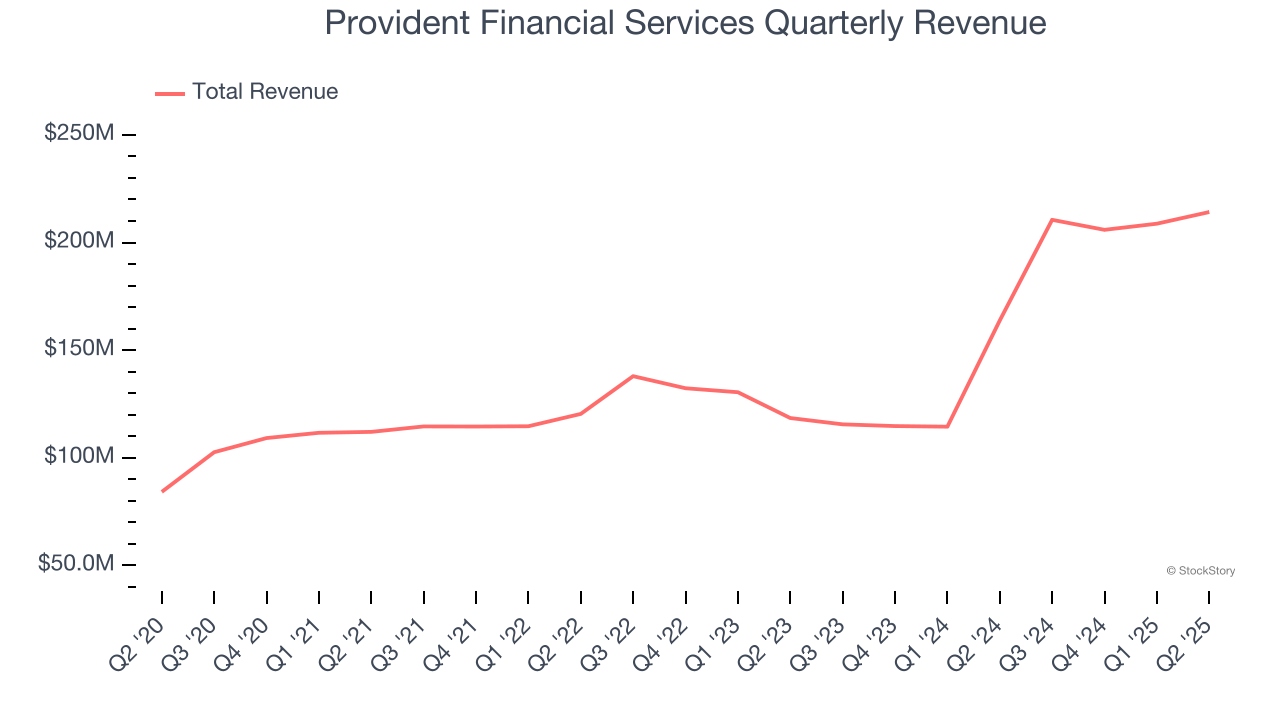
We at StockStory place the most emphasis on long-term growth, but within financials, a half-decade historical view may miss recent interest rate changes, market returns, and industry trends. Provident Financial Services’s annualized revenue growth of 27.1% over the last two years is above its five-year trend, suggesting its demand was strong and recently accelerated.
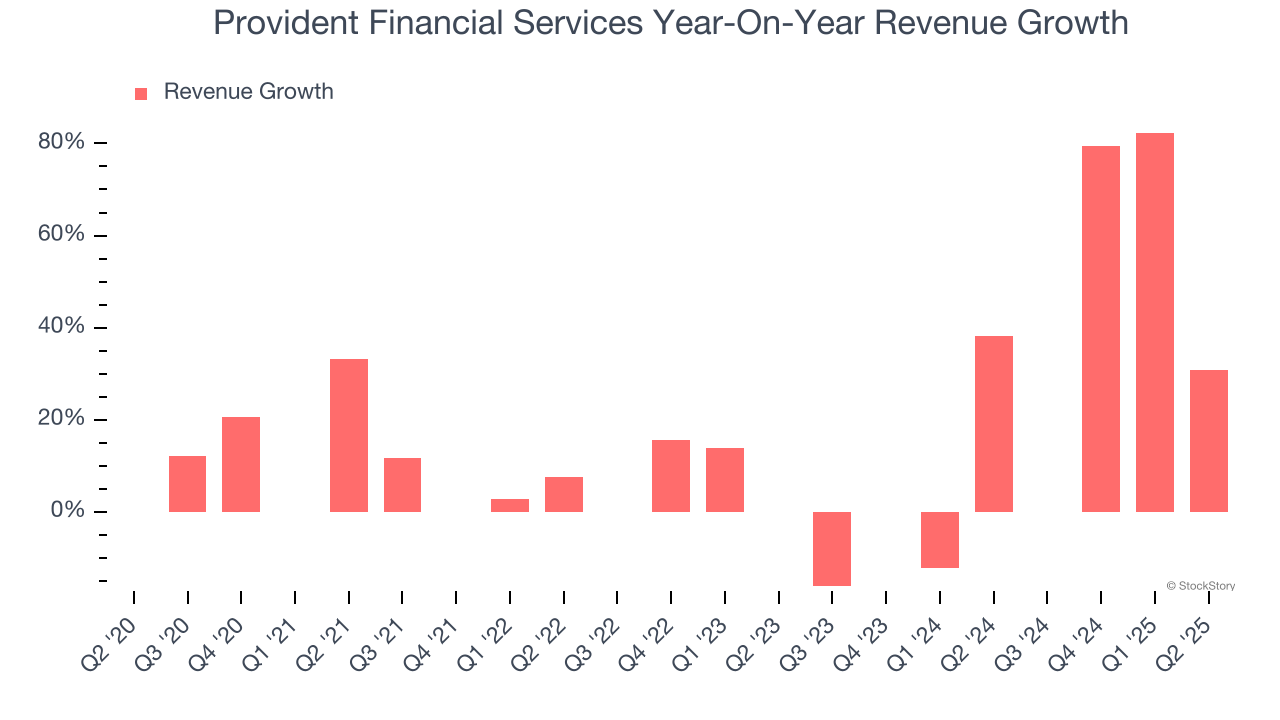
This quarter, Provident Financial Services reported wonderful year-on-year revenue growth of 30.8%, and its $214.2 million of revenue exceeded Wall Street’s estimates by 0.6%.
Net interest income made up 83.3% of the company’s total revenue during the last five years, meaning Provident Financial Services barely relies on non-interest income to drive its overall growth.
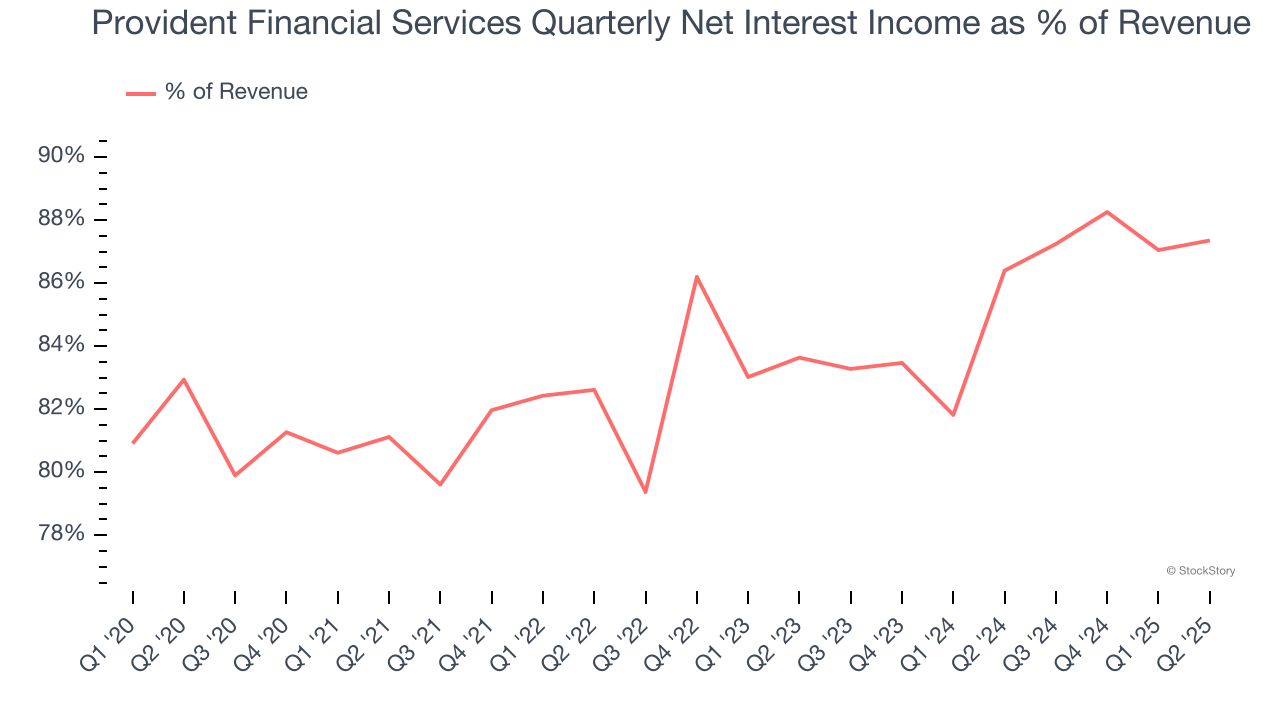
Net interest income commands greater market attention due to its reliability and consistency, whereas non-interest income is often seen as lower-quality revenue that lacks the same dependable characteristics.
Here at StockStory, we certainly understand the potential of thematic investing. Diverse winners from Microsoft (MSFT) to Alphabet (GOOG), Coca-Cola (KO) to Monster Beverage (MNST) could all have been identified as promising growth stories with a megatrend driving the growth. So, in that spirit, we’ve identified a relatively under-the-radar profitable growth stock benefiting from the rise of AI, available to you FREE via this link.
Tangible Book Value Per Share (TBVPS)
The balance sheet drives banking profitability since earnings flow from the spread between borrowing and lending rates. As such, valuations for these companies concentrate on capital strength and sustainable equity accumulation potential.
When analyzing banks, tangible book value per share (TBVPS) takes precedence over many other metrics. This measure isolates genuine per-share value by removing intangible assets of debatable liquidation worth. Traditional metrics like EPS are helpful but face distortion from M&A activity and loan loss accounting rules.
Provident Financial Services’s TBVPS was flat over the last five years. A turnaround doesn’t seem to be in sight as its TBVPS also dropped by 3.8% annually over the last two years ($15.79 to $14.60 per share).
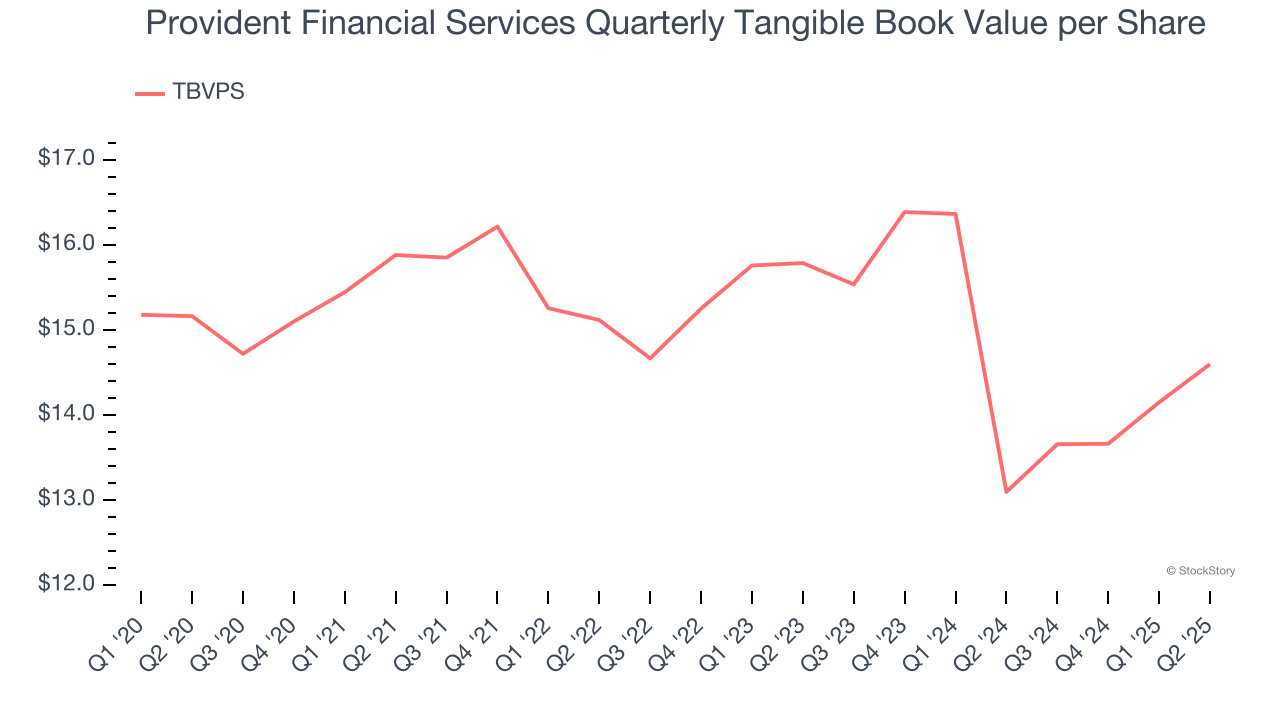
Over the next 12 months, Consensus estimates call for Provident Financial Services’s TBVPS to grow by 8.8% to $15.88, decent growth rate.
Key Takeaways from Provident Financial Services’s Q2 Results
It was encouraging to see Provident Financial Services beat analysts’ EPS expectations this quarter. We were also happy its tangible book value per share narrowly outperformed Wall Street’s estimates. Overall, this print had some key positives. The stock traded up 1.3% to $18.50 immediately following the results.
So should you invest in Provident Financial Services right now? What happened in the latest quarter matters, but not as much as longer-term business quality and valuation, when deciding whether to invest in this stock. We cover that in our actionable full research report which you can read here, it’s free.
Mentioned In This Article
Latest News
| Oct-20 | |
| Oct-02 | |
| Sep-29 | |
| Aug-20 | |
| Aug-04 | |
| Aug-04 | |
| Jul-30 | |
| Jul-30 | |
| Jul-29 | |
| Jul-29 | |
| Jul-22 | |
| Jul-15 | |
| Jul-01 | |
| Jun-23 | |
| Jun-17 |
