Amalgamated Financial's (NASDAQ:AMAL) Q3 Sales Beat Estimates

Socially responsible bank Amalgamated Financial (NASDAQ:AMAL) reported Q3 CY2025 results exceeding the market’s revenue expectations, with sales up 5.6% year on year to $85.61 million. Its non-GAAP profit of $0.91 per share was 4% above analysts’ consensus estimates.
Is now the time to buy Amalgamated Financial? Find out by accessing our full research report, it’s free for active Edge members.
Amalgamated Financial (AMAL) Q3 CY2025 Highlights:
- Net Interest Income: $76.45 million vs analyst estimates of $74.19 million (6% year-on-year growth, 3% beat)
- Net Interest Margin: 3.6% vs analyst estimates of 3.5% (6 basis point beat)
- Revenue: $85.61 million vs analyst estimates of $83.32 million (5.6% year-on-year growth, 2.7% beat)
- Efficiency Ratio: 51% vs analyst estimates of 50.9% (10 basis point miss)
- Adjusted EPS: $0.91 vs analyst estimates of $0.88 (4% beat)
- Tangible Book Value per Share: $25.31 vs analyst estimates of $25 (13.5% year-on-year growth, 1.2% beat)
- Market Capitalization: $803.3 million
Priscilla Sims Brown, President and Chief Executive Officer, commented, “What stands out to me this quarter is mainly that we keep delivering great results. And the quality and sustainability of our earnings allows us to handle problem situations with ease.”
Company Overview
Founded in 1923 by labor unions seeking a financial institution aligned with worker values, Amalgamated Financial (NASDAQGM:AMAL) operates a values-oriented bank that provides commercial banking, trust services, and investment management to socially responsible organizations and individuals.
Sales Growth
Two primary revenue streams drive bank earnings. While net interest income, which is earned by charging higher rates on loans than paid on deposits, forms the foundation, fee-based services across banking, credit, wealth management, and trading operations provide additional income. Luckily, Amalgamated Financial’s revenue grew at an impressive 9.8% compounded annual growth rate over the last five years. Its growth surpassed the average banking company and shows its offerings resonate with customers, a great starting point for our analysis.
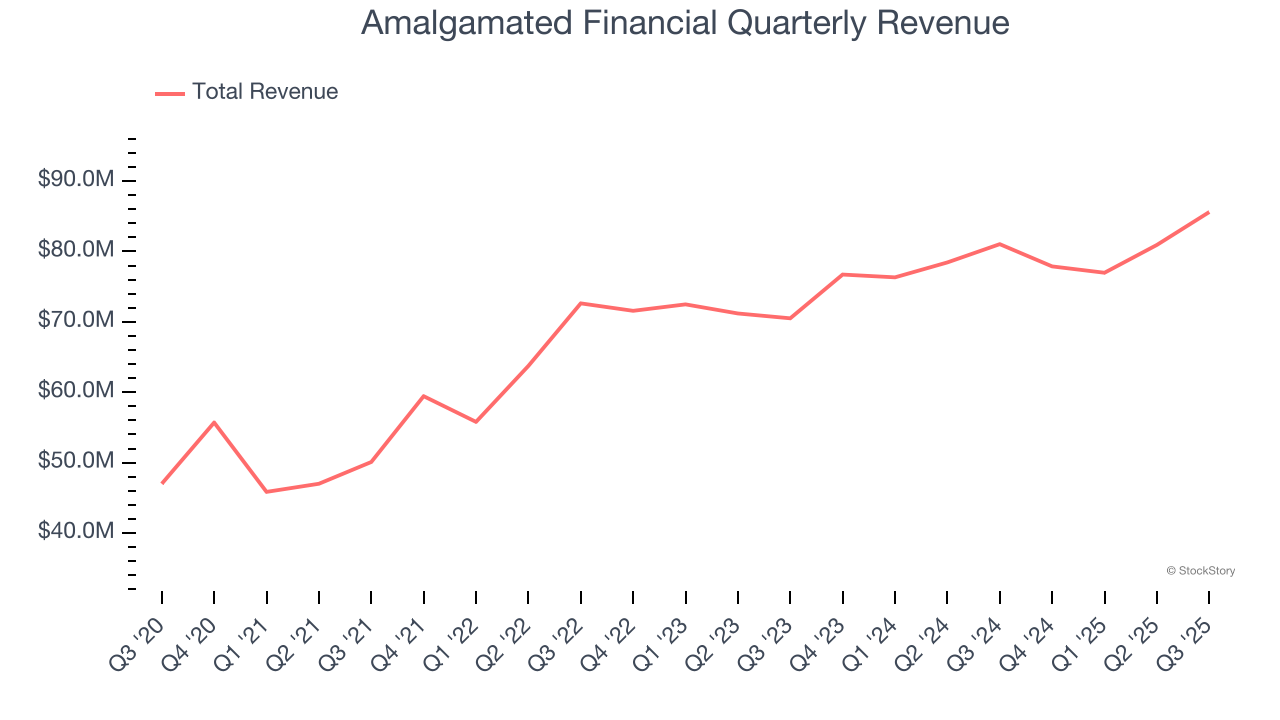
We at StockStory place the most emphasis on long-term growth, but within financials, a half-decade historical view may miss recent interest rate changes, market returns, and industry trends. Amalgamated Financial’s annualized revenue growth of 6.1% over the last two years is below its five-year trend, but we still think the results were respectable.
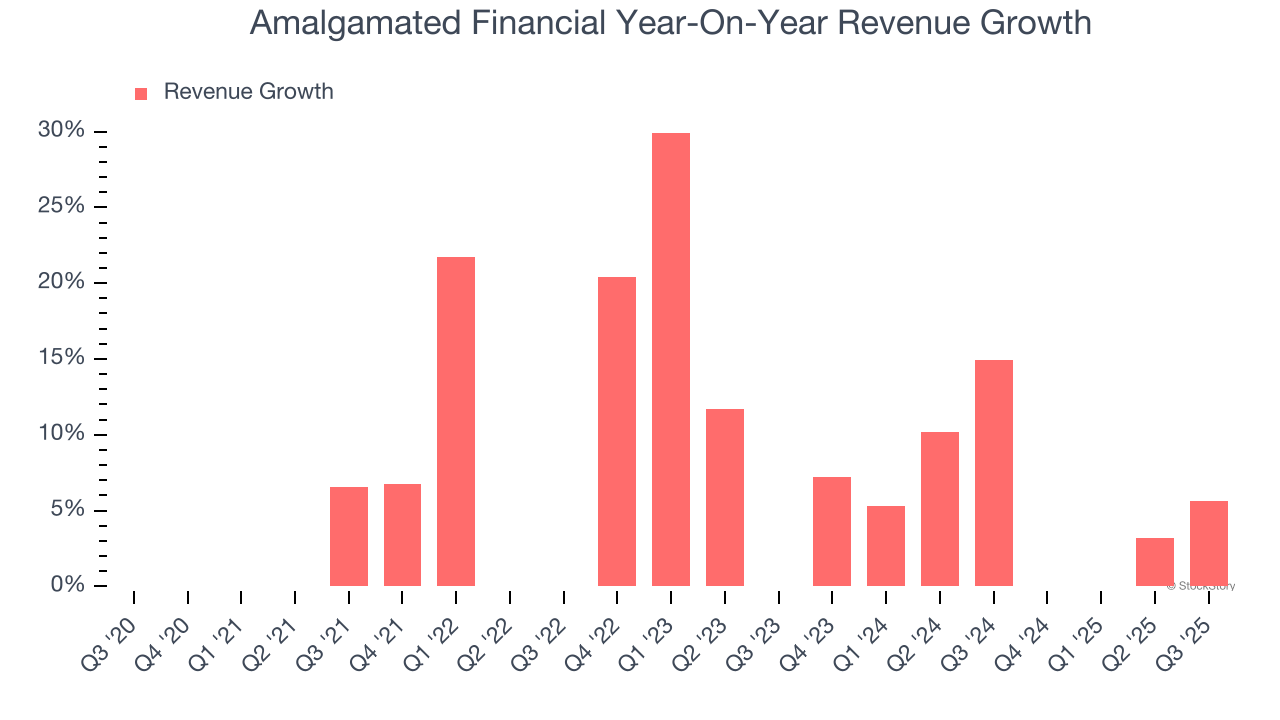
This quarter, Amalgamated Financial reported year-on-year revenue growth of 5.6%, and its $85.61 million of revenue exceeded Wall Street’s estimates by 2.7%.
Net interest income made up 89.1% of the company’s total revenue during the last five years, meaning Amalgamated Financial barely relies on non-interest income to drive its overall growth.
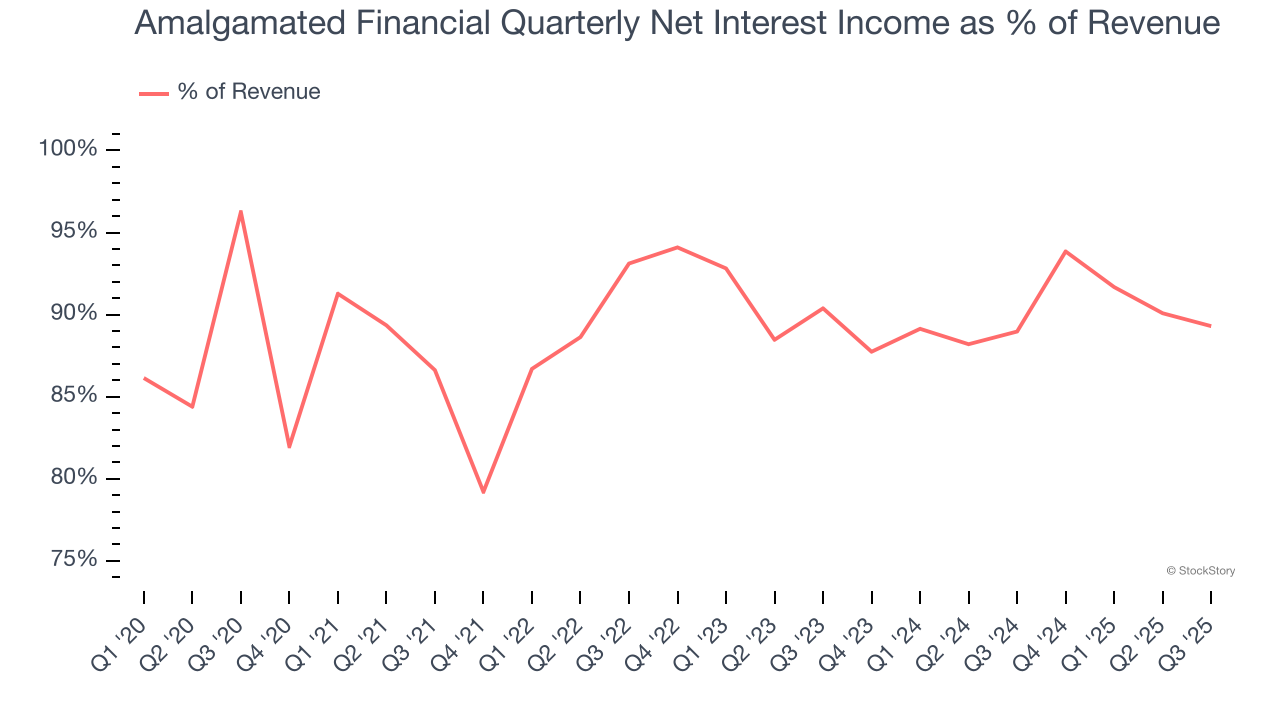
Our experience and research show the market cares primarily about a bank’s net interest income growth as non-interest income is considered a lower-quality and non-recurring revenue source.
Software is eating the world and there is virtually no industry left that has been untouched by it. That drives increasing demand for tools helping software developers do their jobs, whether it be monitoring critical cloud infrastructure, integrating audio and video functionality, or ensuring smooth content streaming. Click here to access a free report on our 3 favorite stocks to play this generational megatrend.
Tangible Book Value Per Share (TBVPS)
Banks operate as balance sheet businesses, with profits generated through borrowing and lending activities. Valuations reflect this reality, emphasizing balance sheet strength and long-term book value compounding ability.
Because of this, tangible book value per share (TBVPS) emerges as the critical performance benchmark. By excluding intangible assets with uncertain liquidation values, this metric captures real, liquid net worth per share. Other (and more commonly known) per-share metrics like EPS can sometimes be murky due to M&A or accounting rules allowing for loan losses to be spread out.
Amalgamated Financial’s TBVPS grew at an exceptional 9.3% annual clip over the last five years. TBVPS growth has also accelerated recently, growing by 20.5% annually over the last two years from $17.43 to $25.31 per share.
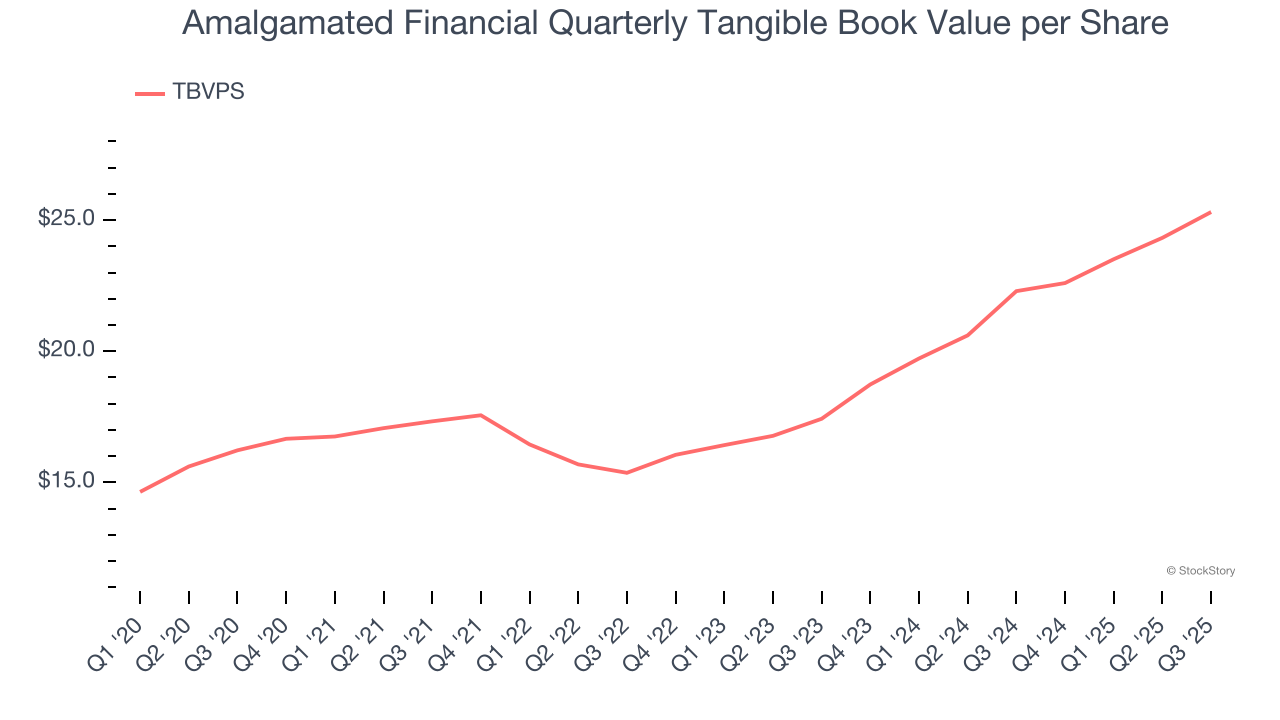
Over the next 12 months, Consensus estimates call for Amalgamated Financial’s TBVPS to grow by 11% to $28.09, solid growth rate.
Key Takeaways from Amalgamated Financial’s Q3 Results
We enjoyed seeing Amalgamated Financial beat analysts’ net interest income expectations this quarter. We were also glad its revenue outperformed Wall Street’s estimates. Overall, we think this was a solid quarter with some key areas of upside. The stock remained flat at $26.68 immediately following the results.
Amalgamated Financial had an encouraging quarter, but one earnings result doesn’t necessarily make the stock a buy. Let’s see if this is a good investment. We think that the latest quarter is only one piece of the longer-term business quality puzzle. Quality, when combined with valuation, can help determine if the stock is a buy. We cover that in our actionable full research report which you can read here, it’s free for active Edge members.
Mentioned In This Article
Latest News
| Oct-08 | |
| Sep-03 | |
| Jul-23 | |
| Jul-23 | |
| Jul-23 | |
| Jul-23 | |
| Jul-21 | |
| Jul-09 | |
| May-05 | |
| Apr-27 | |
| Apr-24 | |
| Apr-23 | |
| Apr-23 | |
| Apr-21 | |
| Apr-09 |
