Walmart Will Make Stock Market History on Dec. 9 -- and It Can Top This Feat in 2026
Key Points
The addressable opportunity of the global retail industry is projected to reach nearly $37 trillion by 2030 -- and Walmart is helping lead the charge.
Walmart is set to become the largest-ever public company to switch to a different stock exchange.
However, it could do something truly special in 2026 if its share price climbs by another 15%.
Over the last three years, artificial intelligence (AI) has been the hottest theme on Wall Street. Ensuring software and systems have the tools to make split-second decisions without the need for human oversight is a technology that the analysts at PwC believe will add $15.7 trillion to the global economy by 2030.
But another industry absolutely dwarfs the projected market size of AI. I'm talking about the global retail market, which, according to estimates from Mordor Intelligence, is expected to grow from roughly $27.3 trillion this year to $36.9 trillion by the turn of the decade.
Where to invest $1,000 right now? Our analyst team just revealed what they believe are the 10 best stocks to buy right now, when you join Stock Advisor. See the stocks »
Although the retail landscape is highly competitive, the rewards can be bountiful for the businesses that manage to stand out. Among pure-play retailers, none has done a better job of rising to the top quite like Walmart (NYSE: WMT), which is generating more revenue from retail sales than any other public company.
Next week, on Dec. 9, Walmart is set to make stock market history. However, this retail juggernaut has an opportunity to top this history-making moment by doing something truly special in 2026.
Image source: Getty Images.
Walmart is making a never-before-seen move
A little more than one week ago, Walmart announced that it would be transferring its stock listing from the New York Stok Exchange (NYSE), which has been its home since 1972, to the Nasdaq Global Select Market on Dec. 9. It also noted that nine of its bond listings would follow its move from the NYSE to the Nasdaq. Walmart's ticker symbol (WMT) will remain unchanged.
Changing exchanges isn't all that rare for public companies. According to the NYSE, which is owned by Intercontinental Exchange, 347 companies have made the move from the Nasdaq to NYSE Group. This includes 10 Nasdaq-100 companies since 2008, and a combined $1.5 trillion in market value since 2000.
What makes Walmart's announced move to the Nasdaq such a jaw-dropper is its market cap.
When beverage and snack giant PepsiCo jumped ship for the Nasdaq exchange in December 2017, its market cap was approximately $166 billion at the time. The only other public company that changed listing exchanges and rivals PepsiCo in size is multinational chemicals and gas company Linde, which had a market cap of $180 billion when it moved to the Nasdaq in November 2023.
As of the closing bell on Nov. 26, Walmart was sporting a market value of $871 billion, or nearly quintuple the market cap of the largest-ever listing change in stock market history.
According to a statement from Chief Financial Officer John David Rainey, this move "aligns with the people-led, tech-powered approach to our long-term strategy." In particular, Walmart has been leaning into AI and automation as ways to reduce expenses, enhance the company's supply chain efficiency, and accurately forecast consumer demand.
However, this is just one way Walmart is set to make history. In 2026, the puzzle pieces are in place for it to do something that only a dozen public companies worldwide have ever accomplished.

Image source: Walmart.
The table is set for Walmart to become Wall Street's next trillion-dollar stock
On Nov. 26, in premarket trading, Eli Lilly crested $1,117 per share and, briefly, became the 11th U.S.-listed public company to reach a $1 trillion market cap. It joined all members of the "Magnificent Seven," Broadcom, Berkshire Hathaway, Taiwan Semiconductor Manufacturing, and Saudi Aramco (which doesn't trade in the U.S.) in the trillion-dollar club.
Based on how the puzzle pieces have landed for Walmart, on a macro and company-specific basis, it has a real path to a trillion-dollar valuation in the new year.
On a macro level, consumers are worried. The University of Michigan Consumer Sentiment Survey dipped to 51 in November, which is down almost 5% from October and 29% from the prior-year period. Consumers are clearly concerned about the state of their personal finances and have a tepid outlook for corporate America.
When consumers worry about their pocketbook, that's when Walmart tends to thrive. It's a company that's succeeded by promoting its value proposition.
Walmart's size is a big reason why consumers choose to shop at its stores. Its deep pockets allow the company to buy products in bulk, which typically lowers the per-unit cost per item. These savings are passed along to its shoppers, which keeps them loyal to the brand.
Don't overlook the size of Walmart's supercenters, either. Similar to Costco Wholesale, Walmart offers a wide variety of basic need goods and discretionary items, allowing consumers to find what they need in a single shopping trip. This makes it an ideal destination for low-, mid-, and high-earning consumers.
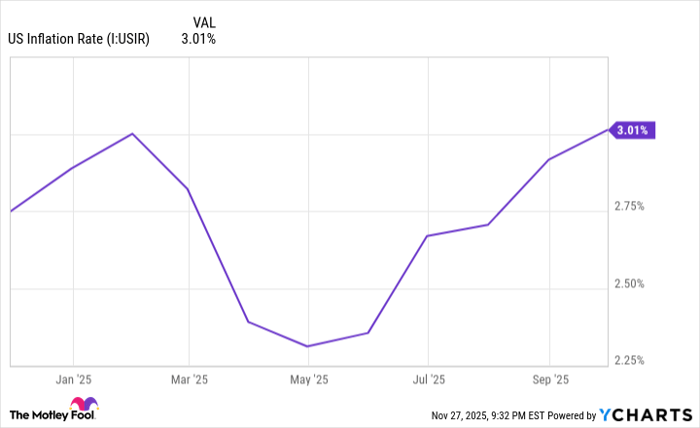
US Inflation Rate data by YCharts.
In addition to poor consumer sentiment, the prevailing rate of inflation has been climbing. In April, President Donald Trump unveiled a 10% global tariff rate and higher "reciprocal tariffs" on dozens of countries deemed to have adverse trade balances with America. In some instances, tariffs are making it costlier for domestic manufacturers, which has pushed up prices for U.S. consumers.
When the U.S. inflation rate is notably climbing, Walmart has historically enjoyed an uptick in foot traffic into its stores. This should be a theme that continues in 2026.
Lastly, Walmart is benefiting from its aforementioned tech push. In October, it partnered with privately held OpenAI to allow users to complete purchases from Walmart directly from the world's most popular large language model chatbot, ChatGPT. It's also relying on generative AI solutions to recommend relevant products online and offer online voice assistance to consumers and its own associates.
Walmart stock needs to climb by just 15%, as of this writing, to reach the $1 trillion plateau -- and 2026 sets the table for this milestone event to occur.
Should you invest $1,000 in Walmart right now?
Before you buy stock in Walmart, consider this:
The Motley Fool Stock Advisor analyst team just identified what they believe are the 10 best stocks for investors to buy now… and Walmart wasn’t one of them. The 10 stocks that made the cut could produce monster returns in the coming years.
Consider when Netflix made this list on December 17, 2004... if you invested $1,000 at the time of our recommendation, you’d have $580,171!* Or when Nvidia made this list on April 15, 2005... if you invested $1,000 at the time of our recommendation, you’d have $1,084,986!*
Now, it’s worth noting Stock Advisor’s total average return is 1,004% — a market-crushing outperformance compared to 194% for the S&P 500. Don’t miss out on the latest top 10 list, available when you join Stock Advisor.
*Stock Advisor returns as of November 24, 2025
Sean Williams has no position in any of the stocks mentioned. The Motley Fool has positions in and recommends Berkshire Hathaway, Costco Wholesale, Taiwan Semiconductor Manufacturing, and Walmart. The Motley Fool recommends Broadcom, Intercontinental Exchange, Linde, and Nasdaq. The Motley Fool has a disclosure policy.
Mentioned In This Article
Latest News
| Oct-10 | |
| Oct-10 | |
| Oct-09 | |
| Oct-09 |
Richest Americans Gained 19% in Wealth as Poorest Lost 56% Since 2022
WMT
Benzinga Prediction Markets
|
| Oct-09 | |
| Oct-09 | |
| Oct-08 |
For Walmart, Replacing Humans With Robots Is a Multibillion-Dollar Struggle
WMT
The Wall Street Journal
|
| Oct-08 | |
| Oct-08 | |
| Oct-08 | |
| Oct-08 | |
| Oct-08 | |
| Oct-08 | |
| Oct-08 | |
| Oct-08 |
