|
|
|

|
|||||
|
|
|
AbbVie has performed exceedingly well over the past 12 years.
The company still has many of the traits that led to that result.
It looks likely to deliver superior returns again over the long run.
One effective way to earn solid, long-term returns is to invest in dividend-paying stocks since reinvesting the payout can help boost stock performance. However, they aren't all created equal, and while some might lead to superior returns over the long run, others will be wealth destroyers.
In which category does AbbVie (NYSE: ABBV), a pharmaceutical giant, belong? Can the stock set investors up for life? Let's find out.
Where to invest $1,000 right now? Our analyst team just revealed what they believe are the 10 best stocks to buy right now, when you join Stock Advisor. See the stocks »

Image source: Getty Images.
AbbVie split from its former parent company, Abbott Laboratories, and became public in 2013. Since then, the company's returns have beaten those of the S&P 500.
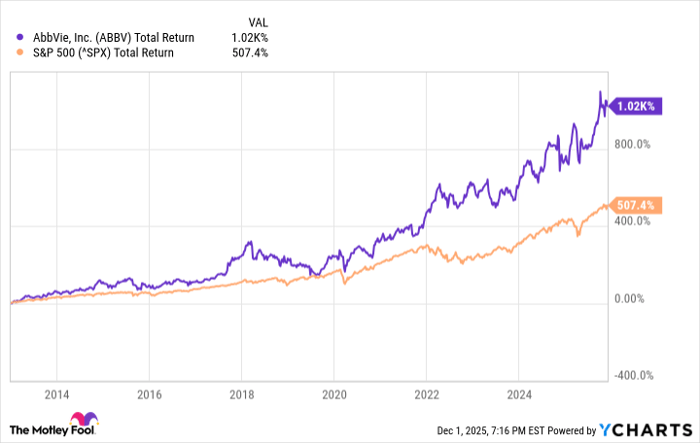
ABBV Total Return Level data by YCharts
Here are four factors that led to this strong performance. First, AbbVie successfully protected its most important medicine, immunology drug Humira, against biosimilars. AbbVie kept cheaper copies at bay by filing additional patents and winning patent-related lawsuits.
Second, AbbVie innovated. It launched new products that took over once Humira eventually hit a patent cliff. The most important were Skyrizi and Rinvoq, two other immunology medicines. Third, AbbVie resorted to acquisitions to bolster its lineup and pipeline.
Finally, thanks to a solid underlying business, AbbVie significantly grew its dividends, and shareholders who reinvested those saw significantly stronger returns.
AbbVie is a Dividend King, a company that has raised its payouts for at least 50 straight years, including the time it spent under Abbott. There is little chance the pharmaceutical giant will stop hiking its dividend anytime soon. Furthermore, AbbVie continues to generate excellent returns and boost its guidance, largely thanks to Skyrizi and Rinvoq, which are expected to support top-line growth until the mid-2030s.
Lastly, AbbVie has a deep pipeline of products across multiple therapeutic areas and is, no doubt, already planning for life after its current main growth drivers. AbbVie possesses many of the qualities necessary to generate superior long-term performance, as well as a dividend that can help enhance returns. The company can help investors establish a solid foundation for their financial future as part of a well-diversified portfolio.
Before you buy stock in AbbVie, consider this:
The Motley Fool Stock Advisor analyst team just identified what they believe are the 10 best stocks for investors to buy now… and AbbVie wasn’t one of them. The 10 stocks that made the cut could produce monster returns in the coming years.
Consider when Netflix made this list on December 17, 2004... if you invested $1,000 at the time of our recommendation, you’d have $560,649!* Or when Nvidia made this list on April 15, 2005... if you invested $1,000 at the time of our recommendation, you’d have $1,100,862!*
Now, it’s worth noting Stock Advisor’s total average return is 999% — a market-crushing outperformance compared to 194% for the S&P 500. Don’t miss out on the latest top 10 list, available when you join Stock Advisor.
*Stock Advisor returns as of December 1, 2025
Prosper Junior Bakiny has no position in any of the stocks mentioned. The Motley Fool has positions in and recommends AbbVie and Abbott Laboratories. The Motley Fool has a disclosure policy.
| 17 hours | |
| Mar-10 | |
| Mar-09 | |
| Mar-09 | |
| Mar-09 | |
| Mar-09 | |
| Mar-09 | |
| Mar-09 | |
| Mar-09 | |
| Mar-08 | |
| Mar-08 | |
| Mar-06 | |
| Mar-06 | |
| Mar-06 | |
| Mar-06 |

Join thousands of traders who make more informed decisions with our premium features. Real-time quotes, advanced visualizations, backtesting, and much more.
Learn more about Finviz Elite