|
|
|

|
|||||
|
|
|
Subscribers to Chart of the Week received this commentary on Sunday, Dec, 7.
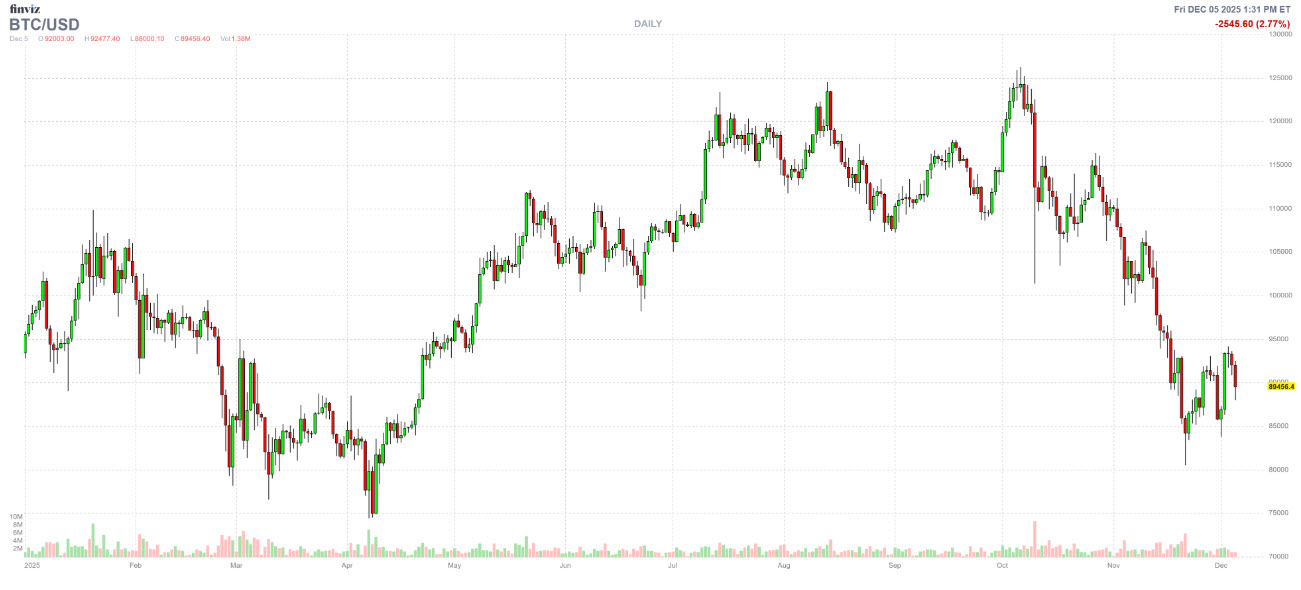
Unmistakably the biggest headline that came out of Wall Street this past week was the catastrophic pivot lower made by Bitcoin (BTC). The four losses took the cryptocurrency leader from an opening price of $91,188.50 on Monday, Dec. 1, to as low as $83,878.01 midday. Almost immediately, the significant shift had a ripple effect on the entire sector, with IG Group Chief Market Analyst Chris Beauchamp calling it a "disaster."
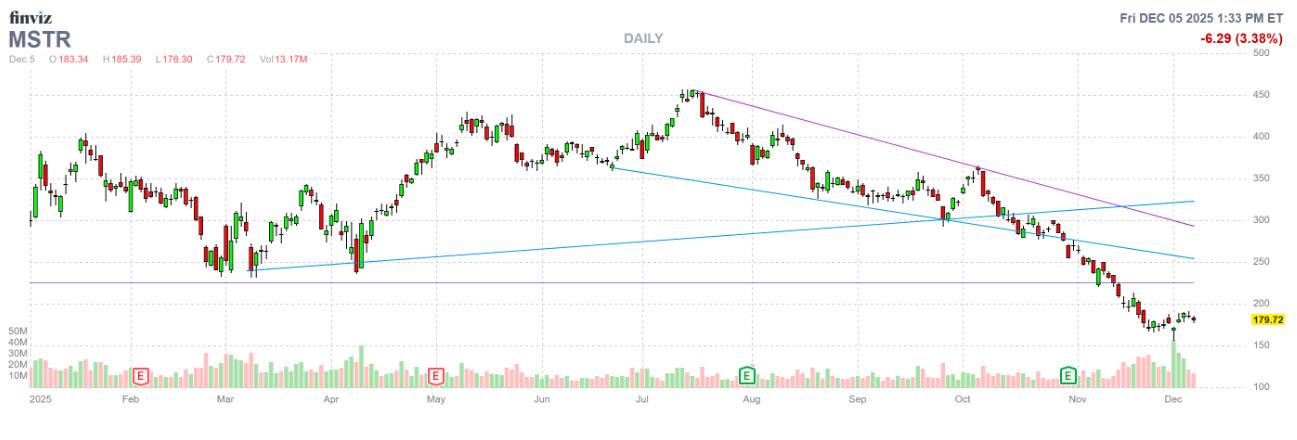
One of the more notable impacts was seen through Strategy (MSTR), when the crypto treasury slashed its full-year BTC yield and profit outlook for 2025. The company also laid the groundwork for a safety net, revealing plans to create a reserve through supportive dividend payments. MSTR barreled lower, though this has been much of the same for the equity, which on Monday marked its 11th close lower in 15 sessions.
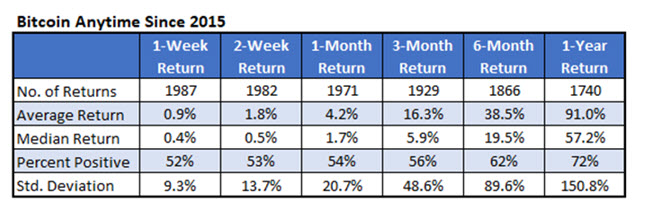
Taking the crypto pullback a step further, I was curious as to whether such steep drawdowns have impacted the equity previously. Schaeffer’s Senior Quantitative Analyst Rocky White looked at six different lengths of time following both a 15% BTC drop over two weeks, as well as a 25% drop over two months. For reference, below is a table sporting all-time BTC performances.
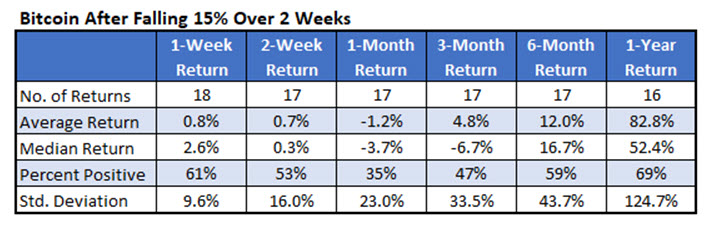
The first table below summarizes BTC returns after a 15% drop in two weeks. The data shows underperformance after two-week drops, with a median return of as much as -6.7% by the three-month mark. Once you get to six months out, however, things significantly improve, with the cryptocurrency seeing a nearly 17% pop, with more than half of those returns positive.
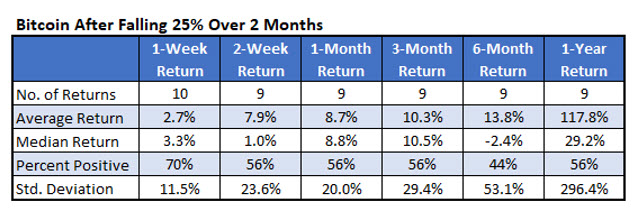
The next table below shows returns after BTC saw a 25% drop in a two-month period. After big two-month drops, the data is mixed, with some outperformance at the one-month mark. This is then followed by a brief stint of underperformance at six months out, which is the inverse move from the prior table during this same time period. In other words, the harder the fall, the harder the climb back to the "top" for the cryptocurrency.
As of Friday, BTC is staring down the barrel of a nearly 2% weekly drop and a three-month deficit that is just shy of 20%. With three weeks left in 2025, BTC has shed 4.5% since the start of the year. While the cryptocurrency has recovered most of its losses over the past two weeks, the pendulum of volatility has already struck investors, leaving a wave of crypto fatigue in its wake.
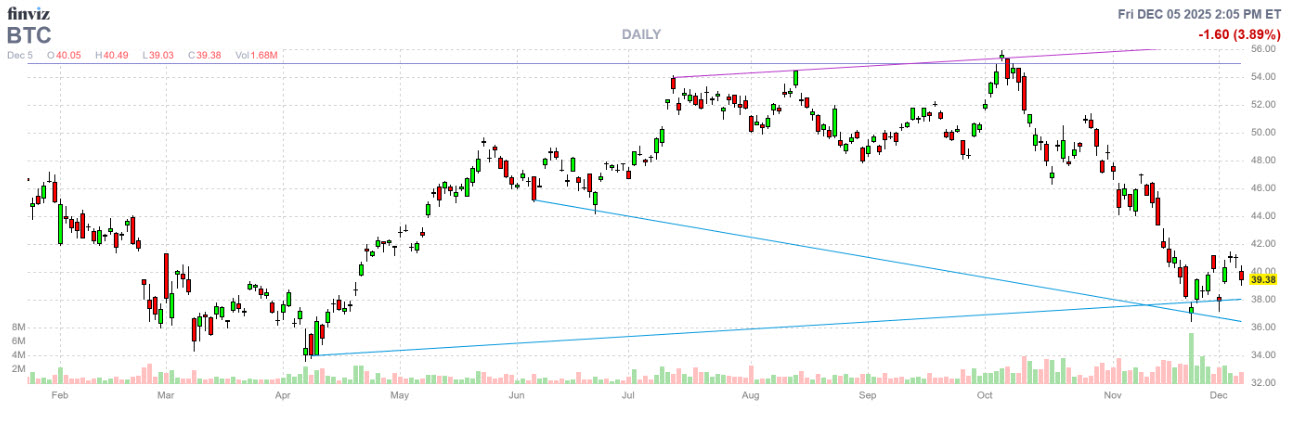
For a final perspective, the Grayscale Bitcoin Mini Trust ETF (BTC) has been consolidating around the $40 level since Monday’s drop. Keeping the above backdrop in mind, a premium-selling strategy could be the move going forward, as the trust’s Schaeffer's Volatility Scorecard (SVS) checks in at six out of 100. In other words, the security has consistently realized lower volatility than its options have priced in over the past 12 months.
| 8 hours | |
| 9 hours | |
| 9 hours | |
| 14 hours | |
| 15 hours | |
| 19 hours | |
| Apr-28 | |
| Apr-28 | |
| Apr-28 | |
| Apr-28 | |
| Apr-27 | |
| Apr-27 | |
| Apr-27 | |
| Apr-27 | |
| Apr-27 |

Join thousands of traders who make more informed decisions with our premium features. Real-time quotes, advanced visualizations, alerts, and much more.
Learn more about Finviz Elite