|
|
|

|
|||||
|
|
|
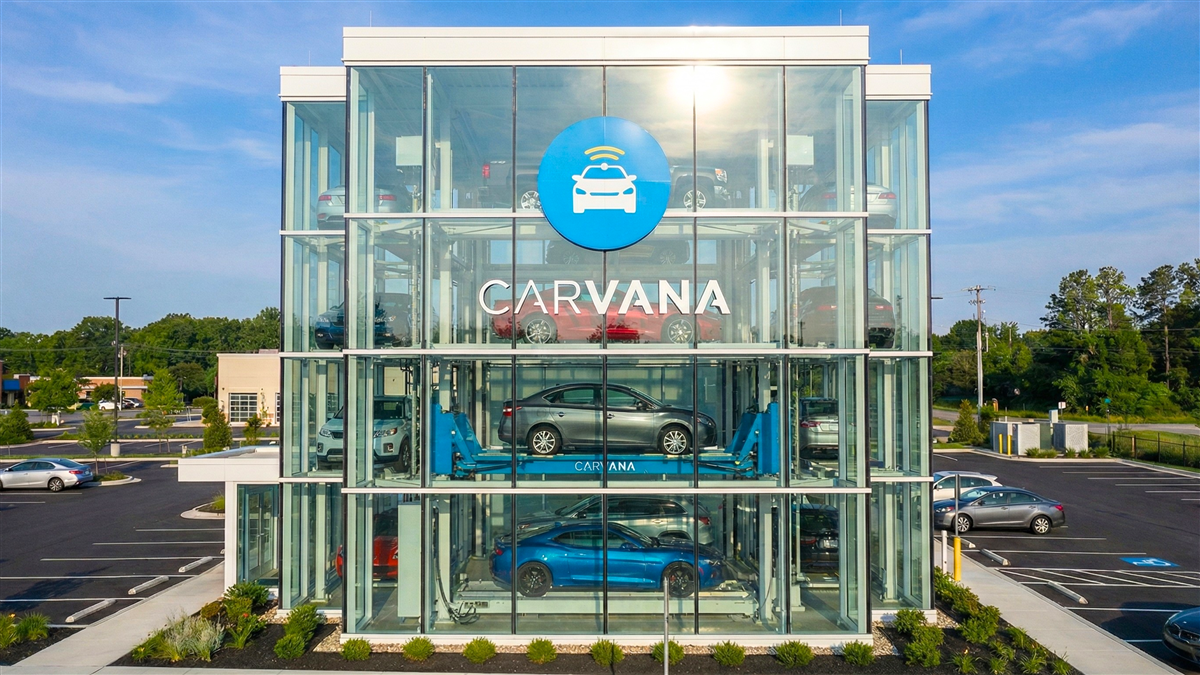
Carvana Co. (NYSE: CVNA) has just completed one of the market's most remarkable comebacks. Just a few years after facing bankruptcy concerns that sent its stock tumbling to an all-time low of $3.72, the company is now joining the prestigious S&P 500 index. This milestone event, effective before the market opens on Dec. 22, 2025, serves as a powerful validation of a dramatic operational and financial turnaround that has seen the stock gain over 10,000% from its 2022 lows.
The market’s reaction to the news was immediate and decisive. Carvana’s stock price jumped by double digits to a new 52-week high of $456.97 on explosive trading volume of over 14 million shares, nearly four times its daily average. This is more than a symbolic victory; it is a significant technical event that will force a new wave of institutional buying, cementing the company’s status as a high-growth industry leader.
Carvana's inclusion in the S&P 500 creates a powerful and automatic demand for its shares, a phenomenon known as the Index Effect. The reason lies in the mechanics of modern investing. An estimated $13 trillion in assets is directly indexed or benchmarked to the S&P 500. The massive passive funds and ETFs that track this index are now obligated to purchase Carvana stock to mirror the index's composition accurately. For these funds, buying is not a choice based on valuation or sentiment; it is a mandate.
This creates a significant, near-term demand shock. The forced buying from passive funds provides a strong technical tailwind and a new level of support for the share price as the inclusion date approaches. This dynamic also puts immense pressure on short sellers, investors who bet that a stock's price will fall. As of mid-November, over 11 million shares of Carvana were held short. The sudden, inelastic demand from index funds can trigger a short squeeze, a scenario where short sellers are forced to buy back shares to close out their losing positions. This rush to buy adds fuel to the fire, further accelerating the stock's upward price momentum.
While the index news is a powerful catalyst, it was earned, not given. Carvana’s inclusion was made possible only after the company met the S&P's strict financial criteria, chief among them being sustained profitability under Generally Accepted Accounting Principles (GAAP). This achievement serves as an institutional stamp of approval on a business that has fundamentally transformed itself from a cash-burning growth story into a profitable industry leader.
The data from its recent financial reports tells the story of this operational success.
This impressive financial recovery is the result of concrete operational improvements. By integrating its acquired ADESA auction sites, the company has positioned inventory closer to customers, cutting average delivery times by a full day. In a pilot program in Phoenix, Carvana is now achieving same-day or next-day delivery for 40% of customers, a capability that sets a new standard for the industry.
Carvana’s recent financial performance has sparked debate over the stock's high valuation, with its price-to-earnings ratio (P/E) now exceeding 100. This premium reflects the market's confidence in Carvana's disruptive potential and its progress toward its long-term target of selling 3 million vehicles annually with industry-leading profit margins.
Investors have also noted the recent pattern of stock sales by top executives. However, these transactions are typically executed under pre-scheduled Rule 10b5-1 trading plans, which allow insiders to sell shares for personal financial management and diversification. Critically, key insiders, including CEO Ernie Garcia III, continue to retain substantial equity stakes, ensuring their long-term interests remain closely aligned with those of shareholders.
With its entry into the S&P 500, Carvana is embarking on a new era. The narrative has decisively shifted from survival to market share dominance. Management's guidance reflects this confidence, forecasting over 150,000 retail units sold in the fourth quarter and full-year 2025 Adjusted EBITDA at or above the high end of its $2 to $2.2 billion range. For investors, the focus now turns to execution as Carvana leverages its powerful e-commerce platform and fortified balance sheet to redefine the future of automotive retail.
Before you make your next trade, you'll want to hear this.
MarketBeat keeps track of Wall Street's top-rated and best performing research analysts and the stocks they recommend to their clients on a daily basis.
Our team has identified the five stocks that top analysts are quietly whispering to their clients to buy now before the broader market catches on... and none of the big name stocks were on the list.
They believe these five stocks are the five best companies for investors to buy now...
The article "Carvana Soars Over 10,000% From Lows—Now It’s in the S&P 500" first appeared on MarketBeat.
| 13 hours | |
| Aug-14 | |
| Aug-13 |
Wall Street is piling into the riskiest corners of the market: Chart of the Day
CVNA
Yahoo Finance Video
|
| Aug-12 | |
| Aug-06 | |
| Aug-05 | |
| Jul-30 | |
| Jul-30 | |
| Jul-30 | |
| Jul-30 | |
| Jul-30 | |
| Jul-30 | |
| Jul-29 | |
| Jul-29 | |
| Jul-29 |
Robinhood, Arm, Carvana: Stocks moving on earnings in after-hours
CVNA CVNA -7.36%
Yahoo Finance Video
|

Join thousands of traders who make more informed decisions with our premium features. Real-time quotes, advanced visualizations, alerts, and much more.
Learn more about Finviz Elite