Better Artificial Intelligence (AI) Stock for 2026: Palantir vs. BigBear.ai
Key Points
Palantir and BigBear.ai want to capitalize on the AI software market. One of them has been significantly more successful at it.
Palantir's growth rate could continue to accelerate in 2026, which may allow it to justify its valuation.
BigBear.ai has a lot of work to do if it wants to make a dent in the AI software space.
Palantir Technologies (NASDAQ: PLTR) and BigBear.ai (NYSE: BBAI) specialize in providing artificial intelligence (AI) software solutions to both commercial and government customers. They help their customers integrate various types of generative AI tools into their operations to enhance productivity, which is why they have been popular among investors this year.
While Palantir's stock price has shot up an impressive 146% so far in 2025, BigBear.ai has registered respectable gains of 50%. However, if you're looking to buy one of these two AI software stocks for your portfolio for 2026, which one should it be? Let's find out.
Where to invest $1,000 right now? Our analyst team just revealed what they believe are the 10 best stocks to buy right now. Continue »
Image source: Getty Images.
Palantir Technologies' terrific growth will continue in 2026
Palantir is emerging as a leader in the AI software market. The company rapidly built a solid client base that includes both federal and commercial customers. More importantly, Palantir isn't just bringing new customers into its fold; it is also gaining new business from existing customers.
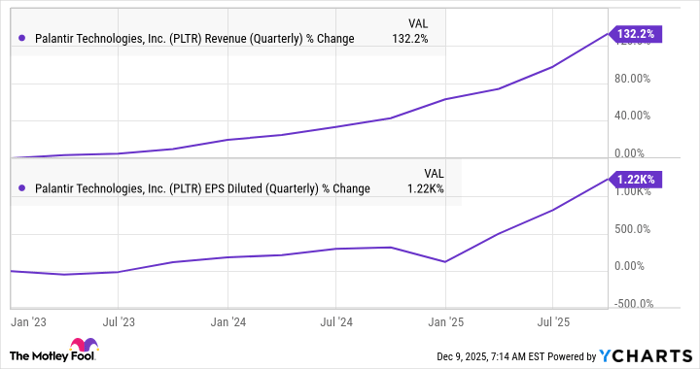
Palantir management highlighted this on the company's November earnings call, pointing out that pilot project deals meant to address a single-use case are eventually turning into bigger and longer contracts. This explains why Palantir saw an uptick in its top- and bottom-line growth in recent quarters.
Data by YCharts.
The company reported a 110% year-over-year increase in its adjusted earnings per share in Q3 to $0.21 per share. That represents a significant acceleration over the 43% year-over-year earnings growth it reported in the year-ago period. However, this isn't the only key metric where Palantir experienced a substantial acceleration.
Palantir booked $2.76 billion worth of contracts in the previous quarter, up 2.5 times from the year-ago period, when its total contract value had increased by just 33% year over year. These bigger contracts are creating a massive revenue pipeline for Palantir. Its remaining deal value (RDV) growth of 91% to $8.6 billion overshadowed the 63% increase in Palantir's top line last quarter. RDV is the total value of unfulfilled contracts at the end of a quarter.
All this suggests that Palantir seems poised to accelerate in 2026, driven by its revenue backlog as well as the new customers it has recently acquired. If those customers start enterprise-wide deployment of Palantir's AI solutions, then it is likely to score bigger deals next year. Also, more business from existing customers should ideally lead to terrific growth in the bottom line as well, since it doesn't need to spend extra on acquiring those customers.
So, don't be surprised to see Palantir's earnings growing at a much faster pace than the 37% increase that analysts are forecasting for 2026, and that could help this generative AI company sustain its impressive stock market momentum in the new year.
BigBear.ai needs to step on the gas
BigBear.ai offers AI-powered software solutions such as digital identity management, predictive analytics, threat detection, digital twins, and AI model management. Its offerings are mainly deployed in the government sector in applications such as homeland and border security, defense, and intelligence. The company also offers AI solutions for manufacturing, supply chain management, and travel operations.
However, the company has found the going tough despite operating in a fast-growing industry. This is evident from the 20% year-over-year drop in revenue in the third quarter to $33.1 million. A key reason behind its weak performance is BigBear.ai's reliance on government programs, which budget and timing issues can impact.
But the company is trying to turn things around. It recently announced the acquisition of a fast-growing generative AI software provider called Ask Sage. This company distributes AI models and helps make agentic AI solutions for defense, security, and other regulated sectors. The good part is that Ask Sage is growing at a much faster pace than BigBear.ai.
Its annual recurring revenue (ARR) is on track to hit $25 million this year, jumping sixfold from last year. BigBear.ai is paying $250 million for this acquisition, and it could lift the company's fortunes in the future. But then, investors shouldn't forget that, unlike Palantir, BigBear.ai hasn't been able to achieve growth organically.
That's mainly because it relies on government contracts for the majority of its revenue. Bulls may argue that BigBear.ai had a substantial backlog of $376 million at the end of the previous quarter, but only $50 million of that was funded. A massive $273 million of its backlog was in the category of priced unexercised options, which means that it can be recognized as revenue only if its customers decide to exercise those contracts.
So, the future revenue visibility of BigBear.ai isn't as solid as Palantir's. Moreover, the company's bottom line is expected to remain in the red in 2026, while revenue growth is expected to come in at 23%. Palantir, meanwhile, is poised to grow its revenue by 40% in 2026 as per consensus estimates, a number that it can exceed thanks to its massive revenue backlog.
Palantir's better, but with caveats
Palantir, therefore, looks like the better AI stock to buy. However, it's way more expensive than BigBear.ai with a sales multiple of 182. BigBear.ai has a sales multiple of 14, but its top line is shrinking. Palantir appears better positioned to justify its expensive valuation, given its ability to continue accelerating in 2026. That's why Palantir stock could continue outperforming BigBear.ai in 2026 and remain the better AI pick of the two.
Should you invest $1,000 in Palantir Technologies right now?
Before you buy stock in Palantir Technologies, consider this:
The Motley Fool Stock Advisor analyst team just identified what they believe are the 10 best stocks for investors to buy now… and Palantir Technologies wasn’t one of them. The 10 stocks that made the cut could produce monster returns in the coming years.
Consider when Netflix made this list on December 17, 2004... if you invested $1,000 at the time of our recommendation, you’d have $499,978!* Or when Nvidia made this list on April 15, 2005... if you invested $1,000 at the time of our recommendation, you’d have $1,126,609!*
Now, it’s worth noting Stock Advisor’s total average return is 971% — a market-crushing outperformance compared to 195% for the S&P 500. Don’t miss out on the latest top 10 list, available when you join Stock Advisor.
*Stock Advisor returns as of December 8, 2025
Harsh Chauhan has no position in any of the stocks mentioned. The Motley Fool has positions in and recommends Palantir Technologies. The Motley Fool has a disclosure policy.
Mentioned In This Article
Latest News
| Oct-10 | |
| Oct-09 | |
| Oct-09 | |
| Oct-09 | |
| Oct-09 | |
| Oct-09 | |
| Oct-09 | |
| Oct-09 | |
| Oct-09 | |
| Oct-09 | |
| Oct-09 | |
| Oct-08 | |
| Oct-08 | |
| Oct-08 | |
| Oct-08 |
