2 Recession-Proof Stocks to Watch in December
Key Points
Walmart's low prices make it a go-to during recessions when people are cutting back on spending.
Johnson & Johnson sells consumer health products that many people don't cut back on when adjusting their budgets.
Walmart and Johnson & Johnson are Dividend Kings.
One thing you eventually learn about the U.S. economy is that it can be fairly unpredictable. Granted, there are many smart economists and financial professionals who are good at predicting where the economy is going, but nobody is ever completely sure of exactly what the future holds. That's why, as an investor, it's always better to be overprepared than underprepared.
The U.S. economy doesn't seem to be heading into a recession in the coming months, but if it does start venturing that way in 2026, it would be wise to have some stocks that are essentially "recession-proof." That doesn't mean those stocks won't experience down periods, but it does mean they'll be well equipped to weather the storm.
Where to invest $1,000 right now? Our analyst team just revealed what they believe are the 10 best stocks to buy right now. Continue »

Image source: Getty Images.
1. Walmart
Walmart (NASDAQ: WMT) has always positioned itself as the value retailer, going so far as to make its slogan "Every Day Low Prices." When recessions hit, money gets tight, and consumers begin looking for bargains and value wherever they can find them.
That's where Walmart comes into the picture. People tend to shy away from retailers like Target and Whole Foods, which are known for more "premium" brands and prices, and head to Walmart, where they can find virtually everything they need at generally lower prices.
Walmart is a one-stop shop. It sells groceries, toiletries, cleaning products, clothing, and other items people use in their daily lives. And with thousands of stores across the country, most consumers can reach a Walmart store within a relatively short time.
During the Great Recession at the brink of the financial crisis from December 2007 to June 2009, the S&P 500 declined by around 38%, while Walmart's stock actually rose nearly 4%.
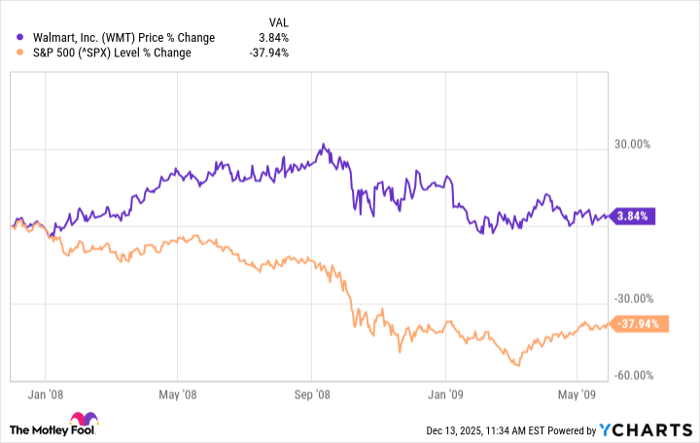
Past performance doesn't guarantee future results, but this is a good example of how resilient the stock can be when times get rough in the economy and stock market. But even without stock price growth, Walmart has a reliable dividend that can help cushion the blow.
With 52 consecutive years of dividend increases, Walmart is a Dividend King (a company with at least 50 consecutive years of increases). That means it has managed to keep increasing its dividend through numerous recessions without missing a beat. That's a company you want in your portfolio when times get rough.
2. Johnson & Johnson
When money is tight, it's fairly easy to cut back on eating out, buying new clothes, and upgrading to the latest smartphone. It's much harder -- and typically not advised -- to cut back on products regarding your health. That's why Johnson & Johnson (NYSE: JNJ) makes for a great buy during recessions.
Johnson & Johnson has its hands in many different facets of the healthcare world, outside of consumer products, which was spun off in August 2023. It develops and sells pharmaceuticals and medical devices that deal with oncology, immunology, neuroscience, vision, surgical tools, surgical technologies, infectious diseases, and more.
Healthcare is generally non-cyclical, meaning business and demand don't move in line with the economy. Yes, consumers and businesses may move to more generic brands. However, people don't stop getting sick or needing essential medical care, which Johnson & Johnson provides, ensuring a steady source of income.
Johnson & Johnson's stock has lagged behind the S&P 500 over the past decade, but its business performance has remained steady during turbulent times. During the Great Recession, its net income fluctuated a bit, but it ended the recession period up over 47% from December 2007 to June 2009.
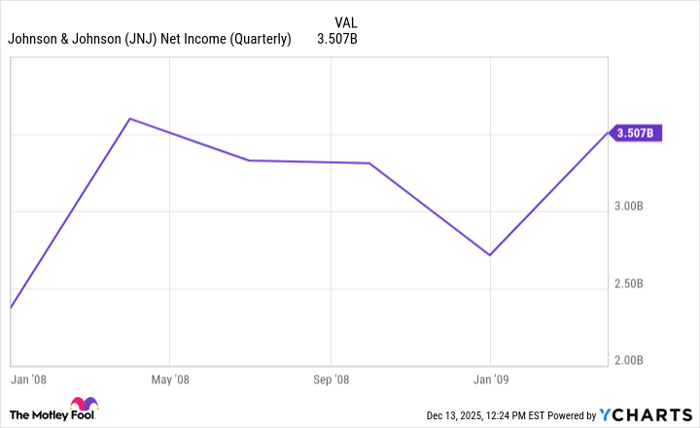
JNJ Net Income (Quarterly) data by YCharts
Like Walmart, Johnson & Johnson is also a Dividend King, with 63 consecutive years of dividend increases. This means its increases have endured the 1970s stagflation, the 1980s double-dip recession, the Great Recession, the COVID-19 pandemic, and other rough patches in the economy. It's a business that has stood the test of time.
Should you buy stock in Walmart right now?
Before you buy stock in Walmart, consider this:
The Motley Fool Stock Advisor analyst team just identified what they believe are the 10 best stocks for investors to buy now… and Walmart wasn’t one of them. The 10 stocks that made the cut could produce monster returns in the coming years.
Consider when Netflix made this list on December 17, 2004... if you invested $1,000 at the time of our recommendation, you’d have $513,353!* Or when Nvidia made this list on April 15, 2005... if you invested $1,000 at the time of our recommendation, you’d have $1,072,908!*
Now, it’s worth noting Stock Advisor’s total average return is 965% — a market-crushing outperformance compared to 193% for the S&P 500. Don't miss the latest top 10 list, available with Stock Advisor, and join an investing community built by individual investors for individual investors.
*Stock Advisor returns as of December 16, 2025.
Stefon Walters has no position in any of the stocks mentioned. The Motley Fool has positions in and recommends Target and Walmart. The Motley Fool recommends Johnson & Johnson. The Motley Fool has a disclosure policy.
Mentioned In This Article
Latest News
| Oct-10 | |
| Oct-10 | |
| Oct-09 | |
| Oct-09 | |
| Oct-09 |
Richest Americans Gained 19% in Wealth as Poorest Lost 56% Since 2022
WMT
Benzinga Prediction Markets
|
| Oct-09 | |
| Oct-09 | |
| Oct-09 |
Boston sues J&J subsidiary over alleged patent infringement for cardiology device
JNJ
Medical Device Network
|
| Oct-09 | |
| Oct-09 | |
| Oct-09 | |
| Oct-08 |
For Walmart, Replacing Humans With Robots Is a Multibillion-Dollar Struggle
WMT
The Wall Street Journal
|
| Oct-08 | |
| Oct-08 | |
| Oct-08 |
