Berkshire Hathaway vs. MetLife: Which Insurance Giant Stands Out?
The Federal Reserve, in its latest meeting, cut interest rates for the third time in 2025, and there is a probability of one more next year. Meanwhile, equity markets continue to perform satisfactorily due to economic growth.
Better pricing, growing climate-related risks and rapid digitalization have been influencing the insurance industry's course through 2025. While insurers continue to face catastrophe losses, improved pricing is supporting profitability.
Against this backdrop, Berkshire Hathaway Inc. BRK.B and MetLife Inc. MET — two insurance giants — are expected to maintain their strength.
With digital innovation accelerating across the industry, merger and acquisition (M&A) activity is likely to pick up, especially in technology-driven transactions, according to Willis Towers Watson’s Quarterly Deal Performance Monitor.
But for long-term insurance-focused investors, which stock offers the more compelling opportunity? Let’s take a closer look at both companies' fundamentals.
Factors to Consider for BRK.B
Berkshire Hathaway is a deeply diversified conglomerate with ownership in more than 90 subsidiaries across insurance, energy, transportation, manufacturing and consumer products. This broad industry exposure reduces concentration risk and provides stability amid varying economic environments. Insurance remains the cornerstone of the business, accounting for roughly one-fourth of total revenues and supplying the company with its most important strategic asset — insurance float.
Outside of insurance, Berkshire’s broad mix of operating companies generates reliable cash flows that help shield overall performance from sector-specific disruptions. Under Warren Buffett’s leadership, the firm has consistently followed a disciplined, value-driven investment approach, targeting businesses and securities with durable fundamentals and attractive long-term potential.
Berkshire has been actively reshaping its investment portfolio to enhance income generation and global diversification. It has exited its position in Chinese EV giant BYD and reduced holdings in Apple and Bank of America, while steadily building positions in several Japanese trading companies.
One of Berkshire’s major financial strengths is its growing insurance float—the capital held between premium intake and claims payments—which increased from approximately $114 billion in 2017 to about $176 billion by the third quarter of 2025. This float provides a significant source of low-cost funding that Berkshire deploys into high-quality investments, including more than $100 billion in short-term U.S. Treasuries and other government-backed securities, representing nearly 90% of recent capital allocations.
With over $100 billion in cash, minimal leverage and an exceptional credit standing, Berkshire maintains one of the strongest balance sheets in corporate America. Its disciplined share repurchase policy highlights management’s prudent capital deployment and ongoing commitment to long-term shareholder value creation.
Berkshire’s return on equity of 7.3% lags the industry average, but the company has improved its returns over time. BRK.B shares have gained 11.7% year to date and outperformed the industry.
Factors to Consider for MET
This global, insurance-based financial services company offers a wide range of protection and investment solutions to individual and institutional customers. Its strategic focus on higher-growth businesses, combined with initiatives to control costs and improve operating efficiency, positions the company well for sustainable long-term growth.
As one of the largest group benefits providers in the United States, MetLife benefits from superior retention and meaningful cross-selling opportunities. Its broad and customizable product suite, along with established partnerships with large corporate clients and payers, supports stable business volumes. In addition, MetLife’s diversified geographic footprint across the United States, Asia, Latin America, and EMEA helps mitigate regional risks and provides a steady and resilient premium base across economic cycles.
Per its New Frontier strategy 2025, the insurer stays focused on extending leadership in Group Benefits, capitalizing on a unique retirement platform, accelerating growth in asset management and expanding in high-growth international markets. Under the New Frontier strategy 2025, the company aims for a 100-basis-point reduction in unit costs over five years by streamlining operations, expanding high-growth segments and accelerating asset management. The prior Next Horizon strategy focused on simplification. AI and automation through enhanced underwriting, claims automation with Sprout.ai, and Intelligent Process Automation drive significant savings.
MetLife has also pursued selective acquisitions to expand capabilities and strengthen its market position. Supported by a strong balance sheet, robust statutory capital and conservative investment management, the company maintains significant financial flexibility. This enables MetLife to return capital to shareholders through dividends and share repurchases while continuing to invest in strategic growth initiatives.
MET’s return on equity of 21% outperformed the industry average. MET shares have gained 0.9% year to date but underperformed the industry.
Estimates for BRK.B and MET
The Zacks Consensus Estimate for BRK.B’s 2025 revenues implies a year-over-year increase of 3.5% while that for EPS implies a year-over-year decrease of 5.2%. However, EPS estimates have moved 6.7% north in the past 30 days.
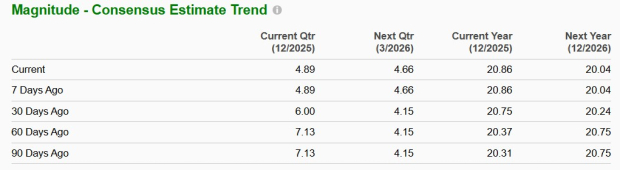
Image Source: Zacks Investment Research
The Zacks Consensus Estimate for MET’s 2025 revenues implies a year-over-year increase of 8.2% and that for EPS implies a year-over-year increase of 7.2%. EPS estimates have moved 0.1% south in the past 30 days.
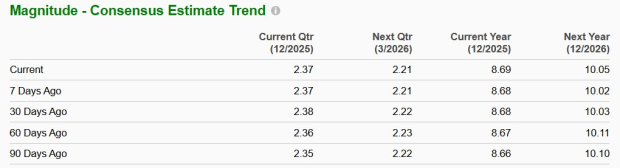
Image Source: Zacks Investment Research
Are BRK.B and MET Shares Expensive?
Berkshire is trading at a price-to-book multiple of 1.56, above its median of 1.52 over the last five years. MET’s price-to-book multiple sits at 1.88, higher than its median of 1.81 over the last five years.
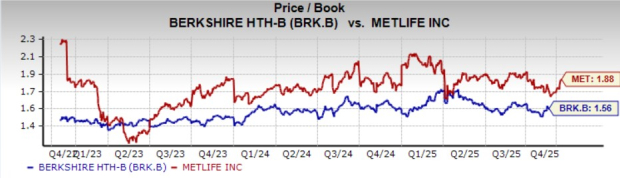
Image Source: Zacks Investment Research
Conclusion
Holding shares of Berkshire Hathaway adds dynamism to shareholders’ portfolios. It is led by Warren Buffett, who has been creating tremendous value for shareholders over nearly six decades with his unique skills. However, all eyes are now on how the behemoth fares when Greg Abel succeeds Warren Buffett as the CEO of Berkshire, starting Jan. 1, 2026. Warren Buffett will continue to be the company's executive chairman.
MetLife continues to benefit from stable premiums, cost-control efforts and a diversified portfolio of market-leading businesses. Its focus on streamlining its business, numerous acquisitions and partnerships, and strong financials position it well for long-term growth.
On the basis of return on equity, which reflects a company’s efficiency in generating profit from shareholders' equity as well as gives a clear picture of the company's financial health, MET scores higher than BRK.B.
Though the stocks carry a Zacks Rank #3 (Hold) each, in terms of price appreciation, MET has an edge over BRK.B.
You can see the complete list of today’s Zacks #1 Rank (Strong Buy) stocks here.
Want the latest recommendations from Zacks Investment Research? Today, you can download 7 Best Stocks for the Next 30 Days. Click to get this free report
MetLife, Inc. (MET): Free Stock Analysis Report
Berkshire Hathaway Inc. (BRK.B): Free Stock Analysis Report
This article originally published on Zacks Investment Research (zacks.com).
Mentioned In This Article
Latest News
| Oct-08 | |
| Oct-08 | |
| Oct-07 | |
| Oct-07 | |
| Oct-07 | |
| Oct-06 | |
| Oct-06 | |
| Oct-05 | |
| Oct-01 | |
| Sep-30 | |
| Sep-29 | |
| Sep-29 | |
| Sep-28 | |
| Sep-28 | |
| Sep-25 |
