KMB vs. PG: Which Consumer Staples Stock Offers Better Upside Now?
The Procter & Gamble Company PG and Kimberly-Clark Corporation KMB are two dominant players in the global consumer staples space, supplying everyday essentials across personal care, household and hygiene categories.
Procter & Gamble, with a market capitalization of roughly $350 billion, stands as one of the world’s largest consumer products companies. PG’s vast portfolio is supported by unmatched brand equity, global scale and a deeply integrated supply chain. The company continues to lean on innovation-led pricing, productivity initiatives and disciplined capital allocation to navigate a challenging consumer and competitive environment.
Kimberly-Clark, by comparison, carries a market capitalization of about $45 billion and operates a more focused portfolio centered on personal care and tissue-based products. KMB has been executing a multi-year transformation aimed at driving volume-plus-mix growth. The company is emphasizing innovation across the good-better-best spectrum, productivity-led margin expansion and a rewired operating model to strengthen competitiveness, particularly in value-sensitive categories.
Both companies are operating in a consumer staples landscape shaped by pressured household budgets, elevated promotional activity and cautious consumption trends. For investors weighing defensive stability against incremental upside potential, the key question is whether PG’s scale-driven resilience outweighs KMB’s opportunity for operational reacceleration and valuation-driven gains.
The Case for KMB
Kimberly-Clark is making steady progress in navigating a complex global environment by leveraging its innovation-led growth strategy and strong brand equity. The company continues to drive volume-plus-mix expansion through new product platforms across the good-better-best spectrum, with innovations, such as enhanced diaper technologies and stronger value-tier offerings, helping defend market share amid intense competition.
Productivity remains a core pillar of the turnaround. The 2024 Transformation Initiative was introduced to build a more agile and focused operating structure. The initiative is designed to accelerate innovation in right-to-win categories while improving growth, profitability and returns on investment. It includes portfolio simplification, business exits and productivity improvements. These actions support Kimberly-Clark’s long-term strategy to drive sustainable, durable growth.
Commercial execution is strengthening across regions, supported by elevated marketing, targeted promotions and omnichannel activation that encourage trial of new products while protecting long-term brand equity. Strong growth in digital and club channels reflects improved channel alignment, with optimized assortments, pack architecture and premiumization supporting continued mix improvement.
Strategically, the acquisition of Kenvue is expected to create a $32-billion global health and wellness leader, combining iconic brands with strong commercial and innovation capabilities. Expected synergies of $2.1 billion and meaningful EPS growth by the second year reinforce Kimberly-Clark’s long-term growth profile.
Despite this progress, the company faces near-term headwinds from softer global demand, heightened promotional activity and cautious consumer behavior. Profitability has been pressured by cost inflation, tariffs and currency headwinds, including a decline in the adjusted gross margin in the third quarter of fiscal 2025, while sales, operating profit and EPS are further constrained by FX impacts, and the PPE divestiture and private label diaper exit.
Kimberly-Clark is mitigating volatility through strategic sourcing, supply-chain optimization and overhead realignment. With long-term targets of at least 40% gross margin and an 18-20% operating margin, the company is positioning itself for stronger profit delivery as these initiatives compound through 2026 and beyond.
The Case for PG
Procter & Gamble continues to demonstrate its business resilience. The company has now delivered more than 40 consecutive quarters of organic sales growth. PG’s exposure to non-discretionary, high-frequency categories such as fabric care, baby care and grooming ensures stable demand even as consumers adjust spending behavior, supporting consistent top-line performance across cycles.
PG’s long-term growth engine remains its innovation capability. The company is in the middle of a broad product upgrade cycle across key franchises, including Tide, Pampers and Olay, aimed at driving measurable performance improvements. These initiatives are backed by substantial reinvestment, with PG spending roughly $10 billion annually on advertising and R&D, equivalent to 11% of sales.
The company demonstrated strong cash generation and shareholder returns in the first quarter of fiscal 2026. Adjusted free cash flow productivity reached an impressive 102%, supporting the return of $3.8 billion to shareholders. This included $2.55 billion in dividends and $1.25 billion in share repurchases. Combined with the maintained fiscal 2026 guidance of up to 4% organic sales growth, P&G remains well-positioned for sustained value creation.
However, unit volumes remain flat globally, and organic sales growth has decelerated from the mid-single-digit level to around 2% in the first quarter of fiscal 2026. Competitive pressure has intensified across key markets, particularly in North America and Europe. This dynamic has already resulted in a roughly 30-basis-point year-over-year decline in global market share.
Margins are also under pressure as PG deliberately steps up investment. The core gross margin declined by approximately 50 basis points year over year in the fiscal first quarter, as higher brand support, restructuring costs and competitive spending outweighed productivity gains of more than 200 basis points. While management views this as a strategic trade-off to protect long-term brand equity, it limits earnings leverage in the near term and caps upside if category growth remains subdued.
How Does the Zacks Consensus Estimate Compare for KMB & PG?
The Zacks Consensus Estimate for Kimberly-Clark’s current financial-year sales and EPS implies year-over-year declines of 17.8% and 16.4%, respectively. The consensus estimate for EPS for the current financial year has moved down 7 cents to $6.10 over the past 30 days.
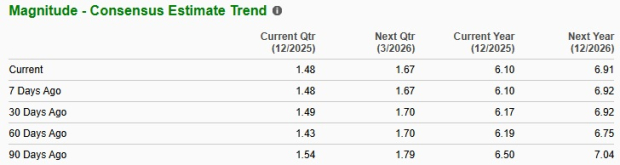
Image Source: Zacks Investment Research
The Zacks Consensus Estimate for Procter & Gamble’s current fiscal-year sales and EPS indicates year-over-year increases of 3.1% and 2.6%, respectively. The consensus estimate for EPS for the current fiscal year has been unchanged at $7.01 over the past 30 days.
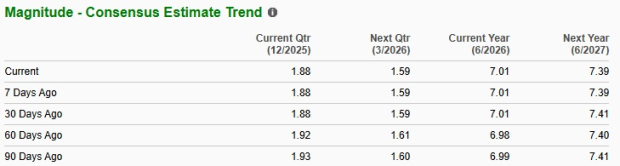
Image Source: Zacks Investment Research
Stock Performances of KMB & PG
Over the past year, shares of Kimberly-Clark have slumped 20.9%, while Procter & Gamble has declined 8.5%.
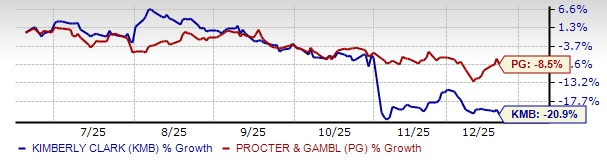
Image Source: Zacks Investment Research
Dive Into Stock Valuations of KMB & PG
Kimberly-Clark is trading at a forward price-to-sales (P/S) multiple of 1.99, below its median of 2.21 in the past three years. Procter & Gamble's forward 12-month P/S multiple sits at 3.86, below its median of 4.30 in the past three years.
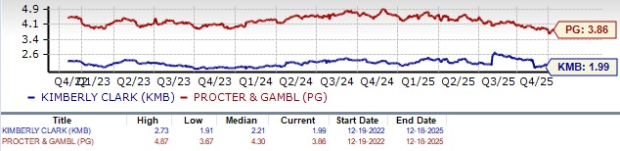
Image Source: Zacks Investment Research
KMB or PG: Which Is the Better Bet Now?
Procter & Gamble appears better positioned for the near to medium-term performance, given its superior earnings visibility and defensive business mix. While Kimberly-Clark continues to execute on its transformation and innovation strategy, near-term headwinds from declining earnings, margin pressure and softer demand limit the upside potential. PG benefits from resilient demand in essential categories, strong brand equity and disciplined reinvestment that supports consistent organic growth.
Although competitive pressures and higher spending weigh on margins, earnings expectations remain stable. In contrast, KMB’s recovery is more dependent on successful execution and margin normalization. Overall, the current backdrop favors PG for investors prioritizing stability and predictable returns.
Both Kimberly-Clark and Procter & Gamble currently carry a Zacks Rank #3 (Hold).
You can see the complete list of today’s Zacks #1 Rank (Strong Buy) stocks here.
Want the latest recommendations from Zacks Investment Research? Today, you can download 7 Best Stocks for the Next 30 Days. Click to get this free report
Procter & Gamble Company (The) (PG): Free Stock Analysis Report
Kimberly-Clark Corporation (KMB): Free Stock Analysis Report
This article originally published on Zacks Investment Research (zacks.com).
Mentioned In This Article
Latest News
| 4 hours | |
| 8 hours | |
| 9 hours |
Kimberly-Clark Forecasts Quarterly Sales Decline Following Social-Media Firestorm in China
KMB
The Wall Street Journal
|
| 9 hours | |
| 10 hours | |
| Oct-14 | |
| Oct-14 | |
| Oct-13 |
Kimberly-Clark, Kenvue Win Conditional EU Approval for $40 Billion Tie-Up
KMB
The Wall Street Journal
|
| Oct-13 | |
| Oct-13 | |
| Oct-10 | |
| Oct-08 | |
| Oct-08 | |
| Oct-06 | |
| Oct-06 |
