2 Stocks to Avoid as Crypto Momentum Wanes
The northeast United States wasn’t the only region gripped by bitter cold this month—a new winter has also hit the cryptocurrency market. Weak sentiment and choppy trading threaten Bitcoin with its worst yearly performance since 2022. What’s caused the cryptocurrency stallout in 2025, and can investors hope for a brighter year in 2026?
Below, we’ll explore why digital assets have floundered in 2025, and name two crypto-related companies you might want to stay clear of until Bitcoin reverses its momentum.
Crypto Has Lagged Most Asset Classes in 2025
Cryptocurrencies entered the year with plenty of momentum, but the strong bullish sentiment waned as Bitcoin’s price wobbled. Following the 2024 U.S. Presidential election, Bitcoin soared from $70,000 per token to over $120,000 amid anticipation of a friendlier regulatory environment and increased investor risk-taking. We've seen more risk-taking from investors (look at all the dips that were bought this year!), but the friendlier regulatory environment hasn’t materialized in the way Bitcoin bulls hoped.
The Trump administration eased some rules on cryptocurrency trading, but the main regulatory focus remains uncertain. The U.S. House of Representatives passed the Clarity Act last summer to establish clearer rules for digital assets. However, the bill is unlikely to make it through the Senate as currently conceived, and draft revisions are underway on both sides of the aisle. The Senate is hopeful for a vote in 2026, but no firm date is scheduled.
U.S regulators are the only concerns of the crypto market. While the current government is more open to digital assets than previous administrations, the same can’t be said for other world leaders. The European Union tightened oversight of crypto exchanges and stablecoins, as did some Asian regulators.
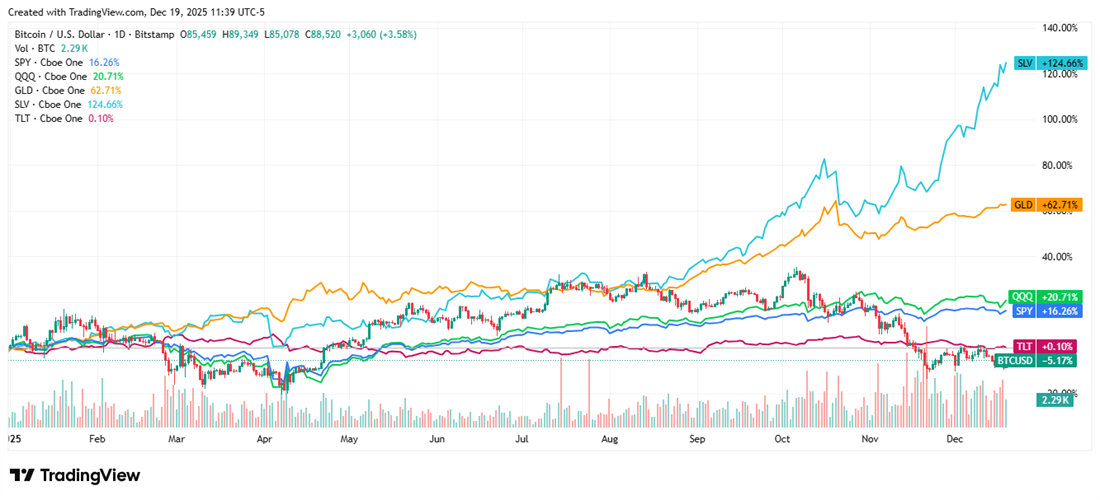
And of course, cryptocurrency mining and trading remain completely banned in China. Cryptocurrency was becoming a proxy to the broader tech sector, moving in lockstep with risk-on assets like AI stocks. However, the chart above shows that the correlation has broken down, and Bitcoin is now underperforming not just stocks but also commodities and bonds.
2 Stocks to Avoid as Crypto Markets Stall
With the launch of Bitcoin and Ethereum ETFs, investors now have easy access to major cryptocurrencies through traditional channels. As a result, stocks once valued for their crypto exposure—like miners and treasury-heavy companies—are losing investor interest.
Two stocks stand out as especially vulnerable in the current environment. Both have significant crypto exposure, and their recent moves suggest growing financial and technical risks.
SharpLink Gaming: Overvaluation and Liquidity Concerns
SharpLink Gaming Inc. (NASDAQ: SBET) made plenty of headlines earlier this year when the small gaming and advertising company made a full-fledged pivot to crypto.
After hiring Ethereum co-founder Joseph Lubin to the C-suite, SBET doubled down by converting the company into an Ethereum treasury, buying more than $3 billion in ETH tokens and staking nearly all of them to earn yield.
The resulting yield has brought in record revenue, but the company’s future is now entirely tied to Ethereum's price.
If regulators deem ETH tokens a security next year, SharpLink may be forced to register as an investment company, triggering significant compliance costs and business model shifts.
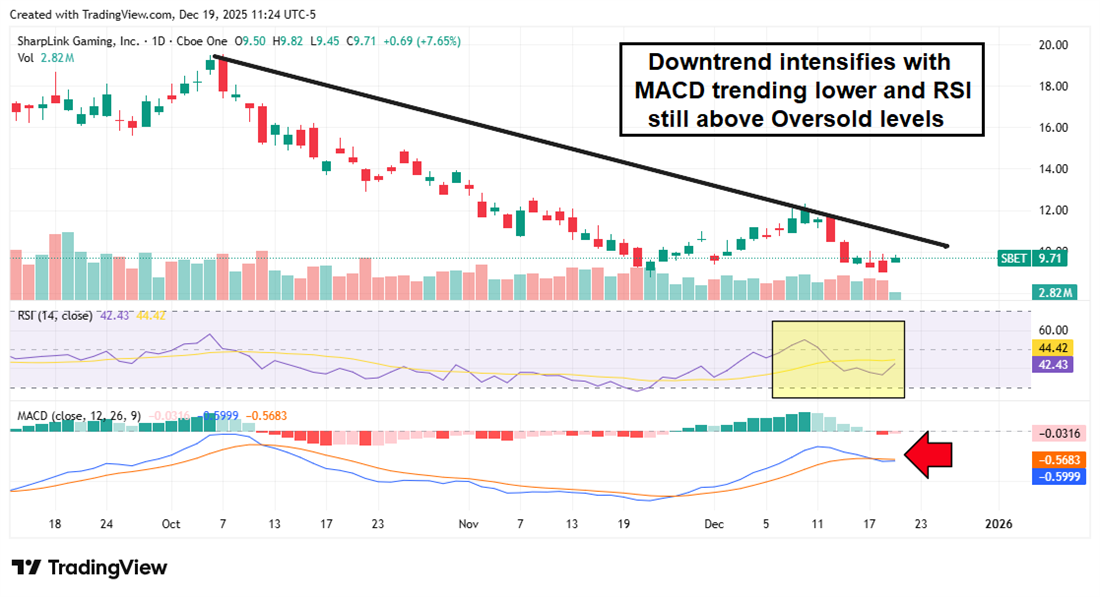
The stock is also facing pressure from valuation and technical headwinds. Despite record revenue, the company still lost 63 cents per share in Q3 2025, and the stock is still heavily overvalued despite the recent decline. The Moving Average Convergence Divergence (MACD) indicator just formed a bearish crossover, hinting that another burst of downward momentum could hit the stock soon.
TeraWulf: Debt Risk Becoming Burdensome
TeraWulf Inc. (NASDAQ: WULF) has a noble goal: to become the first carbon-neutral cryptocurrency miner. One of its facilities, Project Nautilis, runs entirely on hydroelectric power out of New York.
TeraWulf also offers high-performance computing (HPC) solutions to data centers, and this combination of revenue sources has led WULF shares to a 120% year-to-date (YTD) performance.
But the company’s rapid expansion was mostly debt-fueled, and now, debt issues are surfacing.
TeraWulf had about $5 billion in debt financing agreements on the books in 2025, with total debt now exceeding $1.5 billion. Analysts warn that this debt load could become unmanageable as costs rise and liabilities grow even closer to matching the company’s assets.
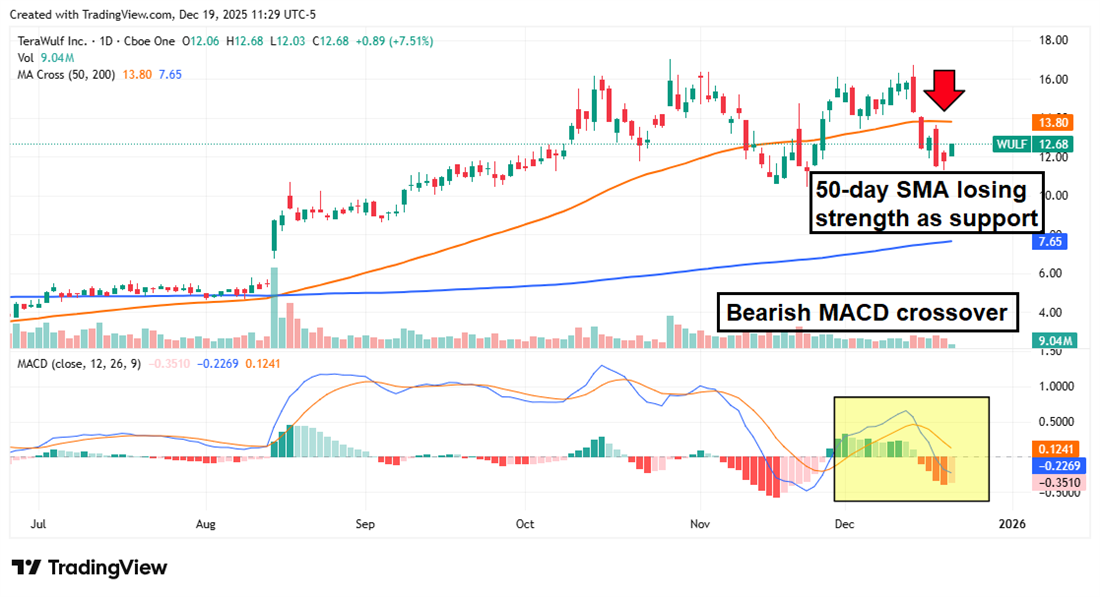
The fundamental weakness has boiled over into the chart, and now technical headwinds threaten to bring the stock down from its lofty perch. A key support area at the 50-day simple moving average (SMA) has been broken, and this breakdown was confirmed with a bearish crossover on the MACD. While TeraWulf isn’t solely reliant on Bitcoin for income anymore, a further decline in BTC could put serious pressure on the company’s growing debt woes.
Where Should You Invest $1,000 Right Now?
Before you make your next trade, you'll want to hear this.
MarketBeat keeps track of Wall Street's top-rated and best performing research analysts and the stocks they recommend to their clients on a daily basis.
Our team has identified the five stocks that top analysts are quietly whispering to their clients to buy now before the broader market catches on... and none of the big name stocks were on the list.
They believe these five stocks are the five best companies for investors to buy now...
The article "2 Stocks to Avoid as Crypto Momentum Wanes" first appeared on MarketBeat.
Mentioned In This Article
Latest News
| Oct-09 | |
| Oct-07 | |
| Oct-07 | |
| Oct-05 | |
| Oct-05 | |
| Oct-05 | |
| Oct-05 | |
| Sep-30 | |
| Sep-29 | |
| Sep-24 | |
| Sep-24 | |
| Sep-23 | |
| Sep-23 | |
| Sep-23 | |
| Sep-22 |
