|
|
|

|
|||||
|
|
|
New Elite Feature: Compare relative returns, fundamentals, and sector rankings head-to-head.
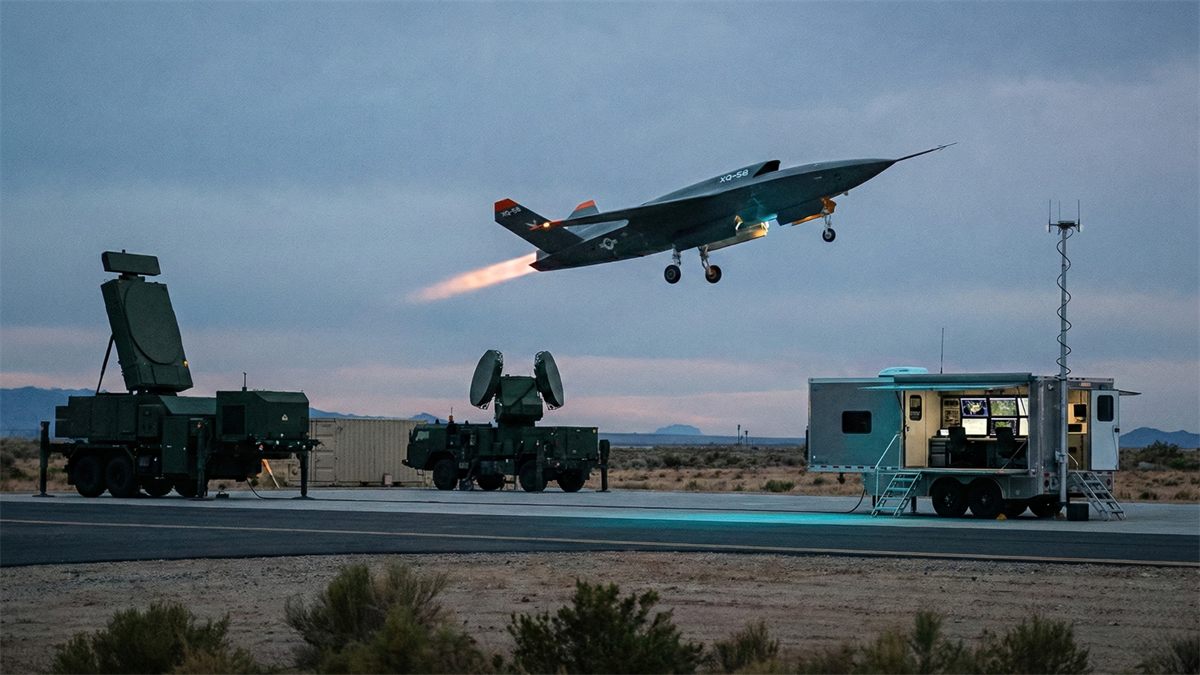
For decades, the defense sector was viewed as a safe harbor for conservative investors. Companies like Lockheed Martin (NYSE: LMT) or General Dynamics (NYSE: GD) were treated as bond proxies, stocks that offered slow growth, reliable dividends, and low volatility. They were the industrial giants that investors bought and held for 30 years to protect their capital.
However, 2025 has shattered that mold. A global shift toward asymmetric warfare, where relatively cheap drones can disable expensive armored vehicles, has forced the Pentagon to radically alter its spending habits. This strategic pivot has decoupled agile, tech-focused mid-cap companies from their slower-moving peers. Investors are no longer valuing these firms strictly on cash flow and dividends; they are valuing them on growth and technological disruption.
Leading this charge are Kratos Defense & Security Solutions (NASDAQ: KTOS) and AeroVironment (NASDAQ: AVAV). These two companies have transitioned from niche experimental players to central pillars of national security, creating a new defense-tech asset class—with charts that behave more like Silicon Valley software stocks than traditional industrial manufacturers.
To understand why these stocks are moving, investors must understand a key military concept: attritable systems.
In the past, defense spending focused on legacy platforms, such as aircraft carriers and fighter jets designed to last for decades. These programs generate revenue through long-term maintenance contracts. However, modern conflict requires assets that are sophisticated enough to complete a mission but affordable enough to be lost in combat without breaking the budget. This is the definition of attritable.
For investors, this shift alters the sector's fundamental business model. The market is effectively moving from a Maintenance Model to a Consumption Model.
This creates a cycle of high-volume sales similar to a commodities business or a software licensing model. The market is currently placing a premium on companies that can deliver these systems at scale, fueling the valuation expansion we see today.
Skeptics have long criticized Kratos Defense & Security Solutions as a collection of science projects, a company with impressive experimental technology that lacked steady production contracts. In 2025, Kratos effectively silenced those critics by graduating from prototype testing to mass manufacturing.
The market has responded aggressively to this execution, driving Kratos’ stock price up over 200% year-to-date. This surge is underpinned by concrete federal commitments that provide long-term revenue visibility.
In January 2025, Kratos secured the $1.45 billion MACH-TB 2.0 contract. This award solidified the company's position as the primary provider of hypersonic testbed systems. Furthermore, the company successfully scaled its Zeus solid rocket motor production line.
By becoming a merchant supplier of these motors, Kratos is no longer building its own systems; it is selling the engines that power the broader hypersonic industry.
Perhaps the most significant milestone was the U.S. Marine Corps' designation of the XQ-58A Valkyrie as a Program of Record. In government contracting, moving from an experimental budget line to a Program of Record is the gold standard, guaranteeing recurring funding in the federal budget for years to come.
Wall Street has taken note of this maturity. Analysts, including those at KeyBanc, recently upgraded the stock to Overweight, signaling to institutional investors that Kratos has successfully made the leap from a speculative bet to a foundational defense holding.
While Kratos is winning on production scaling, AeroVironment is capitalizing on a rapidly changing regulatory landscape.
As the market leader in loitering munitions (often called suicide drones), AeroVironment has solidified its position through aggressive acquisition and favorable government policy.
The most immediate catalyst for the stock arrived on Dec. 22, 2025.
The Federal Communications Commission, acting on mandates from the 2025 National Defense Authorization Act (NDAA), effectively banned the authorization of new drones from foreign competitors, specifically targeting Chinese manufacturers.
This regulatory action clears the field for AeroVironment. By freezing the import of competing foreign models, the government has created a massive regulatory moat around AeroVironment’s commercial and tactical business lines, effectively locking in its domestic market share.
Beyond regulation, AeroVironment is aggressively focused on growth. The company reported a substantial 151% year-over-year revenue increase, achieving a record $472.5 million in the most recent quarter. This growth was further bolstered by the strategic $4.1 billion acquisition of BlueHalo in May 2025.
Through this acquisition, AeroVironment has expanded beyond drones into Directed Energy (lasers) and space technologies. While the company posted a net loss recently due to integration costs, the backlog tells a different story. The company secured an $874 million IDIQ (Indefinite Delivery, Indefinite Quantity) contract in December 2025, proving that global customers are lining up for their systems faster than they can be built.
While the growth thesis is compelling, investors must recognize that the boring safety of traditional defense stocks is gone. By trading like technology stocks, Kratos and AeroVironment also inherit the tech sector's volatility.
Both companies currently trade at high valuation multiples relative to legacy primes such as Northrop Grumman (NYSE: NOC). This means the market has priced in a significant amount of future perfection. Any delay in Valkyrie production or hiccups in the BlueHalo integration could cause sharp, short-term pullbacks, as seen in AeroVironment’s post-earnings dip earlier this month.
However, for investors with a higher risk tolerance, these pullbacks are often viewed as entry points rather than exit signals. The demand for speed, autonomy, and attritable mass is not a temporary trend; it is the new doctrine of modern warfare.
The data indicates that the defense sector is undergoing a structural split. On one side are the traditional primes, offering stability and yield. On the other side are disruptors such as Kratos and AeroVironment, offering velocity and expansion.
For investors, these companies represent the software layer of national defense, adaptable, scalable, and essential for modern combat. While these stocks carry higher volatility than their industrial predecessors, the combination of regulatory protection for AeroVironment and production scaling for Kratos offers a growth trajectory rarely seen in this industry.
The message from the market in late 2025 is clear: Modern warfare requires speed, and investors are rewarding the companies that can deliver it.
Before you make your next trade, you'll want to hear this.
MarketBeat keeps track of Wall Street's top-rated and best performing research analysts and the stocks they recommend to their clients on a daily basis.
Our team has identified the five stocks that top analysts are quietly whispering to their clients to buy now before the broader market catches on... and none of the big name stocks were on the list.
They believe these five stocks are the five best companies for investors to buy now...
The article "Why Kratos and AeroVironment Are Suddenly Moving Like Tech Stocks" first appeared on MarketBeat.
| Jun-04 | |
| Jun-04 | |
| Jun-04 | |
| Jun-04 | |
| Jun-03 | |
| Jun-03 | |
| Jun-03 | |
| Jun-03 | |
| Jun-03 | |
| Jun-03 | |
| Jun-03 | |
| Jun-02 |
Defense contractor eyes Beavercreek and Xenia expansion, w/ 200 new jobs
AVAV
Dayton Daily News, Ohio
|
| Jun-02 |
Thomas Gnau: Defense contractor eyes Beavercreek and Xenia expansion, w/ 200 new jobs
AVAV -6.30% AVAV
Journal-News, Hamilton, Ohio
|
| Jun-02 |
L3Harris, Northrop Win Pentagon Contracts. Karman Bolsters AI Efforts.
NOC
Investor's Business Daily
|
| Jun-02 |

Join thousands of traders who make more informed decisions with our premium features. Real-time quotes, advanced visualizations, alerts, and much more.
Learn more about Finviz Elite