Meet the Little-Known Company Yielding Nearly 14% That Can Continue to Deliver Monthly for Income Seekers in 2026
Key Points
Over the previous 51 years, dividend stocks have more than doubled the annualized return of non-payers.
Although ultra-high-yielding stocks can sometimes be more trouble than they're worth, proper vetting can uncover hidden gems with high-octane income potential.
This relatively unknown business development company is generating a double-digit weighted-average yield on its loan portfolio and is currently trading at a 16% discount to its book value.
Over the last century, no asset class has generated a higher average annual return than stocks. With thousands of publicly traded companies and exchange-traded funds (ETFs) to choose from, there's a very good chance one or more securities can help you meet your financial goal(s).
But among the countless investing strategies on Wall Street, buying and holding high-quality dividend stocks yields an above-average rate of success.
Where to invest $1,000 right now? Our analyst team just revealed what they believe are the 10 best stocks to buy right now, when you join Stock Advisor. See the stocks »

Image source: Getty Images.
Dividend stocks have run circles around non-payers over the last half-century
Dividend stocks rising in value over long periods shouldn't come as a surprise. Most companies that pay a regular dividend to their shareholders are profitable on a recurring basis, time-tested, and capable of providing a transparent long-term growth outlook. In short, they're businesses that investors don't worry too much about when they go to sleep at night.
However, you might be stunned by the magnitude of outperformance for income stocks when compared to non-payers over the last half-century.
In "The Power of Dividends: Past, Present, and Future," analysts at Hartford Funds, in collaboration with Ned Davis Research, compared the annualized returns of dividend stocks to non-payers spanning 51 years (1973-2024). They found that income stocks produced a 9.2% average annual return and were less volatile than the benchmark S&P 500. Meanwhile, the non-payers were more volatile than the S&P 500 and produced a modest average annual return of just 4.31%.
Ideally, income seekers want the highest yield possible with minimal risk to their invested principal. Unfortunately, studies have shown that risk and yield tend to correlate. In other words, companies with ultra-high yields are often more trouble than they're worth.
Since yield is a function of payout relative to share price, a company with a struggling or failing operating model and a declining share price can "trick" investors into believing it offers a tantalizing yield. This is known as a yield trap, and it's the last thing an income seeker wants in their portfolio.
Thankfully, not all dividend stocks with supercharged yields are bad news. With proper vetting, some of Wall Street's safest double-digit-yielding income stocks can be uncovered.
Arguably, the safest dividend stock with a double-digit yield on Wall Street is a company that few investors are even aware exists.

Image source: Getty Images.
Say hello to a monthly dividend payer yielding 13.6%!
This special income stock, which I hold in my portfolio and is virtually unknown by most investors, is small-cap business development company (BDC), PennantPark Floating Rate Capital (NYSE: PFLT).
A BDC is a type of company that invests in the equity (common and preferred stock) and/or debt of middle-market companies, which are generally unproven micro- and small-cap businesses. As of the end of September, its investment portfolio consisted of nearly $241 million in common and preferred stock and more than $2.5 billion in debt securities.
With 91% of its $2.77 billion investment portfolio tied up in loans, it's clear that this is a debt-focused, yield-driven company. Since it's predominantly dealing with middle-market companies, many of which lack access to traditional financial services, PennantPark can generate market-topping yields from the financing it provides. As of Sept. 30, 2025, its weighted-average yield on debt investments was 10.2%, which is more than double the yield investors are generating from 30-year Treasury bonds.
However, it's not just PennantPark's outsize weighted-average yield that'll turn heads. The overwhelming majority of financing, comprising approximately 99% of outstanding loans, is variable-rate.
When the Federal Reserve was aggressively combating a rapid uptick in the U.S. inflation rate by raising its federal funds target rate, PennantPark's weighted-average yield on debt investments climbed by more than five percentage points. Even though the nation's central bank is now in a rate-easing cycle, which is lowering PennantPark's weighted-average yield on debt investments, it's been taking advantage of what are still bountiful loan yields as the Fed slow-steps its rate-cutting.
PennantPark Floating Rate Capital's management team has also done a remarkable job of protecting the company's invested principal while expanding the portfolio. Including common and preferred stock positions, the portfolio consisted of 164 holdings, with an average investment size of $16.9 million, as of the end of fiscal 2025 (Sept. 30, 2025). Having such a diverse portfolio ensures that no single investment is vital to its success or capable of sinking the proverbial ship.
Additionally, 99.2% of its $2.51 billion loan portfolio is first-lien secured debt. In the event of a default by a borrower, first-lien debtholders are at the front of the line for repayment.
What's more, PennantPark's vetting process has proven to be top-notch. The company's reported non-accruals (i.e., delinquent borrowers) represented just 0.4% of the overall portfolio on a cost basis as of the end of fiscal 2025. That's identical to the non-accruals reported in the fiscal fourth quarter of 2024.
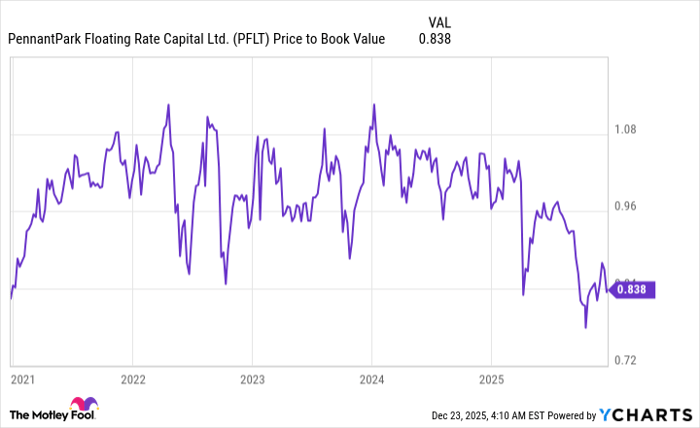
PFLT Price to Book Value data by YCharts.
There's a value proposition with this company, as well. Historically, the share price of most BDCs will hover around their reported book value. PennantPark ended its fiscal year with a generally accepted accounting principles (GAAP) net asset value (NAV) per share of $10.83. However, it closed out the Dec. 22 trading session at just $9.07 per share, representing a 16% discount to its GAAP NAV.
But what investors will love most about PennantPark Floating Rate Capital is its monthly dividend. Though this payout doesn't increase on an annual basis, its sustainable $0.1025-per-share monthly dividend currently works out to a 13.6% annual yield.
Rarely do double-digit-yielding stocks offer this combination of value and operating safety. PennantPark is a rare breed of dividend payer that can deliver monthly for income seekers in 2026.
Should you buy stock in PennantPark Floating Rate Capital right now?
Before you buy stock in PennantPark Floating Rate Capital, consider this:
The Motley Fool Stock Advisor analyst team just identified what they believe are the 10 best stocks for investors to buy now… and PennantPark Floating Rate Capital wasn’t one of them. The 10 stocks that made the cut could produce monster returns in the coming years.
Consider when Netflix made this list on December 17, 2004... if you invested $1,000 at the time of our recommendation, you’d have $504,994!* Or when Nvidia made this list on April 15, 2005... if you invested $1,000 at the time of our recommendation, you’d have $1,156,218!*
Now, it’s worth noting Stock Advisor’s total average return is 986% — a market-crushing outperformance compared to 196% for the S&P 500. Don't miss the latest top 10 list, available with Stock Advisor, and join an investing community built by individual investors for individual investors.
*Stock Advisor returns as of December 26, 2025.
Sean Williams has positions in PennantPark Floating Rate Capital. The Motley Fool has no position in any of the stocks mentioned. The Motley Fool has a disclosure policy.
Mentioned In This Article
Latest News
| Oct-06 | |
| Oct-02 | |
| Sep-02 | |
| Aug-31 | |
| Aug-11 | |
| Aug-10 | |
| Aug-10 | |
| Aug-04 | |
| Jul-06 | |
| Jul-02 | |
| Jun-02 | |
| May-27 | |
| May-08 | |
| May-07 | |
| May-07 |
