Should You Continue to Hold BRKR Stock in Your Portfolio?
Bruker Corporation BRKR is well-poised to grow in the coming quarters due to the solid prospects of the CALID group. Within Bruker Scientific Instruments (“BSI”) Nano, revenue momentum is strong across key end markets, including academic and semiconductor metrology. Additionally, BioSpin’s prospects are further bolstered by the Chemspeed acquisition and innovations. Meanwhile, potential macroeconomic impacts and funding challenges may bring operational risks for Bruker.
In the past year, this Zacks Rank #3 (Hold) stock has declined 17.5% compared with the 18.8% fall of the industry and a 16.7% rise of the S&P 500 composite.
The renowned medical device company has a market capitalization of $7.31 billion. Bruker’s earnings yield of 3.9% favorably compares with the industry’s 3.3% yield. In the trailing four quarters, it surpassed earnings estimates thrice and missed on one occasion, the average surprise being 9.2%.
Let’s delve deeper.
Upsides for BRKR Stock
CALID Group Holds Potential: The segment has been gaining from the strong demand for differentiated instruments. Year to date through September 2025, CALID Group revenues totaled $879 million, driven by microbiology and infectious disease diagnostics with strong performance from both the MALDI Biotyper and the ELITech molecular diagnostics franchises. Life science mass spectrometry is seeing early traction for recently launched products, including the new timsOmni and the new tims Metabo. Molecular spectroscopy revenues remained stable, but with strong applied market orders in the third quarter.
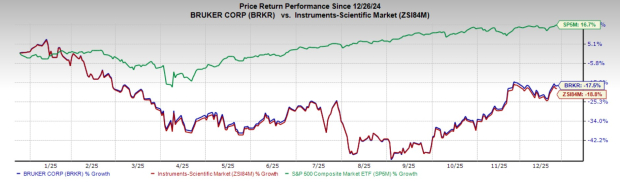
Image Source: Zacks Investment Research
Furthermore, Bruker introduced several innovations, including the Fourier 80 multinuclear benchtop FT-NMR spectrometer and MOVE-T, a state-of-the-art liquid dairy analyzer. Meanwhile, the acquisition of Austria-based biocrates in June further enhances its mass spectrometry (MS)-based metabolomics solutions. In April 2025, Bruker announced a major investment in RECIPE Chemicals + Instruments GmbH, enhancing its capabilities in small molecule clinical diagnostic assays.
BSI Nano Group’s Prospects Seem Bright: The business is seeing robust revenue growth across its end markets, including academic, government, industrial and semiconductor metrology. In 2024, Bruker acquired the majority of NanoString Technologies’ assets and subsequently formed the Spatial Biology division. The company also purchased Nion, a manufacturer of high-end scanning transmission electron microscopes. Bruker consistently integrates and nurtures its acquired businesses for growth and increased profitability while continuing to prioritize research and development.
Year to date, Bruker Nano’s revenues totaled $775 million, supported by contributions from Spatial Biology and strength in biopharma markets. The high-performance computing and AI megatrend is driving the success of the semiconductor and advanced packaging tools business. The company made several launches, such as nVista 2P miniature, two-photon microscope, and Beacon Discovery Optofluidic System, offering an accessible entry point into live single-cell functional analysis.
Strong Prospects for BioSpin: Bruker is strategically progressing with its BioSpin products that have specific applications in structural proteomics, drug discovery, research, and food and materials science fields. The 2024 acquisition of Chemspeed Technologies AG accelerated the company’s entry into lab automation, digitalization and scientific software solutions. The addition of Spectral Instruments Imaging enhanced the Preclinical Imaging (PCI) portfolio with in vivo optical imaging. Further, Bruker’s minority investment in NovAliX aligns with the segment's goals of expanding its technological capabilities, entering new markets and enhancing its product portfolio.
On the innovation front, the company introduced the Dynamic Nuclear Polarization (d-DNP) Polarizer this year, designed to enhance the sensitivity of Nuclear Magnetic Resonance (“NMR”) and Magnetic Resonance Imaging by transferring polarization from electron spins to nuclear spins. The company also developed and tested the world’s first high-resolution 1.3 GHz NMR spectrometer with a stable, standard-bore 54 mm superconducting magnet.
What Ails Bruker?
Macroeconomic Factors: Bruker’s operations are exposed to the macroeconomic challenges, including geopolitical conditions in Russia and Ukraine, which are impacting the company’s operational results. New U.S. tariffs imposed have had a material adverse effect on its business, results of operations and financial condition and may continue to do so in the foreseeable future. In addition, supply-chain risks associated with inflation, the threat of recession, currency volatility, and the worldwide shortage of semiconductor chips, components and raw materials such as copper also persist. All these issues are leading to higher costs and expenditures for the company and putting pressure on profitability.
Funding Constraints: During fiscal year 2025, under the new U.S. administration, there has been significant disruption in U.S. academic funding for high-end research instrumentation used in academic and medical research. With U.S. academic and governmental researchers experiencing material reductions or delays in government funding, or modifications of the terms or conditions of funding, including allowable overhead rates, this has impacted the demand for the company’s products and services, adversely affecting its business and results of operations. These trends are likely to persist in the foreseeable future.
BRKR Stock Estimate Trend
The Zacks Consensus Estimate for Bruker’s 2025 earnings per share (EPS) has dropped 1 cent to $1.89 in the past 30 days.
The Zacks Consensus Estimate for the company’s 2025 revenues is pegged at $3.42 billion. This suggests a 1.6% rise from the year-ago reported number.
Key Picks
Some better-ranked stocks in the broader medical space are lllumina ILMN, BrightSpring Health Services BTSG and Insulet PODD.
Illumina has an earnings yield of 3.4% compared to the industry’s -17.2% yield. Shares of the company have risen 0.3% in the past year compared with the industry’s 17% growth. ILMN’s earnings outpaced estimates in three of the trailing four quarters and missed on one occasion, the average surprise being 6.7%.
ILMN sports a Zacks Rank #1 (Strong Buy) at present. You can see the complete list of today’s Zacks #1 Rank stocks here.
BrightSpring Health Services, sporting a Zacks Rank #1, has an estimated long-term earnings growth rate of 53.3% compared with the industry’s 15.5% growth. Its earnings beat the Zacks Consensus Estimate in each of the trailing four quarters, with the average surprise being 45.1%. BTSG shares have surged 114.4% compared with the industry’s 6.5% growth in the past year.
Insulet, carrying a Zacks Rank #2 (Buy), has an earnings yield of 1.7% compared with the industry’s 0.1% yield. Shares of the company have jumped 8.7% against the industry’s 0.3% fall. PODD’s earnings surpassed estimates in each of the trailing four quarters, with the average surprise being 17.8%.
Want the latest recommendations from Zacks Investment Research? Today, you can download 7 Best Stocks for the Next 30 Days. Click to get this free report
Illumina, Inc. (ILMN): Free Stock Analysis Report
Insulet Corporation (PODD): Free Stock Analysis Report
Bruker Corporation (BRKR): Free Stock Analysis Report
BrightSpring Health Services, Inc. (BTSG): Free Stock Analysis Report
This article originally published on Zacks Investment Research (zacks.com).
Mentioned In This Article
Latest News
| Oct-12 | |
| Oct-12 | |
| Oct-09 | |
| Oct-09 | |
| Oct-08 | |
| Oct-08 | |
| Oct-07 | |
| Oct-06 | |
| Oct-05 | |
| Oct-01 | |
| Oct-01 | |
| Sep-28 | |
| Sep-25 | |
| Sep-25 | |
| Sep-23 |
