|
|
|

|
|||||
|
|
|

Earnings results often indicate what direction a company will take in the months ahead. With Q3 behind us, let’s have a look at Campbell's (NASDAQ:CPB) and its peers.
As America industrialized and moved away from an agricultural economy, people faced more demands on their time. Packaged foods emerged as a solution offering convenience to the evolving American family, whether it be canned goods or snacks. Today, Americans seek brands that are high in quality, reliable, and reasonably priced. Furthermore, there's a growing emphasis on health-conscious and sustainable food options. Packaged food stocks are considered resilient investments. People always need to eat, so these companies can enjoy consistent demand as long as they stay on top of changing consumer preferences. The industry spans from multinational corporations to smaller specialized firms and is subject to food safety and labeling regulations.
The 20 shelf-stable food stocks we track reported a mixed Q3. As a group, revenues beat analysts’ consensus estimates by 0.9%.
While some shelf-stable food stocks have fared somewhat better than others, they have collectively declined. On average, share prices are down 1.1% since the latest earnings results.
With its iconic canned soup as its cornerstone product, Campbell's (NASDAQ:CPB) is a packaged food company with an illustrious portfolio of brands.
Campbell's reported revenues of $2.68 billion, down 3.4% year on year. This print exceeded analysts’ expectations by 0.9%. Overall, it was a satisfactory quarter for the company with a narrow beat of analysts’ organic revenue estimates but a slight miss of analysts’ gross margin estimates.
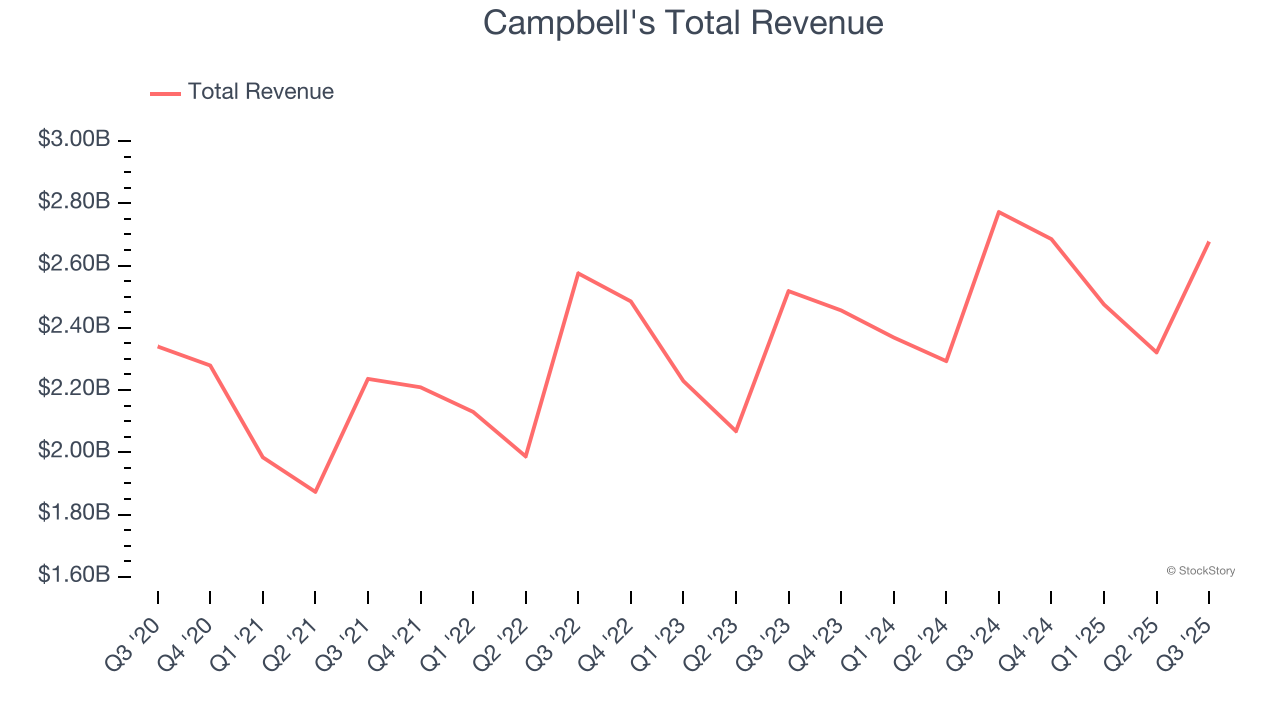
Unsurprisingly, the stock is down 6.5% since reporting and currently trades at $28.09.
Is now the time to buy Campbell's? Access our full analysis of the earnings results here, it’s free for active Edge members.
Best known for its SuperPretzel soft pretzels and ICEE frozen drinks, J&J Snack Foods (NASDAQ:JJSF) produces a range of snacks and beverages and distributes them primarily to supermarket and food service customers.
J&J Snack Foods reported revenues of $410.2 million, down 3.9% year on year, in line with analysts’ expectations. The business had a very strong quarter with a solid beat of analysts’ EBITDA estimates and a beat of analysts’ EPS estimates.

The market seems happy with the results as the stock is up 8.2% since reporting. It currently trades at $89.89.
Is now the time to buy J&J Snack Foods? Access our full analysis of the earnings results here, it’s free for active Edge members.
Whether it be packaged crackers, broths, or beverages, Treehouse Foods (NYSE:THS) produces a wide range of private-label foods for grocery and food service customers.
TreeHouse Foods reported revenues of $841.9 million, down 1.5% year on year, falling short of analysts’ expectations by 1%. It was a disappointing quarter as it posted a significant miss of analysts’ EBITDA and gross margin estimates.
Interestingly, the stock is up 24.3% since the results and currently trades at $23.68.
Read our full analysis of TreeHouse Foods’s results here.
Best known for its SPAM brand, Hormel (NYSE:HRL) is a packaged foods company with products that span meat, poultry, shelf-stable foods, and spreads.
Hormel Foods reported revenues of $3.19 billion, up 1.5% year on year. This result came in 2% below analysts' expectations. Aside from that, it was a satisfactory quarter as it also recorded a solid beat of analysts’ EBITDA estimates but a miss of analysts’ revenue estimates.
Hormel Foods had the weakest performance against analyst estimates among its peers. The stock is up 3% since reporting and currently trades at $24.12.
Read our full, actionable report on Hormel Foods here, it’s free for active Edge members.
The result of a 2015 mega-merger between Kraft and Heinz, Kraft Heinz (NASDAQ:KHC) is a packaged foods giant whose products span coffee to cheese to packaged meat.
Kraft Heinz reported revenues of $6.24 billion, down 2.3% year on year. This print was in line with analysts’ expectations. Taking a step back, it was a slower quarter as it logged a significant miss of analysts’ organic revenue estimates and a miss of analysts’ gross margin estimates.
The stock is down 5.3% since reporting and currently trades at $24.09.
Read our full, actionable report on Kraft Heinz here, it’s free for active Edge members.
In response to the Fed’s rate hikes in 2022 and 2023, inflation has been gradually trending down from its post-pandemic peak, trending closer to the Fed’s 2% target. Despite higher borrowing costs, the economy has avoided flashing recessionary signals. This is the much-desired soft landing that many investors hoped for. The recent rate cuts (0.5% in September and 0.25% in November 2024) have bolstered the stock market, making 2024 a strong year for equities. Donald Trump’s presidential win in November sparked additional market gains, sending indices to record highs in the days following his victory. However, debates continue over possible tariffs and corporate tax adjustments, raising questions about economic stability in 2025.
Want to invest in winners with rock-solid fundamentals? Check out our Strong Momentum Stocks and add them to your watchlist. These companies are poised for growth regardless of the political or macroeconomic climate.
StockStory’s analyst team — all seasoned professional investors — uses quantitative analysis and automation to deliver market-beating insights faster and with higher quality.
| Jun-10 | |
| Jun-09 | |
| Jun-09 | |
| Jun-08 | |
| Jun-08 | |
| Jun-08 | |
| Jun-08 | |
| Jun-08 | |
| Jun-08 | |
| Jun-08 | |
| Jun-08 | |
| Jun-08 | |
| Jun-07 | |
| Jun-06 | |
| Jun-05 |

Join thousands of traders who make more informed decisions with our premium features. Real-time quotes, advanced visualizations, alerts, and much more.
Learn more about Finviz Elite