Is the Vanguard Russell 2000 Index Fund ETF a Buy Now?
Key Points
Small cap stocks have lagged behind as large caps lead the artificial intelligence revolution.
A reversal of this demand dynamic, however, could be developing.
Whatever awaits, any ETF trade should be a philosophically strategic long-term holding.
Does the broad market's steep valuation have you leery of buying anything right now? If so, you're not alone. The S&P 500's (SNPINDEX: ^GSPC) trailing price-to-earnings ratio of just under 27 (and by some measures it's more than 30) is higher than it's been in years. Even if the advent of artificial intelligence (AI) allows most companies to grow into their stocks' lofty valuations, it may not happen soon enough to sidestep a correction in the meantime. We could even slip into a full-blown bear market if the feared AI bubble ends up popping.
If you dig deeper though, you will find that most stocks are not outrageously overpriced at this time. A small handful of huge technology companies operating in the artificial intelligence sector are skewing the S&P 500's valuation sharply higher. If you take these companies out of the equation, the S&P 500's trailing valuation is actually more or less in line with long-term norms. Meanwhile, the rest of the market is quietly priced below its long-term average valuations, making new investments in the Vanguard S&P Small-Cap 600 ETF (NYSEMKT: VIOO) or the Vanguard Russell 2000 ETF (NASDAQ: VTWO) particularly attractive right now.
Where to invest $1,000 right now? Our analyst team just revealed what they believe are the 10 best stocks to buy right now, when you join Stock Advisor. See the stocks »
AI euphoria just a little too distracting for the crowd
It's an often-forgotten detail. But just because it's used as a broad market barometer doesn't mean the S&P 500 represents the entirety of the stock market.
Most of the time a position in an exchange-traded fund like the SPDR S&P 500 ETF Trust (NYSEMKT: SPY) or the Vanguard S&P 500 ETF (NYSEMKT: VOO) does more or less match the overall performance of most of the market... simply because most stocks rise and fall in tandem.
Every now and then though, we see a meaningful divergence between the large caps of the S&P 500 and the small caps that make up the Russell 2000.
That's what we've seen since the last bear market ended in 2022. Fueled by the explosion of AI, a small number of stocks soared, outracing even their own earnings growth. It was just these few names though. Everything else was held to more reasonable, sustainable valuations. Indeed, the demand for the market's most popular AI-related stocks was so strong that investors lost interest in most everything else, including the Russell 2000's small caps.
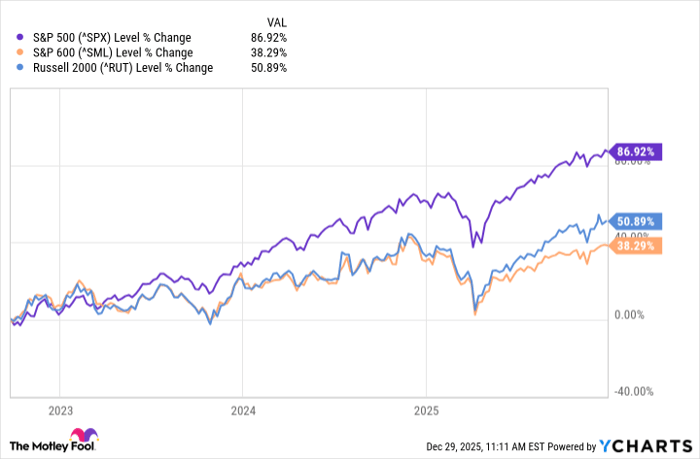
This was arguably a serious mistake, however. While these smaller businesses weren't experiencing outsized earnings growth stemming from artificial intelligence during this stretch, their profits did continue to grow well. End result? A trailing price-to-earnings (P/E) ratio of right about 18, according to data from World PE Ratio, which is no higher than its peak valuation reached at any point since late 2004.
It's not like the Russell 2000's relatively low valuation right now is a mathematical fluke either. Numbers from Yardeni Research suggest the index's forward-looking P/E ratio of 24.6 is (with the exception of the pandemic-prompted sell-off in early 2020) no higher than it's been since 2014.
The comparable -- and somewhat overlapping -- S&P 600 Small Cap Index mirrored by the Vanguard S&P Small-Cap 600 ETF is also dirt cheap here, and actually, even cheaper. The Vanguard ETF's calculated trailing P/E ratio currently stands at 17.9, while Yardeni reports the index's forward-looking P/E ratio stands at a below-average 15.5, with its per-share earnings expected to soar through the end of the new year.
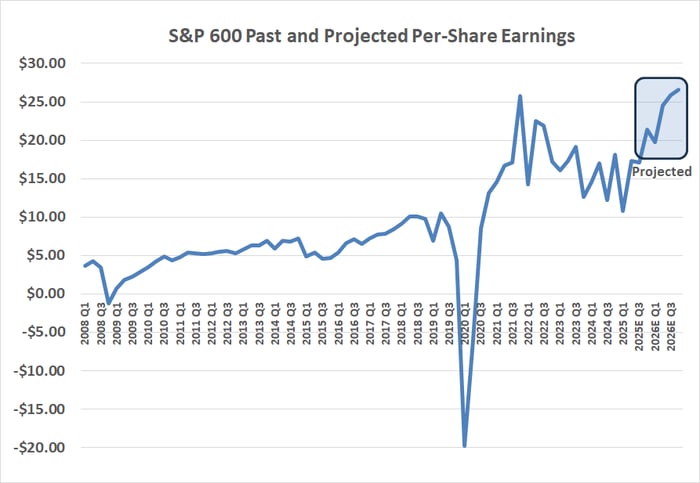
Data source: Standard & Poor's. Chart by author.
Analysts are increasingly taking notice
A few analysts have taken notice of the depth of this disparity, too, turning bullish in response. As Acuitas Investments Chief Investment Officer Chris Tessin recently opined, "You could drive a truck through the return differential." Tessin is particularly excited about the prospects of mergers and acquisitions within the small-cap realm, as these deals tend to value smaller target companies at a nice premium.
Brokerage firm Merrill Lynch's analysts are on board with the idea, too. Merrill's head of portfolio strategy Marci McGregor recently explained in an article on its website, "Since 1990, small-caps have outperformed large-caps on average in the one, three, six, 12, and 24 months after the Federal Reserve (the Fed) has cut interest rates" like it recently did, and is likely to do again more than once in 2026.

Image source: Getty Images.
Just bear in mind that McGregor, Tessin, and several other analysts encouraging investors to own small caps here and now largely agree that any new entries into any small-cap ETF should be viewed as a multiyear trade. If you're already a fan of exchange-traded funds though, you've likely already got this sort of long-term mindset.
Not your only option, but certainly the easiest option
The Vanguard Russell 2000 ETF or its close cousin, the Vanguard S&P Small-Cap 600 ETF, obviously aren't your only choices here. There are other small-cap exchange-traded funds. Or, you can gain exposure to this sliver of the market with individual small-cap companies.
That could prove tricky, though. It's not always easy to get complete, timely information regarding many of these businesses. This is a case where it arguably makes the most sense to buy into the strategic philosophy of a broad ETF, and then just leave it alone on faith that time will make the most of the decision.
Or more to the point for interested investors, yes, if your portfolio feels too overloaded with expensive large caps right now, the Vanguard Russell 2000 ETF is a great buy at this time.
Should you buy stock in Vanguard Russell 2000 ETF right now?
Before you buy stock in Vanguard Russell 2000 ETF, consider this:
The Motley Fool Stock Advisor analyst team just identified what they believe are the 10 best stocks for investors to buy now… and Vanguard Russell 2000 ETF wasn’t one of them. The 10 stocks that made the cut could produce monster returns in the coming years.
Consider when Netflix made this list on December 17, 2004... if you invested $1,000 at the time of our recommendation, you’d have $505,749!* Or when Nvidia made this list on April 15, 2005... if you invested $1,000 at the time of our recommendation, you’d have $1,149,658!*
Now, it’s worth noting Stock Advisor’s total average return is 979% — a market-crushing outperformance compared to 195% for the S&P 500. Don't miss the latest top 10 list, available with Stock Advisor, and join an investing community built by individual investors for individual investors.
*Stock Advisor returns as of January 1, 2026.
James Brumley has no position in any of the stocks mentioned. The Motley Fool has positions in and recommends Vanguard S&P 500 ETF. The Motley Fool has a disclosure policy.
Mentioned In This Article
Latest News
| 27 min | |
| 17 hours | |
| Oct-25 | |
| Oct-23 | |
| Oct-23 | |
| Oct-23 | |
| Oct-23 | |
| Oct-23 | |
| Oct-22 | |
| Oct-22 | |
| Oct-22 | |
| Oct-21 | |
| Oct-21 | |
| Oct-21 | |
| Oct-21 |
