Is Valero Energy Stock Too Expensive for Investors at Current Levels?
Valero Energy Corporation VLO appears overvalued at current levels, trading at a trailing 12-month EV/EBITDA of 7.90x—well above the broader industry average of 4.42x and Par Pacific Holdings’ PARR 4.45x. In comparison, Phillips 66 PSX is valued even more richly, with an EV/EBITDA multiple of 13.69x.
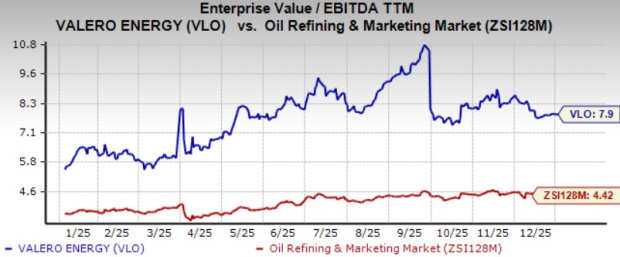
Is the premium valuation for VLO, compared to the industry, justified? Although investors are willing to pay a premium for the stock, investors need to analyze the company’s fundamentals and overall business environment before making investment decisions.
VLO's Refining Business to Benefit From Soft Oil Prices
With West Texas Intermediate (WTI) oil prices currently trading below $60 per barrel, according to data from Oilprice.com, which is significantly lower than a year ago, the overall energy business is now highly uncertain. However, unlike many other energy players, Valero Energy is expected to gain from the current crude pricing environment.
This is because Valero Energy is a leading refining company with the capacity to process 3.2 million barrels of oil daily. As a refining company, VLO is now able to purchase oil at a lower cost, enabling the production of end products, such as gasoline and distillates. Additionally, crude prices are likely to remain soft in the coming days, as the U.S. Energy Information Administration (“EIA”) expects global oil inventories to continue increasing.
EIA projects the spot average West Texas Intermediate price for 2026 at $51.42 per barrel, lower than $65.32 per barrel in 2025. Thus, like PSX and PARR, VLO, which generates the majority of its gross margin from refining activities, is expected to benefit from soft oil prices.
VLO’s High-Complexity Refineries Can Process Even Cheaper Oil
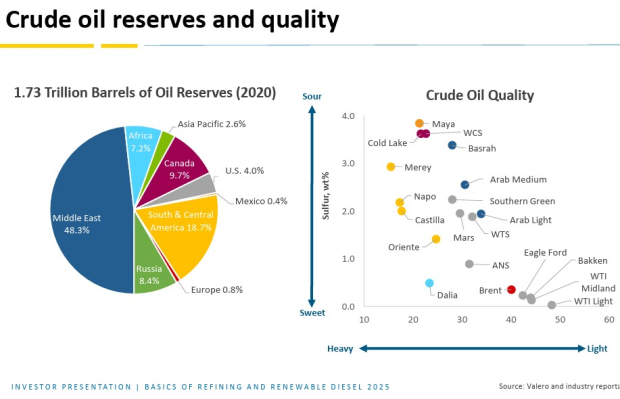
Most of the crude oil reserves worldwide are sour and heavy, but they trade at a discount to lighter oils, such as Brent and WTI. However, this is a plus for leading refiners like Valero Energy, as they have advanced refineries that can process heavier crude oil.
Thus, VLO, with its high-complexity throughput capacity, like PARR and PSX, can take advantage of cheaper feedstock costs while converting heavier crude to advanced and high-value refined products.
Should Investors Buy the Stock?
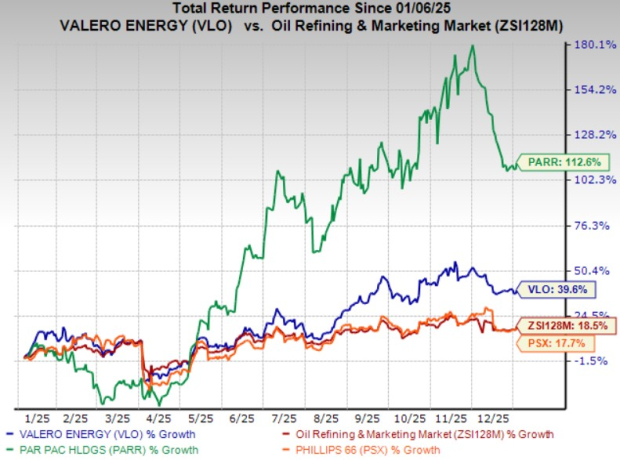
All the positives are getting reflected in VLO’s price chart. Over the past year, the stock has gained 39.6%, surpassing the industry’s 18.5% improvement. In comparison, PSX has gained 17.7% over the same period, while PARR surged 112.6%.
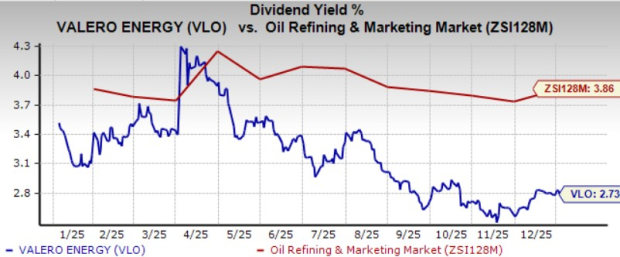
Despite the positive developments, investors should keep in mind that although having those complex refineries is a plus, this also requires higher maintenance and capital outlay. Also, Valero Energy’s dividend yield of 2.73% is lower than the industry’s 3.86%, which could disappoint some dividend-loving investors.
Thus, paying a premium price at least at this level may not be justified now, and investors shouldn’t rush to bet on the stock right away. Those who have already invested should continue to hold the stock, which currently carries a Zacks Rank #3 (Hold). You can see the complete list of today’s Zacks #1 Rank (Strong Buy) stocks here.
Want the latest recommendations from Zacks Investment Research? Today, you can download 7 Best Stocks for the Next 30 Days. Click to get this free report
Valero Energy Corporation (VLO): Free Stock Analysis Report
Phillips 66 (PSX): Free Stock Analysis Report
Par Pacific Holdings, Inc. (PARR): Free Stock Analysis Report
This article originally published on Zacks Investment Research (zacks.com).
Mentioned In This Article
Latest News
| 22 min | |
| 1 hour | |
| 3 hours |
Stock Market Today: Mood in Markets Improves After Trump Vows Not to Strike Iran Before Midterms
PSX VLO
The Wall Street Journal
|
| 7 hours | |
| Oct-08 |
American Oil Refiners Are Printing Money as Wars Shrink Global Energy Supplies
VLO PSX
The Wall Street Journal
|
| Oct-08 | |
| Oct-08 | |
| Oct-06 | |
| Oct-06 | |
| Oct-05 | |
| Oct-05 | |
| Oct-02 | |
| Oct-01 | |
| Oct-01 | |
| Sep-29 |
