SMH vs SOXX: What's the Better Semiconductor ETF Buy?
Key Points
Semiconductors have been one of the market's best-performing sectors.
The largest semiconductor funds are the VanEck Semiconductor ETF (SMH) and the iShares Semiconductor ETF (SOXX).
The biggest difference between the two is how they weight their portfolios.
Since the artificial intelligence (AI) boom began, one of the biggest market winners has been semiconductor stocks. The two largest exchange-traded funds (ETFs) that investors can choose between for exposure to this sector are the VanEck Semiconductor ETF (NASDAQ: SMH) and the iShares Semiconductor ETF (NASDAQ: SOXX).
Which one is better for investors? Let's break down the key considerations.
Where to invest $1,000 right now? Our analyst team just revealed what they believe are the 10 best stocks to buy right now. Continue »
Category exposure
In short, the biggest difference between the two ETFs is concentration.
Both ETFs track an index of semiconductor manufacturers that is weighted according to market capitalization, and hold roughly 25-30 positions.
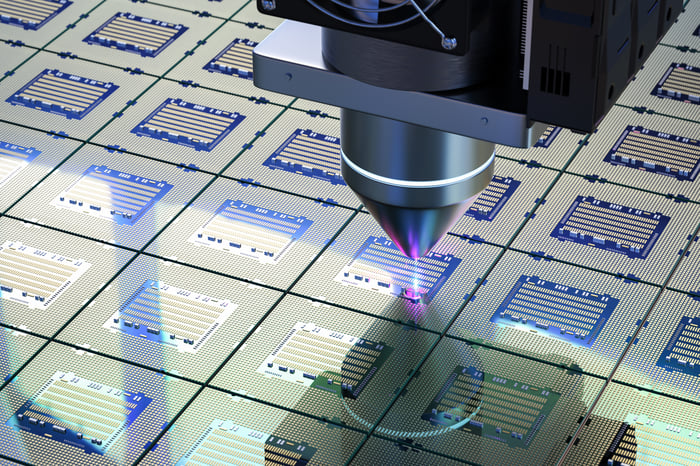
Image source: Getty Images.
The VanEck ETF weights its portfolio without constraint. That means the largest companies, such as Nvidia and Taiwan Semiconductor Manufacturing, can have huge allocations due to their relative size. Combined, those two companies alone account for roughly one-third of the portfolio.
The iShares ETF, on the other hand, puts caps on individual holding weights. The top five securities are capped at 8% and any remaining positions are capped at 4%. Additionally, the total weight given to American depositary receipts (ADRs) is limited to no more than 10% of the portfolio.
That makes the VanEck ETF more concentrated, more top-heavy, and much more tilted to the largest semiconductor companies. The iShares ETF tends to be less concentrated and spread out more between larger and smaller companies.
The verdict: SMH vs. SOXX
The choice of which is "better" largely comes down to whether you want heavier exposure to the industry's biggest companies.
Given that the market has favored large caps for some time, I'm inclined to believe that the VanEck Semiconductor ETF is the better choice at the moment. Investors haven't shown a consistent willingness to give up their large-cap bias.
Over the longer term, more diverse exposure to the semiconductor space might be preferable since there's less reliance on just a few big names. Given current conditions, however, VanEck looks like the winner.
Should you buy stock in VanEck ETF Trust - VanEck Semiconductor ETF right now?
Before you buy stock in VanEck ETF Trust - VanEck Semiconductor ETF, consider this:
The Motley Fool Stock Advisor analyst team just identified what they believe are the 10 best stocks for investors to buy now… and VanEck ETF Trust - VanEck Semiconductor ETF wasn’t one of them. The 10 stocks that made the cut could produce monster returns in the coming years.
Consider when Netflix made this list on December 17, 2004... if you invested $1,000 at the time of our recommendation, you’d have $493,290!* Or when Nvidia made this list on April 15, 2005... if you invested $1,000 at the time of our recommendation, you’d have $1,153,214!*
Now, it’s worth noting Stock Advisor’s total average return is 973% — a market-crushing outperformance compared to 195% for the S&P 500. Don't miss the latest top 10 list, available with Stock Advisor, and join an investing community built by individual investors for individual investors.
*Stock Advisor returns as of January 6, 2026.
David Dierking has positions in iShares Trust-iShares Semiconductor ETF. The Motley Fool has positions in and recommends Nvidia, Taiwan Semiconductor Manufacturing, and iShares Trust-iShares Semiconductor ETF. The Motley Fool has a disclosure policy.
Mentioned In This Article
Latest News
| 7 hours | |
| Oct-08 | |
| Oct-08 | |
| Oct-08 | |
| Oct-08 | |
| Oct-07 | |
| Oct-07 | |
| Oct-06 | |
| Oct-06 | |
| Oct-06 | |
| Oct-06 | |
| Oct-05 | |
| Oct-05 | |
| Oct-02 | |
| Oct-02 |
