Meta's New AI Glasses See "Unprecedented Demand"-What's Next?
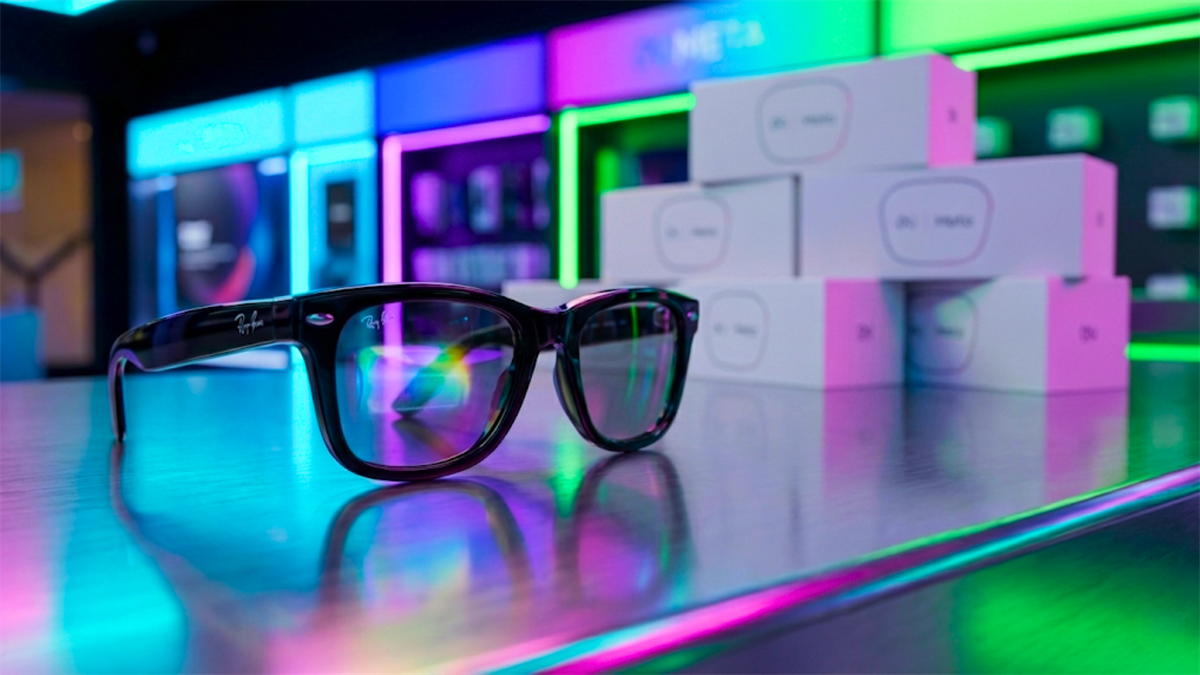
Meta Platforms (NASDAQ: META) just provided an interesting update on its latest artificial intelligence (AI) glasses. In September of last year, the Magnificent Seven company unveiled its next-generation AI device, the Meta Ray-Ban Display. As the name suggests, these new glasses have a built-in display, a significant advancement over the firm’s previous hardware. They also come with a neural wristband that senses movement. This allows users to control the glasses by making various hand gestures.
On Jan. 6, Meta released a blog post that provided important information from a demand and rollout perspective. The company noted: “Meta Ray-Ban Display is a first-of-its-kind product with extremely limited inventory. Since launching last fall, we’ve seen an overwhelming amount of interest, and as a result, product waitlists now extend well into 2026."
Additionally, due to “unprecedented demand," Meta decided to put the product’s international rollout on pause. This announcement has both positive and negative implications for Meta. Let’s break down these considerations, how markets reacted, and what to watch next.
Can Meta Ray-Ban Display Help Reality Labs Turn a Corner?
Right off the bat, the comments around Meta Ray-Ban Display’s U.S. demand are clearly a positive for the company. After years of commitment to virtual reality and AI hardware, the products have not meaningfully contributed to Meta’s growth. Over the last 12 months (LTM) ended in Q3 2025, Meta’s Reality Labs segment generated $2.3 billion in revenue. That’s only a 7% growth rate compared to the approximately $2.1 billion generated in the LTM ended in Q3 2024. This compares to Meta’s overall LTM growth rate of 21%. Additionally, Reality Labs' LTM operating loss was $18.1 billion.
Clearly, Meta needs a new blockbuster product to accelerate Reality Lab’s growth and help offset its operating losses. The statements regarding Meta Ray-Ban Display demand provide hope that the product could be a key part of the solution. Still, reading between the lines also raises significant questions.
Balancing Demand Strength With Production Concerns
While Meta said the product is seeing unprecedented demand, they also said supply is “extremely limited”. The real question is why. Did Meta intentionally limit its manufacturing capacity for the devices early on, waiting to see the response from consumers? Or is the firm’s limited supply due to structural manufacturing difficulties? While both could be true at this point, it feels fair to give Meta some grace.
The Meta Ray-Ban Display retails for $799, much more expensive than previous models, priced between $200 and $400. Thus, it makes sense for Meta to move slowly and evaluate how consumers respond to such an increase.
In the first quarter after the product's launch, Meta reportedly sold 15,000 units, capturing 6% market share in the category. Although this number of units may seem small, we need to consider it within its context. For a brand-new product, 6% market share after just one quarter is strong. The number provides some validation of Meta’s demand statements.
Furthermore, the device is certainly unique. It's not unreasonable to think that adding a display and the neural wristband would introduce significantly greater manufacturing complexity. While this could be limiting supply now, it doesn’t mean Meta won’t resolve these potential issues over time.
However, it’s not great to see Meta delay its international rollout. The product is planned for release in early 2026 in the United Kingdom, France, Italy, and Canada. Pausing this makes the path to revenue growth and market share gains longer in these markets. Although the move could also accelerate these metrics in the U.S., ultimately, Meta shares were little changed on the day of the announcement, rising 0.3%. Meanwhile, the S&P 500 rose 0.6%.
Notably, Meta’s AI glasses manufacturing partner, EssilorLuxottica (OTCMKTS: ESLOY), rose over 5% on Jan. 6. In aggregate, these reactions suggest that positive demand data outweighed negative implications regarding supply.
Future Quarters Will Be Telling for Meta Ray-Ban Display
It’s far too early to call the Meta Ray-Ban Display a true success or failure. However, given the company’s statements, investors will likely want to see Meta ramp up U.S. supply and sales significantly in the coming quarters.
This would greatly ease concerns around potential manufacturing issues and show that scaling the product won’t be a long-term issue. It would also provide more robust evidence of strong demand.
Where Should You Invest $1,000 Right Now?
Before you make your next trade, you'll want to hear this.
MarketBeat keeps track of Wall Street's top-rated and best performing research analysts and the stocks they recommend to their clients on a daily basis.
Our team has identified the five stocks that top analysts are quietly whispering to their clients to buy now before the broader market catches on... and none of the big name stocks were on the list.
They believe these five stocks are the five best companies for investors to buy now...
The article "Meta’s New AI Glasses See “Unprecedented Demand”—What’s Next?" first appeared on MarketBeat.
Mentioned In This Article
Latest News
| 3 hours | |
| 4 hours | |
| 5 hours | |
| 5 hours | |
| 7 hours | |
| 9 hours | |
| 11 hours | |
| 11 hours | |
| 12 hours | |
| 13 hours | |
| 13 hours | |
| 13 hours | |
| Oct-13 | |
| Oct-13 | |
| Oct-13 |
