Inside D-Wave's Major Acquisition-What Changes for Investors
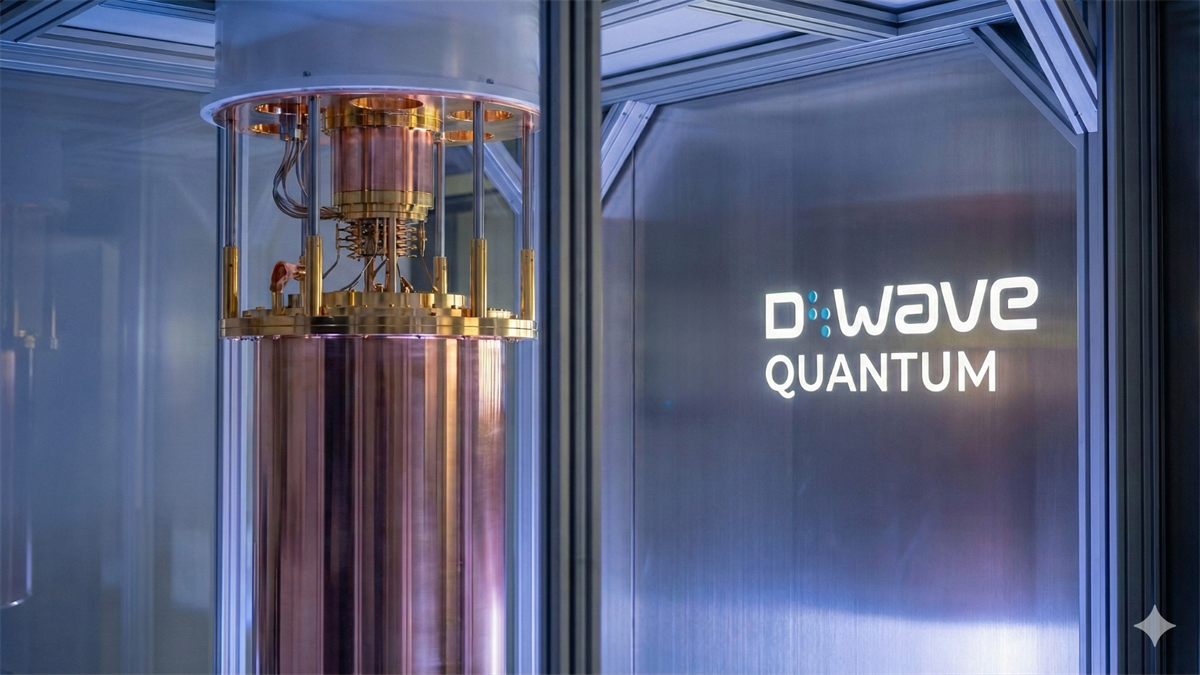
Popular quantum computing company D-Wave Quantum Inc. (NYSE: QBTS) has taken another step toward cementing its status as a leader in the field with its early-2026 announcement that it plans to acquire privately-held rival Quantum Circuits Inc. in a deal worth $550 million. The move is D-Wave's first major acquisition announced since it revealed well over $800 million in cash reserves in its second-quarter 2025 earnings results, prompting speculation among investors that the company was preparing to go on a buying spree.
D-Wave has recently been demonstrating its efforts to expand its technological reach beyond its earlier ventures in quantum annealing, an approach known for being extremely effective at optimization-related problems but less beneficial in other types of settings. The agreement to acquire Quantum Circuits is perhaps the largest show of D-Wave's seriousness about broadening into the more common gate-model approach, thereby also growing the number and type of use cases for D-Wave's quantum systems.
Why Quantum Circuits?
With nearly a billion dollars in cash reserves late in 2025, D-Wave likely had its choice of quite a few different players in the quantum industry as it turned its acquisitions. Quantum Circuits is a strong choice thanks to its decade-plus history of gate-model quantum computing systems.
One disadvantage D-Wave has had relative to competitors like Rigetti Computing (NASDAQ: RGTI) has been that it has lagged behind in developing gate-model tech.
Now, D-Wave will most likely close this gap and firm up its advantage by possessing gate-model technology as well as quantum systems based on annealing systems, the latter of which are already commercially available.
Quantum Circuits is known for so-called dual-rail technology that includes built-in error detection.
The result is that it can build higher-quality qubits than competitors while also reducing the physical resources required in this manufacturing process. D-Wave expects that it will be able to launch a dual-rail quantum system commercially sometime in 2026.
Financial Impacts on D-Wave
The Quantum Circuits acquisition may help D-Wave leapfrog over the quantum competition by allowing D-Wave to bring industry-leading gate-model systems to market in addition to its annealing-based systems. This makes the purchase price of $550 million—consisting of $300 million in common stock and $250 million in cash—a small price to pay.
D-Wave ended the third quarter of 2025 with $836 million in cash and equivalents, up significantly year-over-year (YOY) and even somewhat on a sequential basis as well.
It will be essential for D-Wave to maintain a strong cash buffer going forward, particularly given the company's minuscule revenue up to this point. D-Wave reported just $3.7 million in revenue for the third quarter, and despite the fact that this represents a doubling in sales YOY, it remains much smaller than some of its rivals in this respect. At the same time, quarterly net losses were nearly $141 million.
Is It Time to Buy D-Wave?
D-Wave shares got a slight boost following its announcement on Jan. 7, rising to about $32 per share, but gave up those gains by the end of the trading week. Investors are likely still cautious.
When D-Wave's acquisition is completed (expected in January 2026), it will gain access to powerful technology, but it will not immediately introduce new products to the market. It will also not immediately have broad commercial viability for either gate-model or annealing-based quantum systems.
In this way, D-Wave's acquisition announcement is the latest in a string of promising developments in the past year that have yet to materially impact the company's ability to boost its revenue or narrow its losses.
Many analysts still anticipate that widespread commercialization of quantum tech remains many years off. D-Wave may have an advantage in the race toward that goal, but investors will still need to wait until any company achieves it.
For this reason, analyst optimism surrounding QBTS shares—and Wall Street's expectation that the stock might climb by about 20% to nearly $34 per share—comes with a caveat that D-Wave remains a speculative play. Some investors may increasingly view this company as the top choice among quantum firms, but significant risks remain until quantum technology becomes widely useful to a broader group of potential customers.
Where Should You Invest $1,000 Right Now?
Before you make your next trade, you'll want to hear this.
MarketBeat keeps track of Wall Street's top-rated and best performing research analysts and the stocks they recommend to their clients on a daily basis.
Our team has identified the five stocks that top analysts are quietly whispering to their clients to buy now before the broader market catches on... and none of the big name stocks were on the list.
They believe these five stocks are the five best companies for investors to buy now...
The article "Inside D-Wave’s Major Acquisition—What Changes for Investors" first appeared on MarketBeat.
Mentioned In This Article
Latest News
| Oct-08 | |
| Oct-06 | |
| Oct-06 | |
| Oct-05 | |
| Oct-05 | |
| Oct-02 | |
| Oct-01 | |
| Sep-29 | |
| Sep-28 | |
| Sep-26 | |
| Sep-25 | |
| Sep-24 | |
| Sep-23 | |
| Sep-23 | |
| Sep-23 |
