2 Big Things Lucid Group Absolutely Must Do in 2026
Key Points
Lucid has established itself as a maker of cutting-edge luxury EVs, but it's still a long way from profitability.
There are two big things that Lucid can do in 2026 to move closer to breaking even.
If it fails to do either, the company's future will be in question.
Lucid Group (NASDAQ: LCID) has never lacked ambition. Its engineers built a genuinely world-class electric luxury sedan in the Lucid Air. Now, the company is betting that the newly launched Gravity SUV can bring it one big step closer to justifying its massive Arizona factory.
But 2026 is shaping up to be a make-or-break year for Lucid -- not because it will suddenly become profitable (that won't happen yet), but because two specific things will help investors see whether Lucid has a realistic path to that profitability any time soon.
Where to invest $1,000 right now? Our analyst team just revealed what they believe are the 10 best stocks to buy right now. Continue »
Here are the two things that Lucid must do in 2026.
1. Keep demand for the Gravity SUV strong -- and ideally, growing
The Gravity is Lucid's most important product yet.
That isn't a knock on the Air. It's just reality: Particularly in the U.S. market, SUVs are where the volume is, especially for buyers willing to spend luxury-EV money.
If Lucid is going to get closer to profitability, the Gravity has to do what the Air couldn't: sell in meaningful numbers, consistently, without heavy price cuts or endless incentives.
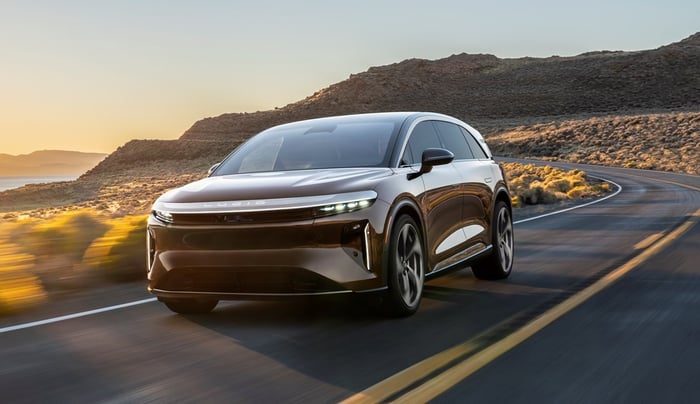
Lucid's new Gravity SUV might not be "make-or-break" for the company. But if it doesn't sell well, the next product could be. Image source: Lucid Group.
How will we know whether that's happening? Here are some things to watch:
- Pricing and trim mix: Lucid has always planned to add lower-cost versions of the Gravity, just as it did with the Air. That will bring average pricing down over the course of 2026, which is fine. But if Lucid cuts prices after they're announced, that's a red flag suggesting that demand is soft.
- Fewer incentives: Discounts and subsidized leases can pull demand forward, juicing deliveries for a time. But profit margins will be hurt, and in time, Lucid's luxury pricing power will erode.
- Owner buzz as Lucid scales: Early on, the sense with the Air was that the hardware -- the actual car -- was excellent, but the software was buggy. Early adopters tend to forgive such things, but mainstream buyers won't. This will be extra-important in 2027, when Lucid starts ramping its lower-cost midsize model.
Here's the big concern: If Gravity demand fades after the initial wave, Lucid risks getting stuck burning cash with two underwhelming models. If that happens, the midsize model could become life-or-death for the company -- if it isn't already.
2. Launch the midsize model by the end of 2026 -- as promised
Lucid has said it will begin production of a new midsize platform by the end of 2026. For investors, that isn't just a product milestone: It's Lucid's best shot at reaching the kind of volume where the math starts to improve.
Why? Because Lucid's current lineup lives in the deep end of the automotive pricing pool. That's fine for building the foundation of a luxury brand. It's not fine for scale.
And Lucid needs scale, soon. The company's big factory in Arizona has a capacity of about 90,000 vehicles a year. Applying an old auto industry rule of thumb, that means the factory will likely lose money until it gets to about 80% of that number -- or around 72,000 vehicles a year.
Lucid produced 18,378 vehicles in 2025. That was a good result, up more than 100% from its 2024 total.
But it's a long way from 72,000, where the company might finally break even. And the Gravity, a luxury SUV that currently starts at just under $80,000, isn't going to fill that gap on its own.
But the new midsize platform just might. It's expected to underpin three new Lucid models, with prices starting around $50,000. That's still a premium price, but it's one that makes significant volumes far more likely.
Lucid has to get this new platform right -- and deliver it on time.
The common thread: Execution needs to match the story in 2026
Lucid's story is still a good one. It has established itself as a premium EV brand with industry-leading range and technology, with a promise that it will expand into higher-volume segments over time.
For investors, 2026 is the year in which Lucid needs to deliver on two big steps toward that promise:
- Prove that the Gravity isn't a one-quarter wonder, and
- Launch the promised midsize platform by the end of 2026 -- and make it good.
If Lucid can do both, it will have credible momentum, and that should start driving the long-floundering stock upwards. If it can't, the company will face some grim questions about its future.
Should you buy stock in Lucid Group right now?
Before you buy stock in Lucid Group, consider this:
The Motley Fool Stock Advisor analyst team just identified what they believe are the 10 best stocks for investors to buy now… and Lucid Group wasn’t one of them. The 10 stocks that made the cut could produce monster returns in the coming years.
Consider when Netflix made this list on December 17, 2004... if you invested $1,000 at the time of our recommendation, you’d have $482,451!* Or when Nvidia made this list on April 15, 2005... if you invested $1,000 at the time of our recommendation, you’d have $1,133,229!*
Now, it’s worth noting Stock Advisor’s total average return is 968% — a market-crushing outperformance compared to 197% for the S&P 500. Don't miss the latest top 10 list, available with Stock Advisor, and join an investing community built by individual investors for individual investors.
*Stock Advisor returns as of January 13, 2026.
John Rosevear has no position in any of the stocks mentioned. The Motley Fool has no position in any of the stocks mentioned. The Motley Fool has a disclosure policy.
Mentioned In This Article
Latest News
| Oct-09 | |
| Oct-09 | |
| Oct-08 | |
| Oct-08 | |
| Oct-07 | |
| Oct-06 | |
| Oct-06 | |
| Oct-06 | |
| Oct-06 | |
| Oct-06 | |
| Oct-05 | |
| Oct-05 | |
| Oct-05 | |
| Oct-02 | |
| Oct-01 |
