QCOM vs. AMD: Which Semiconductor Stock is the Smarter Buy in 2026?
Qualcomm Technologies Inc. QCOM and Advanced Micro Devices, Inc. AMD are premier chip manufacturing firms competing in the mobile, PC and data center markets, with a focus on AI (artificial intelligence) and advanced chip technologies. Qualcomm’s offerings include high-performance, low-power chip designs for mobile devices, PCs, XR (Extended Reality), automotive, wearable, robotics, connectivity and AI use cases. The company boasts a comprehensive intellectual property portfolio comprising 3G, 4G, 5G and other technologies.
Advanced Micro has strengthened its position in the semiconductor market, thanks to its evolution from a purebred consumer-PC chip provider to an enterprise-focused company. Its processors are primarily powered by the company's proprietary "Zen" CPU and "Vega" GPU architectures. The company’s acquisition of Xilinx has helped in expanding into multiple embedded markets. AMD now offers Field Programmable Gate Arrays (FPGAs), Adaptive SoCs and Adaptive Compute Acceleration Platform (ACAP) products.
With growing AI proliferation in PCs, smartphones, automotive and IoT applications, both Qualcomm and Advanced Micro are steadily advancing their semiconductor portfolio to bolster their competitive edge. Let us analyze in depth the competitive strengths and weaknesses of the companies to understand who is in a better position to maximize gains from the emerging market trends.
The Case for QCOM
Qualcomm is well-positioned to meet its long-term revenue targets driven by solid 5G traction, greater visibility and a diversified revenue stream. The company is increasingly focusing on the seamless transition from a wireless communications firm for the mobile industry to a connected processor company for the intelligent edge. Qualcomm had extended its collaboration with Garmin with the addition of the Nexus automotive-grade High Performance Compute (HPC) platform. Powered by Qualcomm’s Snapdragon Elite Platform for automotive, Nexus will integrate multiple vehicle domains, such as in-vehicle infotainment, instrument clusters and ADAS, into a single system for optimal efficiency.
The company is strengthening its foothold in the mobile chipsets market with innovative product launches. It had extended its Snapdragon G Series portfolio with the addition of next-generation gaming chipsets, Snapdragon G3 Gen 3, Snapdragon G2 Gen 2 and Snapdragon G1 Gen 2 chips. Qualcomm is also placing strong emphasis on developing advanced chipsets for the emerging market of AI PCs. The strategy is aimed at moving beyond the slowing smartphone industry, which is its primary breadwinner. The Snapdragon X chip for mid-range AI desktops and laptops is the fourth such product in the Snapdragon X processor line, following the successful launch of the Snapdragon X Plus 8-core, Snapdragon X Plus and Snapdragon X Elite series.
Despite efforts to ramp up its AI initiatives, Qualcomm has been facing tough competition from Intel Corporation INTC in the AI PC market. Shift in the share among original equipment manufacturers (OEMs) at the premium tier has reduced Qualcomm's near-term opportunity to sell integrated chipsets from the Snapdragon platform. The company is also facing stiff competition from Samsung’s Exynos processors in the premium smartphone market, while MediaTek is gaining market share in the mid-range and budget smartphone market. Competition is also likely to come from formidable rivals like Broadcom and NVIDIA Corporation NVDA. Qualcomm’s extensive operations in China are further likely to be significantly affected by the U.S.-China trade hostilities.
The Case for AMD
AMD is strengthening its footprint in the AI market through an expanding portfolio. The latest MI350 series instinct accelerator families strengthen its competitive position in the AI space. AMD introduced its Helios design supporting Meta Platforms’ new Open Rack Wide specification. It is also benefiting from strong enterprise adoption and expanded cloud deployments.
AMD’s footprint is strong in the data center market thanks to strong adoption of EPYC processors. It is benefiting from strong enterprise adoption, expanded cloud deployments and emerging AI use cases. Rapid adoption of agentic AI is creating additional demand for general-purpose compute infrastructure as customers are realizing that each token generated by a GPU triggers multiple CPU-intensive tasks. This is driving demand for AMD’s fifth-gen EPYC Turin processors. AMD is expanding its footprint in markets like aerospace, streaming, financial services, retail, energy and telecom thanks to strong EPYC demand.
However, in the traditional computing market, which still generates a chunk of its revenues, AMD is up against Intel's strong market position. With Intel systems so well entrenched, there is an obvious preference for system integrators to choose Intel processors over AMD. Moreover, AMD faces significant competition from NVIDIA in the GPU market. AMD has had relatively greater success in the mobile segment, and its current product lineup indicates that this focus will continue. However, competition in the mobile segment is likely to accelerate, with more ARM-based devices coming on the market.
How Do Zacks Estimates Compare for QCOM & AMD?
The Zacks Consensus Estimate for Qualcomm’s fiscal 2026 sales and EPS implies year-over-year growth of 2.7% and 1%, respectively. The EPS estimates have been trending northward on average over the past 60 days.
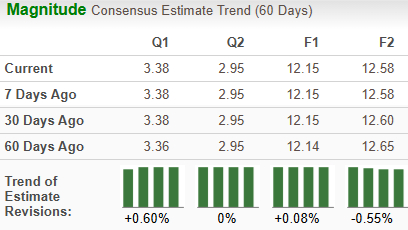
Image Source: Zacks Investment Research
The Zacks Consensus Estimate for Advanced Micro’s 2025 sales suggests year-over-year growth of 31.6%, while that for EPS implies a rise of 19.6%. The EPS estimates have been trending southward over the past 60 days.
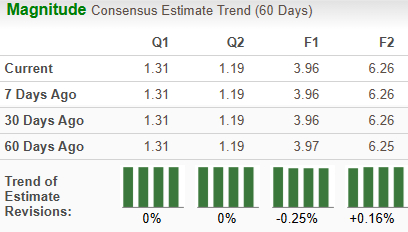
Image Source: Zacks Investment Research
Price Performance & Valuation of QCOM & AMD
Over the past year, Qualcomm has gained a mere 0.6% compared with the industry’s growth of 42.8%. Advanced Micro has surged 84.2% over the same period.
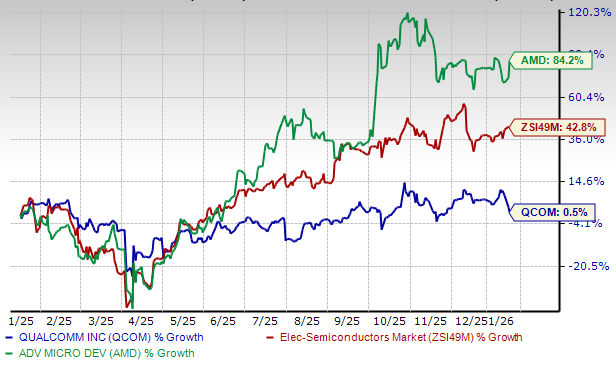
Image Source: Zacks Investment Research
Qualcomm looks more attractive than Advanced Micro from a valuation standpoint. Going by the price/earnings ratio, Qualcomm’s shares currently trade at 13.46 forward earnings, significantly lower than 34.67 for Advanced Micro.
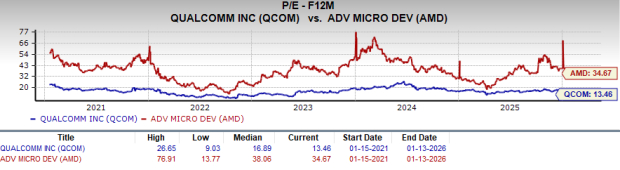
Image Source: Zacks Investment Research
QCOM or AMD: Which is a Better Pick?
Qualcomm and Advanced Micro carry a Zacks Rank #3 (Hold) each. You can see the complete list of today’s Zacks #1 Rank (Strong Buy) stocks here.
Both companies expect their sales and profits to improve in 2025. Advanced Micro has shown steady revenue and EPS growth for years, while Qualcomm has been facing a bumpy road. AMD has also recorded a better price performance than Qualcomm. However, QCOM is trading cheaply compared with AMD. Qualcomm has a VGM Score of A. Consequently, Qualcomm appears to have a slight edge over AMD and seems to be a better investment option at the moment.
Want the latest recommendations from Zacks Investment Research? Today, you can download 7 Best Stocks for the Next 30 Days. Click to get this free report
Intel Corporation (INTC): Free Stock Analysis Report
QUALCOMM Incorporated (QCOM): Free Stock Analysis Report
Advanced Micro Devices, Inc. (AMD): Free Stock Analysis Report
NVIDIA Corporation (NVDA): Free Stock Analysis Report
This article originally published on Zacks Investment Research (zacks.com).
Mentioned In This Article
Latest News
| 1 hour | |
| 5 hours | |
| 5 hours | |
| 6 hours | |
| 11 hours | |
| 11 hours | |
| 11 hours | |
| Oct-09 | |
| Oct-09 | |
| Oct-09 | |
| Oct-09 | |
| Oct-09 | |
| Oct-09 | |
| Oct-09 | |
| Oct-09 |
