3 Reasons MRCY is Risky and 1 Stock to Buy Instead

Mercury Systems has been on fire lately. In the past six months alone, the company’s stock price has rocketed 96.6%, reaching $98.50 per share. This was partly due to its solid quarterly results, and the run-up might have investors contemplating their next move.
Is there a buying opportunity in Mercury Systems, or does it present a risk to your portfolio? Get the full breakdown from our expert analysts, it’s free.
Why Do We Think Mercury Systems Will Underperform?
We’re glad investors have benefited from the price increase, but we don't have much confidence in Mercury Systems. Here are three reasons you should be careful with MRCY and a stock we'd rather own.
1. Slow Organic Growth Suggests Waning Demand In Core Business
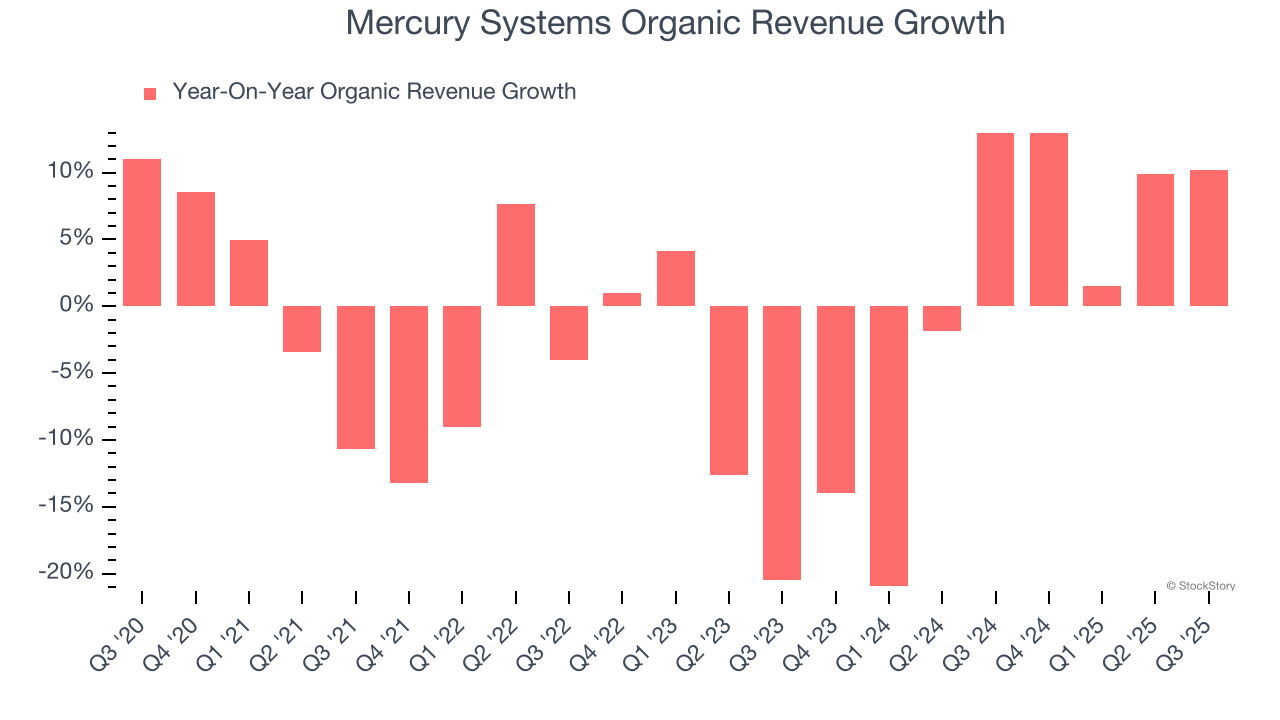
In addition to reported revenue, organic revenue is a useful data point for analyzing Defense Contractors companies. This metric gives visibility into Mercury Systems’s core business because it excludes one-time events such as mergers, acquisitions, and divestitures along with foreign currency fluctuations - non-fundamental factors that can manipulate the income statement.
Over the last two years, Mercury Systems’s organic revenue averaged 1.3% year-on-year growth. This performance was underwhelming and suggests it may need to improve its products, pricing, or go-to-market strategy, which can add an extra layer of complexity to its operations.
2. Shrinking Operating Margin
Operating margin is a key measure of profitability. Think of it as net income - the bottom line - excluding the impact of taxes and interest on debt, which are less connected to business fundamentals.
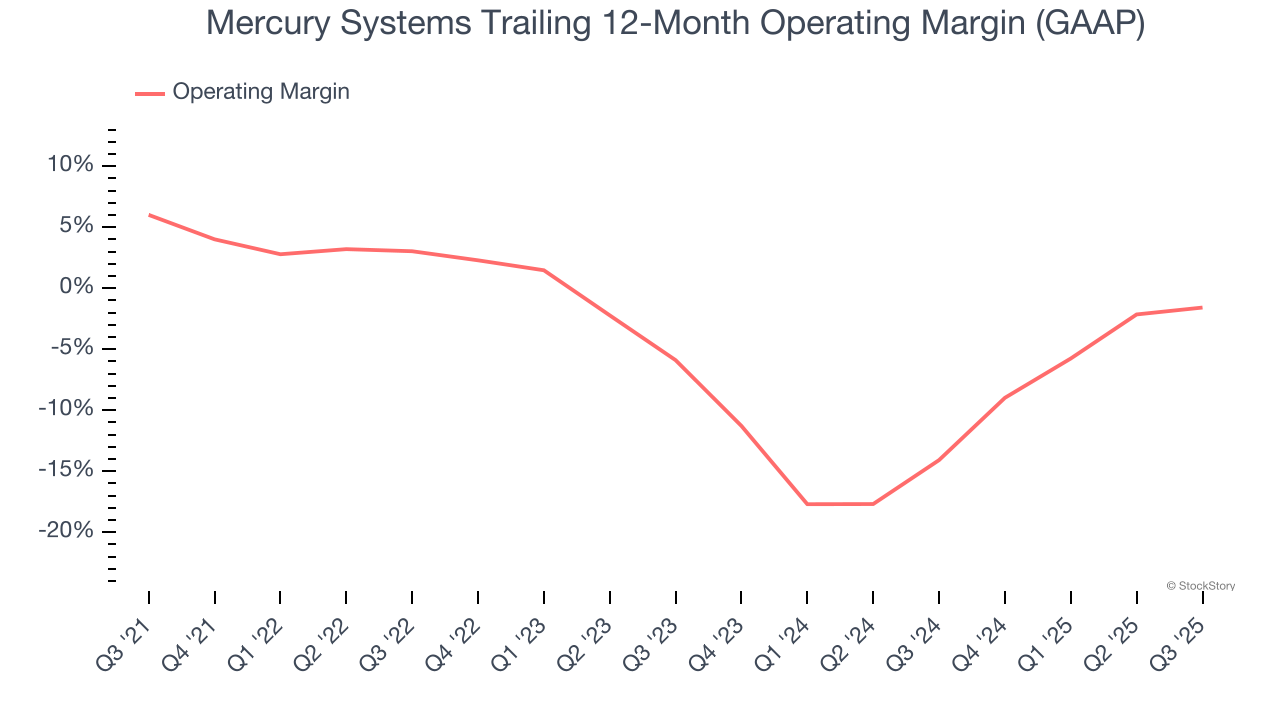
Analyzing the trend in its profitability, Mercury Systems’s operating margin decreased by 7.6 percentage points over the last five years. This raises questions about the company’s expense base because its revenue growth should have given it leverage on its fixed costs, resulting in better economies of scale and profitability. Mercury Systems’s performance was poor no matter how you look at it - it shows that costs were rising and it couldn’t pass them onto its customers. Its operating margin for the trailing 12 months was negative 1.6%.
3. EPS Trending Down
Analyzing the long-term change in earnings per share (EPS) shows whether a company's incremental sales were profitable – for example, revenue could be inflated through excessive spending on advertising and promotions.
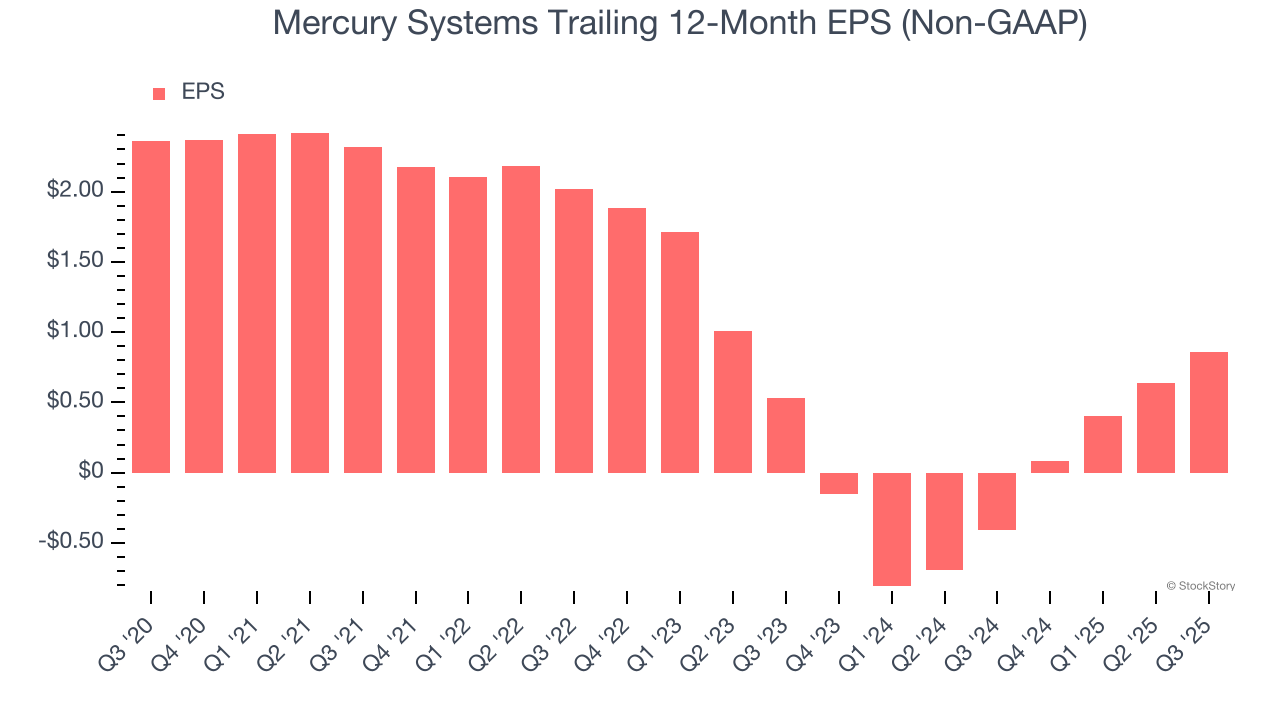
Sadly for Mercury Systems, its EPS declined by 18.3% annually over the last five years while its revenue grew by 2.5%. This tells us the company became less profitable on a per-share basis as it expanded.
Final Judgment
Mercury Systems doesn’t pass our quality test. After the recent rally, the stock trades at 100.3× forward P/E (or $98.50 per share). At this valuation, there’s a lot of good news priced in - we think there are better stocks to buy right now. We’d suggest looking at one of our top software and edge computing picks.
Stocks We Like More Than Mercury Systems
If your portfolio success hinges on just 4 stocks, your wealth is built on fragile ground. You have a small window to secure high-quality assets before the market widens and these prices disappear.
Don’t wait for the next volatility shock. Check out our Top 5 Growth Stocks for this month. This is a curated list of our High Quality stocks that have generated a market-beating return of 244% over the last five years (as of June 30, 2025).
Stocks that have made our list include now familiar names such as Nvidia (+1,326% between June 2020 and June 2025) as well as under-the-radar businesses like the once-small-cap company Comfort Systems (+782% five-year return). Find your next big winner with StockStory today.
Mentioned In This Article
Latest News
| Oct-13 | |
| Oct-08 | |
| Oct-06 | |
| Sep-16 | |
| Aug-25 | |
| Aug-19 | |
| Aug-19 | |
| Aug-19 | |
| Aug-18 | |
| Aug-18 | |
| Aug-18 | |
| Aug-18 | |
| Aug-18 | |
| Aug-14 | |
| Aug-12 |
