1 Magnificent S&P 500 Dividend Stock Down 20% to Buy and Hold Forever
Key Points
Lingering inflation has forced most consumer goods companies to make unpopular decisions, leading to unpredictably disappointing results.
An entire group of stocks may have simply fallen out of favor because of the tremendous preference for AI names.
Reversals of both of these dynamics, however, are on the horizon.
Does your portfolio need reliable dividends, but you don't want to pay too much for too little yield? That's a tall order these days. The rapid rise of artificial intelligence (AI) stocks has lifted lots of tickers to unusually high valuations, dialing back their relative dividend payouts.
Not every name has suffered this phenomenon, though. If you're willing to give up a little bit of growth potential and a lot of excitement, there's a handful of reliable "forever" dividend payers you can step into today at a fantastic price. And one of the best of the best of these tickers right now is Procter & Gamble (NYSE: PG).
Where to invest $1,000 right now? Our analyst team just revealed what they believe are the 10 best stocks to buy right now, when you join Stock Advisor. See the stocks »

Image source: Getty Images.
A challenging environment for consumer goods stocks
You've certainly heard of the company. What you may not realize is the breadth and depth of its presence within the consumer goods space. P&G is the name behind Tide laundry detergent, Gillette razors, Dawn dishwashing liquid, Crest toothpaste, Pampers diapers, Bounty paper towels, and many more. It's not just the world's biggest consumer staples name as measured by revenue and market cap, reporting a top line of $84.3 billion for the fiscal year ending in June. Several of its products dominate their respective categories. And it's much easier to remain in the lead of a particular market than it is to dethrone a market leader.
Sheer size can also work against a company, of course. Not only does more size generally mean more corporate complexity, but it also creates bigger year-over-year comparisons that make growth look a little less meaningful.
That's arguably one of the chief reasons P&G shares have performed so poorly since November 2024, falling 20% from that peak -- the company's been forced to maneuver rather aggressively in an inflation-riddled environment where consumers are doing more price-conscious shopping (not to mention an environment that now offers them more accessible choices). This, in turn, has led to a few more quarterly revenue and profit shortfalls, and done so for far longer than might have been expected when the headwind first began blowing.
The thing is, this cyclical headwind is likely to be nearer its end than not. In the meantime, Procter & Gamble's dividend was never in any real jeopardy. That's why the stock's prolonged weakness is most definitely a buying opportunity for true long-term income investors.
A light at the end of the tunnel for P&G
P&G's foreseeable future could remain tricky to navigate. Now more than a year into the proverbial gauntlet, however, management has clearly figured out how to do so.
In the meantime, the underlying inflation that's been so problematic for P&G finally appears to be abating at the same time economic growth is perking up. The Federal Reserve is forecasting that the United States' annualized inflation rate will cool from last year's figure of around 3% to just above 2% for 2027, and stay there in 2028. And, following the third quarter's surprisingly strong growth estimate of 4.3%, the Fed's governors expect the country's GDP growth rate to improve from 2025's average in the ballpark of 1.7% to growth of around 2.2% this year, where it should remain next year. As for outside of the U.S. (where Procter & Gamble does about half of its business), the World Bank is calling for global GDP growth of 2.6% in 2026 (roughly in line with last year's progress), helped by well-tempered inflation.
These seemingly small numbers are actually a pretty big deal for P&G's price-sensitive customers.
The irony? While Procter & Gamble may have reported a few disappointing quarterly results of late, the company's actually managed to find a way to widen its profit margins during this turbulent period.
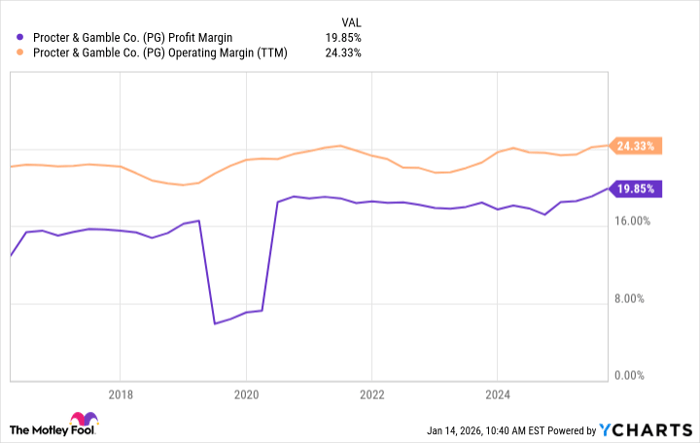
Data by YCharts.
Perhaps more important to income-minded investors, all of this dynamic lends support to Procter & Gamble's already well-supported dividend payment. Of last fiscal year's per-share earnings of $6.51, only $4.08 (or 63%) of that bottom line was distributed in the form of dividends. Indeed, the company's not only paid a dividend like clockwork for 135 years now, but has been able to raise its annual dividend payout every year for the past 69 years. And by more than a little. It's grown by nearly 5% per year over the course of the past decade, handily outpacing inflation during this stretch. There's no end in sight to either streak.
A short-term window of long-term opportunity is open
Given the company's stature, along with the stock's current above-average forward-looking yield of 3%, it's surprising that Procter & Gamble shares have been allowed to sink for as long and as far as they have. On the other hand, it's also possible that slower-growing value stocks like this one have simply fallen out of favor in an environment where investors can't seem to get enough exposure to faster-growing artificial intelligence stocks.
Both dynamics set the stage for a better performance from P&G shares from here, however.
This ticker is much more than a mere way of capitalizing on a short-term shift back to longer-term norms. Procter & Gamble has a long history of solid, risk-adjusted performance that's ultimately rooted in the nature of its products and its dominance of several consumer goods categories. The entry opportunity is a temporary one because it's so unusual to see this stock down this much for so long.
Don't overthink it, even if we don't know if P&G's stock has hit its ultimate low just yet. This is more than enough of a discount to dive into it here and now.
Should you buy stock in Procter & Gamble right now?
Before you buy stock in Procter & Gamble, consider this:
The Motley Fool Stock Advisor analyst team just identified what they believe are the 10 best stocks for investors to buy now… and Procter & Gamble wasn’t one of them. The 10 stocks that made the cut could produce monster returns in the coming years.
Consider when Netflix made this list on December 17, 2004... if you invested $1,000 at the time of our recommendation, you’d have $474,847!* Or when Nvidia made this list on April 15, 2005... if you invested $1,000 at the time of our recommendation, you’d have $1,146,655!*
Now, it’s worth noting Stock Advisor’s total average return is 958% — a market-crushing outperformance compared to 196% for the S&P 500. Don't miss the latest top 10 list, available with Stock Advisor, and join an investing community built by individual investors for individual investors.
*Stock Advisor returns as of January 16, 2026.
James Brumley has positions in Procter & Gamble. The Motley Fool has no position in any of the stocks mentioned. The Motley Fool has a disclosure policy.
Mentioned In This Article
Latest News
| Oct-08 | |
| Oct-08 | |
| Oct-06 | |
| Oct-06 | |
| Oct-06 | |
| Oct-03 | |
| Oct-01 | |
| Sep-29 | |
| Sep-29 | |
| Sep-28 | |
| Sep-24 | |
| Sep-24 | |
| Sep-21 | |
| Sep-18 | |
| Sep-17 |
