A $10 Trillion Opportunity: Why This Unstoppable Stock Could Be a Better Buy Than Tesla Ahead of the Autonomous Driving Revolution
Key Points
Cathie Wood's Ark Investment Management predicts autonomous vehicles will reduce the cost-per-mile of mobility, which will make travel more accessible.
Ark believes this will create a $10 trillion opportunity for providers of autonomous ride-hailing services.
Tesla is one of the biggest developers of self-driving technologies, but ride-hailing giant Uber might be in a better position to win the autonomous race.
Ark Investment Management, which was founded by seasoned investor Cathie Wood, releases a new edition of its "Big Ideas" report every year to highlight potential opportunities across the technology space. In the 2025 edition, the firm discussed how autonomous vehicles could turn ride-hailing into a $10 trillion industry over the long term by making travel significantly more affordable for consumers.
Tesla (NASDAQ: TSLA) is one of the world's leading developers of self-driving cars. Its Cybercab robotaxi is slated for mass production later this year, and CEO Elon Musk wants to build a ride-hailing network where it can autonomously transport passengers at all hours of the day.
Where to invest $1,000 right now? Our analyst team just revealed what they believe are the 10 best stocks to buy right now, when you join Stock Advisor. See the stocks »
However, Tesla might not be the biggest winner of the self-driving revolution. Uber Technologies (NYSE: UBER) operates the world's largest ride-hailing network, and it has partnered with over 20 companies developing autonomous vehicles and delivery robots so far. One of them is already completing over 450,000 trips per week.
Here's why Uber could be a much better investment compared to Tesla as the autonomous revolution gathers momentum.
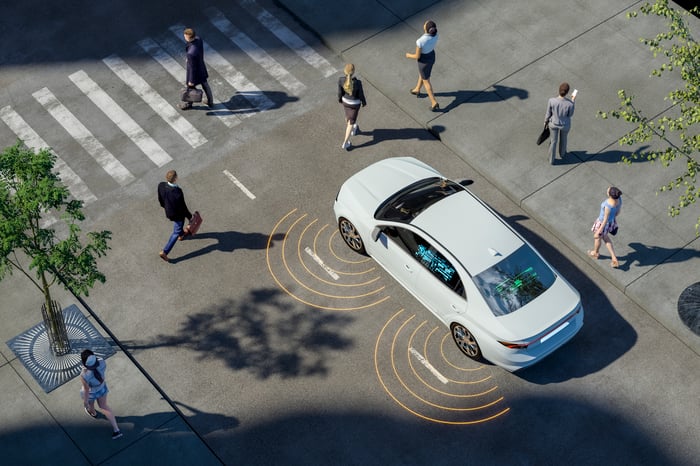
Image source: Getty Images.
Uber already has a distinct advantage over Tesla
Winning the autonomous ride-hailing race will require more than just a good self-driving car. It will take significant digital infrastructure, a user-friendly platform, and a network that customers trust to quickly provide a ride on demand. A company can't provide that timely service if it doesn't deploy enough cars -- but if it deploys too many cars, it will have an underutilized fleet that burns money.
Uber has 15 years of experience in all of those areas across most of the world's major cities. Its platform is so convenient that 189 million people use it every month (as of Sept. 30), and that number continues to grow. Tesla, on the other hand, still has to build an entire platform, network, and all associated infrastructure from scratch if it wants to compete in the ride-hailing space. Therefore, it's a long way behind before its Cybercab even hits the road.
Although Uber hasn't developed a car of its own, it used its immense scale to attract partnerships with over 20 companies in the autonomous industry. As the world's largest ride-hailing network, Uber can give those companies access to the most potential customers, and simply take a cut of every ride along the way.
Alphabet's Waymo is one of Uber's top partners, and it's already completing 450,000 paid autonomous trips every week across five U.S. cities. Another is Stellantis, which owns Chrysler, Jeep, Dodge, and other brands. It's building 5,000 robotaxis specifically for Uber's network, which will be powered by Nvidia's autonomous vehicle platform, which is called Drive Hyperion.
Simply put, Uber doesn't have to rely on the success of any single robotaxi design to dominate the autonomous ride-hailing market. By owning the world's largest network, it's positioning itself to win no matter which companies end up with the best cars. Tesla has a much steeper mountain to climb just to compete in this space, let alone succeed.
Uber is more attractively valued than Tesla (by a wide margin)
Uber's revenue grew by 17% during the first three quarters of 2025, whereas Tesla's revenue shrank by 3% over the same period due to declining sales in its flagship electric vehicle business. Nevertheless, Tesla stock is a whopping four times more expensive than Uber stock on a price-to-sales (P/S) basis, which doesn't make much sense.
Uber's P/S ratio is 3.6, whereas Tesla's is 16.1.
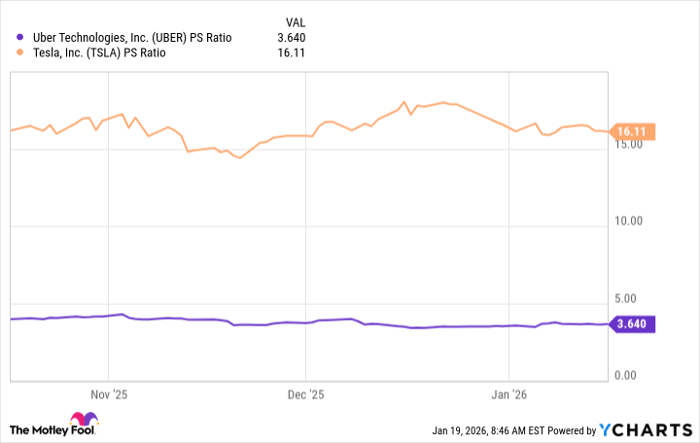
UBER PS Ratio data by YCharts
Tesla stock also trades at a sky-high price-to-earnings (P/E) ratio of 292, making it nine times more expensive than the Nasdaq-100 technology index. Therefore, it's a very difficult investment at the current price, independent of what Uber is doing.
Autonomous ride-hailing could transform Uber's financial results very quickly. During the third quarter of 2025 (ended Sept. 30), the company paid $22 billion to the 9.4 million drivers operating in its network, which was the single largest component of its $49.7 billion in gross bookings (the dollar amount customers spent on its platform). Self-driving robotaxis will reduce Uber's labor costs, resulting in more of its gross bookings converting into revenue (and profit).
Therefore, if autonomous ride-hailing does become a $10 trillion opportunity like Ark Invest expects, Uber's top and bottom line could be poised for explosive growth from here. Factor in Uber's much cheaper valuation, and I think it's a no-brainer buy over Tesla for investors who want exposure to this mobility revolution.
Should you buy stock in Uber Technologies right now?
Before you buy stock in Uber Technologies, consider this:
The Motley Fool Stock Advisor analyst team just identified what they believe are the 10 best stocks for investors to buy now… and Uber Technologies wasn’t one of them. The 10 stocks that made the cut could produce monster returns in the coming years.
Consider when Netflix made this list on December 17, 2004... if you invested $1,000 at the time of our recommendation, you’d have $474,578!* Or when Nvidia made this list on April 15, 2005... if you invested $1,000 at the time of our recommendation, you’d have $1,141,628!*
Now, it’s worth noting Stock Advisor’s total average return is 955% — a market-crushing outperformance compared to 196% for the S&P 500. Don't miss the latest top 10 list, available with Stock Advisor, and join an investing community built by individual investors for individual investors.
*Stock Advisor returns as of January 21, 2026.
Anthony Di Pizio has no position in any of the stocks mentioned. The Motley Fool has positions in and recommends Alphabet, Nvidia, Tesla, and Uber Technologies. The Motley Fool recommends Stellantis. The Motley Fool has a disclosure policy.
Mentioned In This Article
Latest News
| 1 hour | |
| 2 hours | |
| 3 hours | |
| 4 hours | |
| 5 hours | |
| 8 hours | |
| 10 hours | |
| Oct-08 | |
| Oct-08 | |
| Oct-08 | |
| Oct-08 | |
| Oct-08 | |
| Oct-08 | |
| Oct-08 | |
| Oct-08 |
