Ferrari Stock Has Been Hammered. Time to Buy?
Key Points
Fueled by the F80, Ferrari's revenue growth could reaccelerate in 2026.
The company has already allocated vehicle orders all the way into 2027.
To fuel its sales growth, Ferrari plans to lean more on enriching its product mix over the next five years than on production growth.
Shares of Ferrari (NYSE: RACE) have been hammered recently. Year to date, the stock is down about 9% as of this writing. And that's on top of its 13% decrease in 2025. Even more, shares are down 34% from an all-time high closing price of $517.65 in July of last year.
Ouch.
Where to invest $1,000 right now? Our analyst team just revealed what they believe are the 10 best stocks to buy right now. Continue »
With the stock down so substantially, is now a good time to buy? After all, Ferrari recently started sales of its F80 supercar. The high-priced vehicle could be a significant catalyst for both revenue and earnings growth in 2026 -- and possibly even in 2027 as well.
Here's a closer look at the stock, why it has suffered so much recently, and why buying the dip now might make sense.
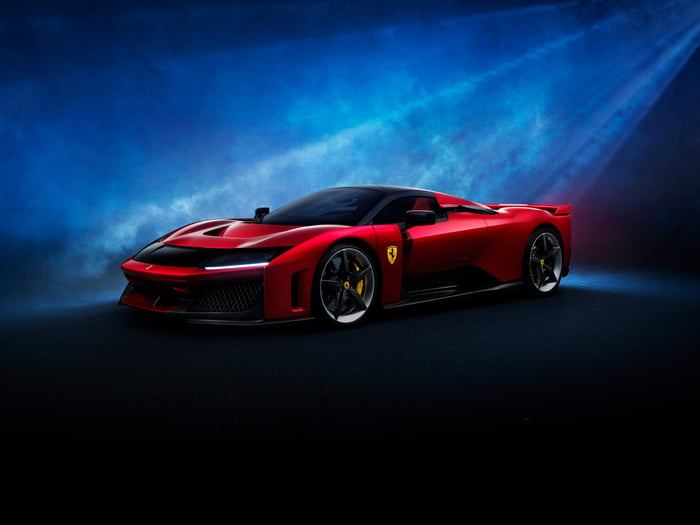
Ferrari F80 supercar. Image source: Ferrari.
Two big problems
Ferrari's stock has faced two major problems recently.
First and foremost, there were tariffs. When President Donald Trump announced tariffs in early 2025, investors feared this would have a significant impact on Ferrari's business. But in subsequent updates from the company, Ferrari explained that the impact of tariffs on its business was small. Still, a more uncertain geopolitical environment, prompted by tariffs, has weighed on sentiment for the stock.
The bigger issue for Ferrari stock, however, came at its 2025 Capital Market Day, where management laid out a growth plan that underwhelmed.
At its Capital Markets Day in October, management said it expected revenue to grow at an average annual rate of just 5% from the start of 2026 to the end of 2030. This spooked investors because it marked a significant slowdown from the sort of growth Ferrari has been delivering. For the full years of 2023 and 2024, for instance, Ferrari's revenue increased by 17.2% and 11.8%, respectively.
Even more concerning, management's forecast for slower growth builds on a trend of decelerating growth recently. Revenue rose at a rate of just 7.4% year over year in the third quarter of 2025, putting the company's trailing-9-month year-over-year revenue growth rate at about 8%.
Protecting the brand
Ferrari's conservative outlook (and even its slower growth more recently) is, however, not an accident. It is the business model.
Ferrari uses order allocation and production plans as tools to preserve exclusivity. In other words, Ferrari keeps production limited so that demand always exceeds supply. And it's working. Management said in the company's third-quarter earnings call that its order book extends out into 2027.
Additionally, there were no comments from management in Ferrari's Capital Markets Day that insinuated demand is slowing. On the contrary, the company's conservative plan seemed to reflect management's protection of Ferrari's pricing power and customer experience. Further, management implied during its Capital Markets Day that, since this plan covers a long-term five-year horizon, there is likely some conservatism baked into it so that Ferrari can ensure it delivers on its promises to shareholders.
Time to buy?
With all of this said, I do believe investors may have overreacted to what might initially seem like a disappointing five-year financial outlook. Not only does the company have a habit of exceeding its guidance, but Ferrari also has a major near-term catalyst for its business: The F80 supercar.
Priced at about $3.9 million, Ferrari quickly secured buyers for all 799 units it announced that it would sell. With deliveries of F80 expected to ramp up this year, these could have a significant impact on both Ferrari's revenue and earnings in 2026.
Overall, I think that with shares trading at a price-to-earnings ratio of about 32 as of this writing, this is a good time to buy the stock. Sure, this isn't a cheap valuation. But Ferrari is an enduring business with a proven brand and demand for its vehicles that continues to exceed supply.
Of course, there are some considerable risks, starting with valuation risk. If Ferrari's top-line annualized growth really does slow to levels close to 5% over the next five years, investors may no longer be willing to pay the same valuation premium for the stock they are paying today. In addition, with a luxury brand like Ferrari, there's always the risk that its pricing power erodes. This could not only pressure margins but also sales, since part of the reason customers buy Ferraris is their high resale value.
Even in light of these risks, however, I think a small position in the stock might make sense. Yes, management's forecast for Ferrari's business growth over the next five years is a bit weak. But this should let the company simultaneously overdeliver on its promises while carefully protecting an iconic brand.
Don’t miss this second chance at a potentially lucrative opportunity
Ever feel like you missed the boat in buying the most successful stocks? Then you’ll want to hear this.
On rare occasions, our expert team of analysts issues a “Double Down” stock recommendation for companies that they think are about to pop. If you’re worried you’ve already missed your chance to invest, now is the best time to buy before it’s too late. And the numbers speak for themselves:
- Nvidia: if you invested $1,000 when we doubled down in 2009, you’d have $475,482!*
- Apple: if you invested $1,000 when we doubled down in 2008, you’d have $47,113!*
- Netflix: if you invested $1,000 when we doubled down in 2004, you’d have $460,340!*
Right now, we’re issuing “Double Down” alerts for three incredible companies, available when you join Stock Advisor, and there may not be another chance like this anytime soon.
*Stock Advisor returns as of January 22, 2026.
Daniel Sparks and his clients have no position in any of the stocks mentioned. The Motley Fool recommends Ferrari. The Motley Fool has a disclosure policy.
Mentioned In This Article
Latest News
| Oct-07 | |
| Oct-05 | |
| Oct-05 | |
| Oct-01 | |
| Oct-01 | |
| Sep-29 | |
| Sep-28 | |
| Sep-25 | |
| Sep-24 | |
| Sep-21 | |
| Sep-20 | |
| Sep-19 | |
| Sep-17 | |
| Sep-14 | |
| Sep-11 |
