NextEra Energy vs. Southern Company: Which Is a Better Utility Pick?
Stocks in the Zacks Utility-Electric Power industry offer an attractive investment opportunity, supported by stable cash flows and the predictability of regulated business models. Most domestic utilities operate under long-term power purchase agreements, which help shield revenues from economic volatility. Rising electricity demand, along with ongoing capital investments, is improving operational efficiency, allowing these companies to deliver consistent earnings and maintain reliable dividend payments.
Let’s compare NextEra Energy Inc. NEE and The Southern Company SO, two of the most prominent U.S. electric utilities that are actively investing in renewable energy, making them pivotal players in the shift toward cleaner power generation. As efforts toward decarbonization accelerate, utilities that actively adopt renewable and low-carbon technologies are well positioned to benefit from reduced fuel cost volatility and expanded market access, enhancing their appeal to both institutional and retail investors.
NextEra Energy’s clean energy investments and strong growth prospects position it as a leading player in the utility sector. Its regulated utility business, Florida Power and Light, provides stable and reliable cash flows under a rate-regulated framework. At the same time, its unregulated subsidiary, NextEra Energy Resources, is a leader in wind and solar generation, supporting long-term growth through an expanding portfolio of renewable projects and battery storage solutions. Supported by a clear commitment to decarbonization, disciplined capital allocation and strong ESG performance, NextEra Energy is well-positioned to benefit as the energy sector transitions toward a cleaner future.
Southern Company offers dependable long-term value through its regulated utility operations and forward-looking clean energy investments. Supported by a diversified generation mix, a large customer base and a constructive regulatory environment, the company delivers stable earnings and consistent dividend growth. The company’s proactive decarbonization strategy, including investments in nuclear power and the integration of renewable energy, positions Southern Company well to manage and benefit from the ongoing energy transition.
As both companies are leading utility players, a closer look at their fundamentals can help identify which stock presents the more compelling investment opportunity.
NEE & SO’s Earnings Growth Projections
The Zacks Consensus Estimate for NextEra Energy’s earnings per share in 2026 indicates year-over-year growth of 7.99%. Long-term (three to five years) earnings growth per share is pegged at 8.08%.
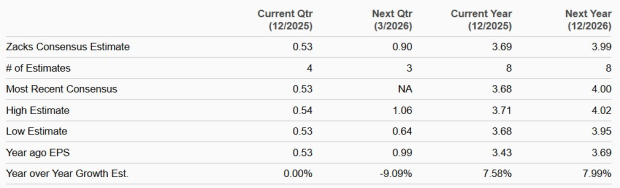
Image Source: Zacks Investment Research
The Zacks Consensus Estimate for Southern Company’s earnings per share in 2026 implies year-over-year growth of 6.82%. Long-term (three to five years) earnings growth per share is pegged at 7.23%.
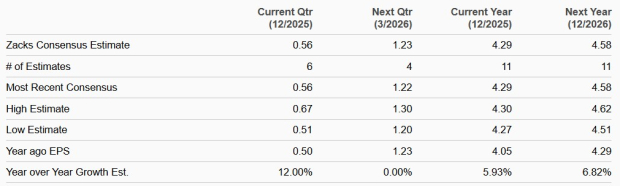
Image Source: Zacks Investment Research
Return on Equity
Return on Equity (ROE) is an essential financial indicator that evaluates a company’s efficiency in generating profits from the equity invested by its shareholders. It demonstrates how well management is utilizing the capital provided to increase earnings and deliver value.
NEE’s current ROE is 12.42% compared with SO’s 12.52%. Both companies outperform the industry’s ROE of 10.47%.
Valuation
NextEra Energy currently appears to be trading at a marginal premium compared with Southern Company on a Price/Earnings Forward 12-month basis. (P/E- F12M).
NEE is currently trading at 20.88X, while SO is trading at 19.36X compared with the industry’s 15.63X.
Debt to Capital
The Zacks Utilities sector is a capital-intensive one, and huge investments are required at regular intervals to upgrade, maintain and expand operations. The usage of new evolving technology also requires investments. Therefore, utilities borrow from the market and add it to their internal cash generation to fund the long-term investments. The decline in interest rate to 3.5% from 3.75% will be beneficial for the capital-intensive utilities.
NEE’s debt-to-capital currently stands at 59.04% compared with SO’s 65.34%.
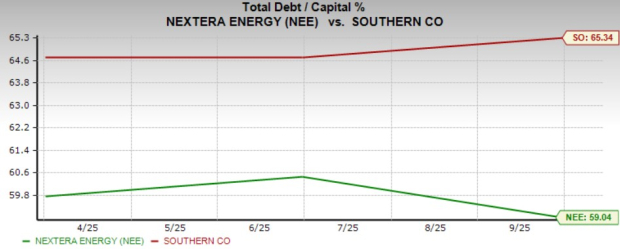
Image Source: Zacks Investment Research
NEE & SO’s Capital Investment
NextEra Energy plans more than $74 billion in capital investment through 2029 to expand clean energy capacity. Southern Company plans to invest $76 billion in capital expenditures through 2029 to strengthen its operations.
Both companies are investing in their generation to meet the rising demand, modernize the grid and upgrade the infrastructure to provide reliable round-the-clock electricity to customers.
NEE & SO’s Dividend Yield
Dividends are regular payments made by a company to its shareholders and represent a direct way for investors to earn a return on their investment. They are an important indicator of a company’s financial health and stability, often signaling strong cash flow and consistent earnings. Utilities are known for regular dividend payments to their shareholders.
Currently, the dividend yield for NextEra Energy is 2.71%, while the same for Southern Company is 3.32%.
Price Performance
Southern Company’s shares have lost 6.3% in the past six months against NextEra Energy’s rally of 15.2% and the industry’s return of 7.6%.
Price Performance (Six months)
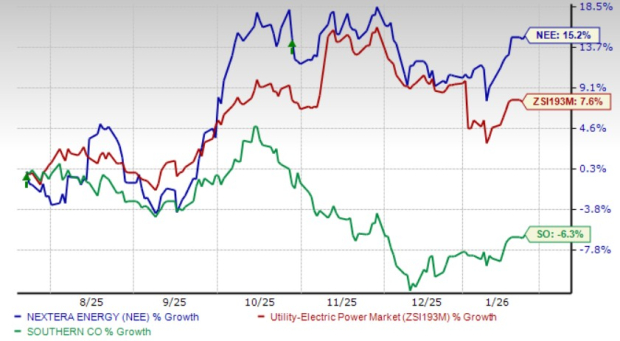
Image Source: Zacks Investment Research
Summing Up
NextEra Energy and Southern Company are strategically investing in their infrastructure to serve millions of customers more efficiently and reliably.
Per the above discussion, both these utilities are evenly matched in most of the metrics. Yet, NextEra Energy with the Zacks Rank #2 (Buy) has a marginal edge over SO, which has a Zacks Rank #4 (Sell).
NEE’s better growth in earnings estimates, comparatively lower debt usage and better price performance make it a better choice in the utility space.
You can see the complete list of today’s Zacks #1 Rank (Strong Buy) stocks here.
Want the latest recommendations from Zacks Investment Research? Today, you can download 7 Best Stocks for the Next 30 Days. Click to get this free report
NextEra Energy, Inc. (NEE): Free Stock Analysis Report
Southern Company (The) (SO): Free Stock Analysis Report
This article originally published on Zacks Investment Research (zacks.com).
Mentioned In This Article
Latest News
| Oct-14 | |
| Oct-14 | |
| Oct-14 | |
| Oct-12 | |
| Oct-12 | |
| Oct-12 | |
| Oct-11 | |
| Oct-10 | |
| Oct-09 | |
| Oct-09 | |
| Oct-09 | |
| Oct-09 | |
| Oct-09 | |
| Oct-09 | |
| Oct-08 |
