The Software Stock That Could Be 2026's Biggest Surprise
Key Points
Worries over Palantir's sky-high valuation and the prospect of a sweeping correction in AI stocks have dragged it down of late.
The stock's lethargy is likely to be temporary.
Investors need fresher evidence that the software outfit can continue grow its bottom line and continue to widen its profit margins.
It's been a less-than-thrilling past few months for investors in Palantir Technologies (NASDAQ: PLTR), but understandably so. Shares of the artificial intelligence software powerhouse remain outrageously valued at over 200 times 2025's expected profits of $0.72 per share. And investors are increasingly nervous that most AI stocks are in a bubble that's about to pop. That's certainly no recipe for bullishness.
However, the new year is now well underway, and we're seeing no concrete evidence yet that the artificial intelligence revolution isn't going to deliver as hoped, so Palantir's stock price may well perk up soon. If it does, one factor fanning those bullish flames will be the market's growing comprehension of how this particular software company's business model works.
Where to invest $1,000 right now? Our analyst team just revealed what they believe are the 10 best stocks to buy right now, when you join Stock Advisor. See the stocks »
Not reinventing the wheel
Developing and coding AI platforms like those that Palantir offers to its customers -- which range from AT&T to Novartis to the Department of Defense, to name just a few -- is neither easy, cheap, nor quick. Once those core software platforms are complete, though, deploying them for new customers is relatively easy with only modest tweaks. Thus, the more Palantir grows, the more profitable -- and higher margin -- its business becomes.

Image source: Getty Images.
We've already seen glimpses of this dynamic in its recent quarterly reports, in fact. For instance, Palantir's third-quarter revenue improved by 63% year over year to $1.18 billion. Its total cost of revenue only grew by 42%, however, while total operating expenses expanded to the tune of just 25%. End result? Operating income more than tripled, while net income more than doubled. (A markedly higher tax bill was the biggest drag on the bottom line's year-over-year change.)
In short, the company's operation appears to be at a financial tipping point.
The analyst community seems to think so anyway. Although its revenue growth is predicted to accelerate from here, profits are expected to grow at an even faster clip, from 2025's estimate of $0.72 per share all the way to $2.21 per share in 2029.
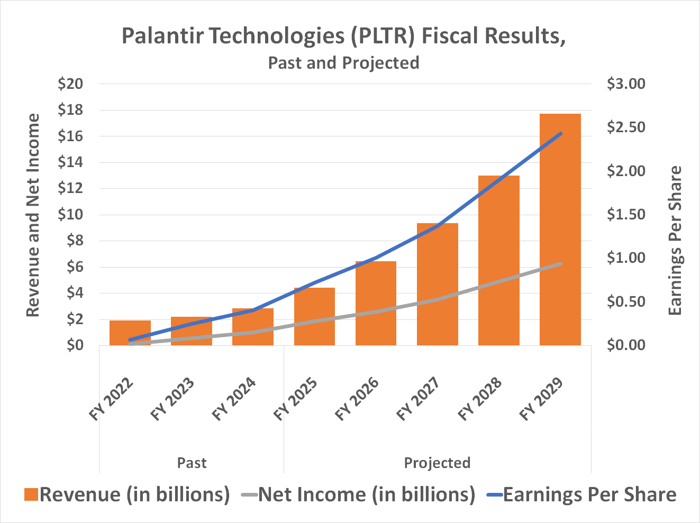
Data source: Morningstar. Chart by author.
Clear hope is enough
This doesn't exactly solve the stock's near-term valuation problem, of course. Palantir shares are priced at a frothy 112 times trailing sales, and a similarly lofty 172 times its projected 2026 profits. Investors were willing to shrug these numbers off for a while and instead focus on the company's compelling story. As time marches on, though, it's becoming increasingly difficult to ignore that it could take years for Palantir Technologies to grow into its currently speculative market cap.
The company doesn't need to do that overnight, though, or even do all of it in a single year. It only needs to demonstrate that its long-term profit-margin trajectory is steep enough to justify the stock's sizable premium in the meantime.
Although it's still plenty speculative, there's a great chance that more investors will recognize that trajectory in Palantir's widening margins at some point in 2026, and that they'll light a fire under the stock price as they do.
Should you buy stock in Palantir Technologies right now?
Before you buy stock in Palantir Technologies, consider this:
The Motley Fool Stock Advisor analyst team just identified what they believe are the 10 best stocks for investors to buy now… and Palantir Technologies wasn’t one of them. The 10 stocks that made the cut could produce monster returns in the coming years.
Consider when Netflix made this list on December 17, 2004... if you invested $1,000 at the time of our recommendation, you’d have $460,340!* Or when Nvidia made this list on April 15, 2005... if you invested $1,000 at the time of our recommendation, you’d have $1,123,789!*
Now, it’s worth noting Stock Advisor’s total average return is 937% — a market-crushing outperformance compared to 194% for the S&P 500. Don't miss the latest top 10 list, available with Stock Advisor, and join an investing community built by individual investors for individual investors.
*Stock Advisor returns as of January 22, 2026.
James Brumley has positions in AT&T. The Motley Fool has positions in and recommends Palantir Technologies. The Motley Fool has a disclosure policy.
Mentioned In This Article
Latest News
| Oct-09 | |
| Oct-09 | |
| Oct-09 | |
| Oct-09 | |
| Oct-09 | |
| Oct-09 | |
| Oct-09 | |
| Oct-09 | |
| Oct-09 | |
| Oct-08 | |
| Oct-08 | |
| Oct-08 | |
| Oct-08 | |
| Oct-08 | |
| Oct-08 |
