Why R&D Spending Is Central to Planet Labs' Long-Term Profitability
Planet Labs PL places strong emphasis on research and development (R&D) as a fundamental pillar of its long-term growth and competitiveness. Being a leading provider of Earth-imaging data and geospatial analytics, operating the largest fleet of Earth-observation satellites globally, continuous R&D makes its existence relevant.
PL classifies R&D expenses as costs incurred and attributable to advancing technology research, platform and infrastructure development and the research and development of new product iterations. R&D expenses were 41% of revenues in fiscal 2025.
Planet Labs relies on continuous innovation across satellite hardware, launch cadence, data infrastructure and analytics software to sustain its competitive edge. It aims to enhance the efficiency and technical performance of each satellite through ongoing R&D, while also investing in its software platform, machine learning tools, analytics applications, and next-generation satellite technologies. These efforts strengthen fleet operations and data collection capabilities, create incremental value for existing customers, and support expansion into new markets and customer segments.
As a result, R&D spending may rise in future periods, helping drive product differentiation and pricing power. Continued investment also enables Planet Labs to lower unit costs, extend satellite lifetimes, improve sensor quality, and optimize launch efficiency. Although near-term losses may continue, successful R&D can scale revenue base, supporting long-term margin expansion. Planet Labs also has a funded R&D initiative with Google, Project Suncatcher.
For Planet Labs, R&D is thus just not a discretionary cost. It is the engine that enables cost efficiency, pricing power, product differentiation and margin expansion.
What About Peers?
R&D expense is critical to the long-term competitiveness and profitability of both Rocket Lab RKLB and BlackSky Technology BKSY.
Rocket Lab’s R&D boosts launch reliability, reusability, and next-gen vehicles like Neutron, while advancing space systems and satellite components. These investments improve scale, broaden markets, and support long-term margin expansion.
BlackSky’s R&D strengthens rapid-revisit imaging, AI-driven analytics and real-time intelligence products, enhancing differentiation, pricing power, and customer ties across government and commercial sectors. Though R&D weighs on near-term earnings, it is vital for durable moats, operating leverage and sustainable profitability.
PL’s Price Performance
PL has gained 494.2% in a year, outperforming the industry.
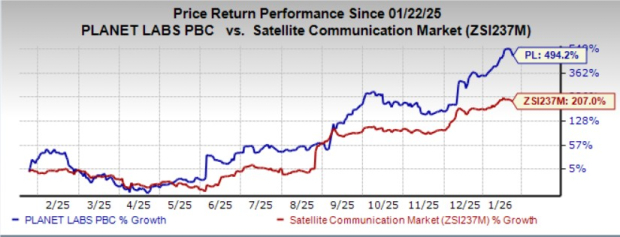
Image Source: Zacks Investment Research
PL’s Expensive Valuation
The stock is overvalued compared with its industry. It is currently trading at a price-to-sales multiple of 22.16, higher than the industry average of 2.39.
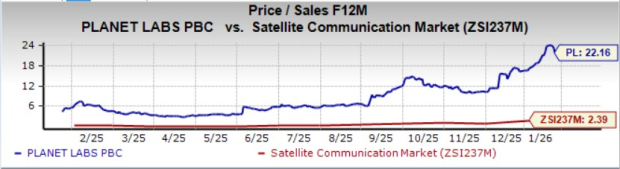
Image Source: Zacks Investment Research
No Estimate Movement for PL
The Zacks Consensus Estimate for PL’s fiscal fourth-quarter 2026 and fiscal first-quarter 2027 EPS witnessed no movement in the last 30 days. The same holds true for fiscal 2026 and 2027.

Image Source: Zacks Investment Research
The consensus estimates for PL’s 2026 and 2027 revenues and EPS indicate year-over-year increases.
PL stock currently carries a Zacks Rank #5 (Strong Sell).
You can see the complete list of today’s Zacks #1 Rank (Strong Buy) stocks here.
Want the latest recommendations from Zacks Investment Research? Today, you can download 7 Best Stocks for the Next 30 Days. Click to get this free report
Planet Labs PBC (PL): Free Stock Analysis Report
Rocket Lab Corporation (RKLB): Free Stock Analysis Report
BlackSky Technology Inc. (BKSY): Free Stock Analysis Report
This article originally published on Zacks Investment Research (zacks.com).
Mentioned In This Article
Latest News
| 6 hours | |
| 9 hours | |
| 9 hours | |
| 12 hours | |
| 12 hours | |
| 19 hours | |
| 20 hours | |
| Oct-08 | |
| Oct-07 | |
| Oct-06 | |
| Oct-05 | |
| Oct-02 | |
| Oct-02 | |
| Oct-02 | |
| Oct-02 |
