Alamos Gold Provides Exploration Update Across Key Projects Including Extending Mineralization Beyond Mineral Reserves at Lynn Lake and Intersecting High-Grade Mineralization at Qiqavik
All amounts are in United States dollars, unless otherwise stated.
TORONTO, Jan. 28, 2026 (GLOBE NEWSWIRE) -- Alamos Gold Inc. (TSX:AGI; NYSE:AGI) (“Alamos” or the “Company”) today reported new results from its 2025 exploration program at the Lynn Lake project in Manitoba, and the Qiqavik Gold project, located in Nunavik, Quebec, Canada. Drilling continues to extend and define new gold mineralization at both projects.
“Our 2025 exploration program was successful across our assets supporting both our near and longer-term growth initiatives. Our success at Lynn Lake is expected to drive additional Mineral Reserve and Mineral Resource growth and highlight the potential for further production upside over the life of the project. At Qiqavik, our first year of drilling on the project intersected high-grade gold mineralization across multiple targets demonstrating the potential for a significant discovery in the underexplored region. Both projects are important elements of our strategy of developing a pipeline of projects that can support sustainable organic growth over the longer-term,” said John A. McCluskey, President and Chief Executive Officer.
Lynn Lake Project Exploration Highlights
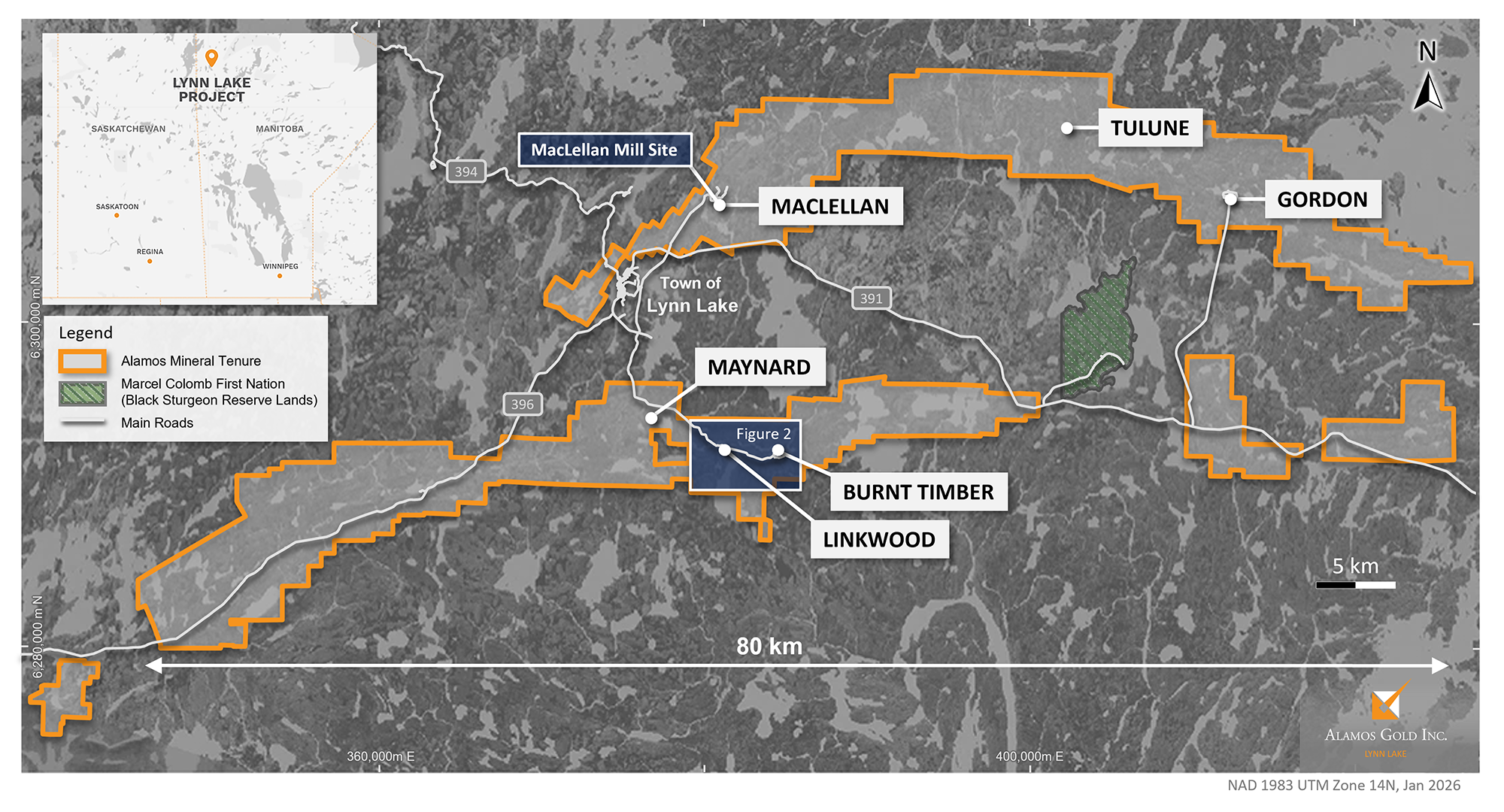
Drilling over the past year has been focused on the Linkwood and Burnt Timber (“BT”) satellite deposits. As outlined in the February 2025 internal study (“2025 Study”), the Linkwood and BT deposits are expected to leverage the infrastructure being constructed for the Lynn Lake project and provide a source of additional mill feed (Figure 1). This is expected to extend the mine life of the combined Lynn Lake project, increase longer term production rates by deferring the processing of lower grade stockpiles, and enhance its economics.
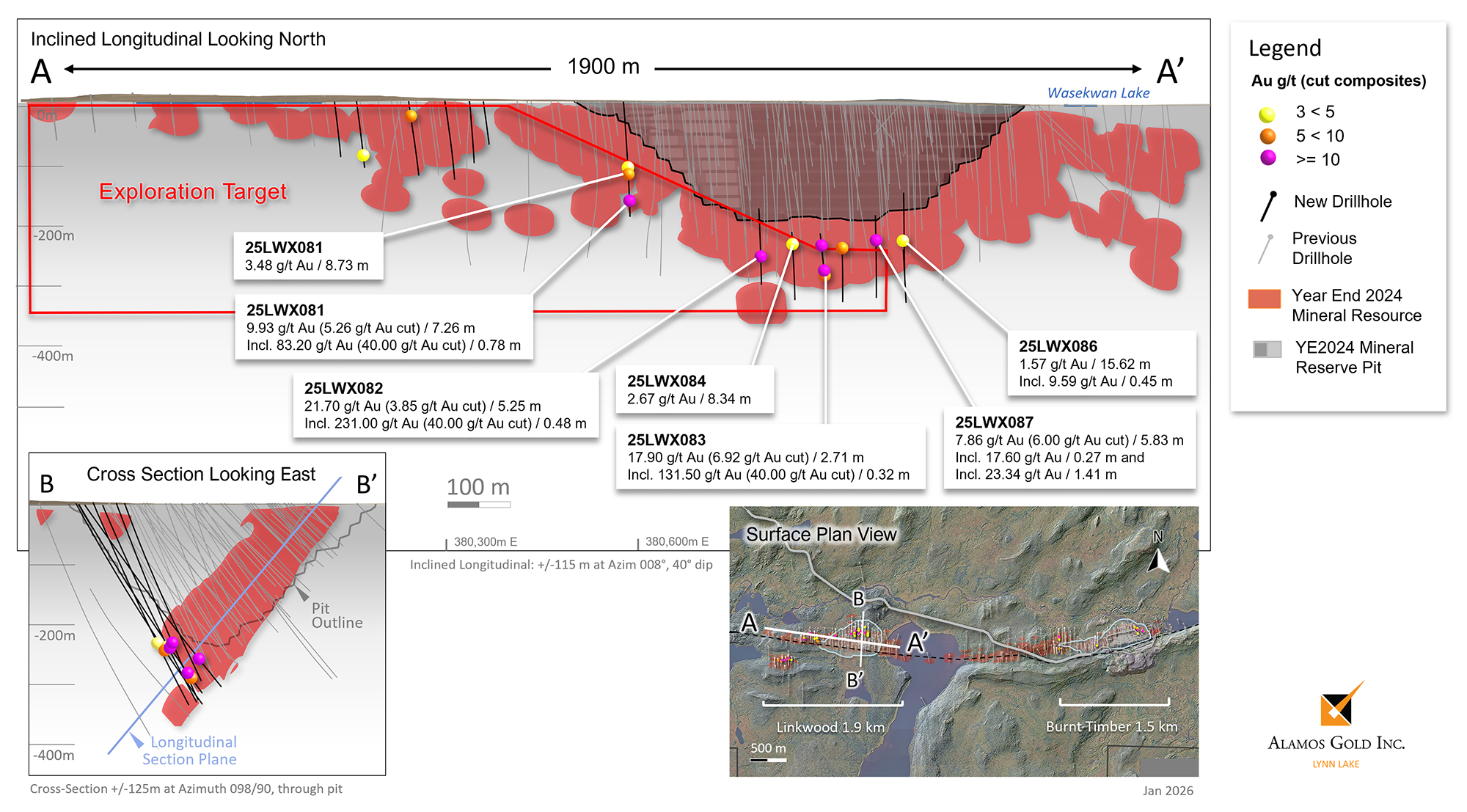
Exploration drilling over the past year has successfully extended mineralization beyond Mineral Reserves utilized in the 2025 Study at both Linkwood and BT. This is expected to contribute to another year of Mineral Reserve and Mineral Resource growth at both deposits, highlighting further upside to the combined project. New highlights include1 (Figure 2 and 3, Table 1):
Linkwood:
- 21.70 g/t Au (3.85 g/t Au cut) over 5.25 m (25LWX082) including;
- 231.00 g/t Au (40.00 g/t Au cut) over 0.48 m.
- 9.93 g/t Au (5.26 g/t Au cut) over 7.26 m (25LWX081) including;
- 83.20 g/t Au (40.00 g/t Au cut) over 0.78 m.
- 7.86 g/t Au (6.00 g/t Au cut) over 5.83 m (25LWX087) including;
- 17.60 g/t Au over 0.27 m; and
- 23.34 g/t Au over 1.41 m.
- 3.48 g/t Au over 8.73 m (25LWX081); and
- 1.57 g/t Au over 15.62 m (25LWX086) including;
- 9.59 g/t Au over 0.45 m.
East Foster:
- 27.68 g/t Au (3.38 g/t Au cut) over 6.26 m (25LWX070) including;
- 356.00 g/t Au (40.00 g/t Au) over 0.48 m.
- 1.05 g/t Au over 16.19 m (25LWX066); and
- 3.19 g/t Au over 5.12 m (25LWX072) including;
- 16.45 g/t Au over 0.98 m.
- 16.45 g/t Au over 0.98 m.
Burnt Timber:
- 2.77 g/t Au over 13.04 m (25BTX073);
- 1.52 g/t Au over 15.76 m (25BTX082);
- 1.46 g/t Au over 15.71 m (25BTX082) including;
- 6.86 g/t Au over 0.64 m; and
- 8.77 g/t Au over 0.49 m; and
- 1.96 g/t Au over 8.25 m (25BTX074) including;
- 18.15 g/t Au over 0.65 m.
- 18.15 g/t Au over 0.65 m.
1Linkwood and Burnt Timber primary gold composites are generated using a 0.5 g/t Au cut-off over ≥5.0 m core length. Select composite intervals reported are ≥10 g*m and do not include more than 5.0 m of internal waste. Drillhole composite intervals reported as “cut” include higher grade samples which have been cut to 40 g/t Au. All reported composite widths are estimated true width of the mineralized zones.
Qiqavik Project Exploration Highlights
The 2025 drill program at Qiqavik was the first completed by Alamos since acquiring the asset in 2024. Drilling in all five target areas intersected gold mineralization, with 72% of the holes reporting gold grades above 1.0 grams per tonne of gold (“g/t Au”) (Table 3). Additionally, the program successfully intersected gold mineralization associated with several previously identified high-grade gold boulder trends, confirming proximal bedrock sources and short glacial transport distances.
The success of this early-stage greenfield drilling program across multiple target areas continues to support the significant gold endowment potential of the Qiqavik Project. New highlights from the 2025 exploration drilling program include1 (Figure 4, Table 3):
Avinngaq Target:
- 54.44 g/t Au over 2.10 m (25QKX009) including;
- 80.00 g/t Au over 1.00 m.
- 1.75 g/t Au over 12.70 m (25QKX011) including;
- 26.80 g/t Au over 0.37 m.
- 3.07 g/t Au over 8.10 m (25QKX014) including;
- 10.33 g/t Au over 1.15 m.
Focused Target:
- 36.10 g/t Au over 0.65 m (25QKX004).
Kuulti Target:
- 2.06 g/t Au over 14.95 m, (25QKX020) including;
- 11.35 g/t Au over 1.20 m.
Gerfaut Target:
- 4.10 g/t Au over 3.85 m (25QKX026) including;
- 17.15 g/t Au over 0.80 m; and
- 2.10 g/t Au over 10.85 m, (25QKX026) including;
- 12.80 g/t Au over 0.75 m.
1Qiqavik gold composites are generated using a 0.5 g/t Au cut-off with no minimum core length applied. All reported composite widths are core length.
Lynn Lake 2025 Exploration Program
A total of $3.4 million was spent on exploration at Lynn Lake in 2025 with the focus on Mineral Resource expansion drilling at both Linkwood and BT. A total of 7,268 metres (“m”) of drilling was completed in 41 holes.
As reported on February 18, 2025, total Mineral Reserves for the Lynn Lake District increased 42% to 3.3 million ounces grading 1.29 g/t Au (80.1 mt). The increase was driven by the successful conversion of Mineral Resources to Reserves at Linkwood and BT in 2024 resulting in an initial Mineral Reserve of 0.9 million ounces grading 0.95 g/t Au (31 mt).
Linkwood and BT are satellite deposits to the Lynn Lake project and are expected to provide additional mill feed. The deposits are accessible by an all-season gravel road from Highway 397, approximately 28 km from the planned MacLellan mill. An internal economic study on Burnt Timber and Linkwood was released on February 13, 2025, outlining an attractive, low capital, high-return project. Linkwood and BT are expected to extend the mine life of the Lynn Lake project to 27 years (from 17), increase longer term rates of production, and enhance the overall economics.
There is significant potential to continue expanding mineralization beyond the currently defined Mineral Reserve pits at both Linkwood and BT. Additionally, the East Foster target is located in proximity to the Linkwood deposit one kilometre (“km”) to the southwest representing an additional potential satellite deposit with mineralization open at depth and along strike. East Foster occurs along an east-west trending splay of the Johnson shear zone with mineralization occurring within silicified felsic dykes intruding carbonate and biotite altered mafic volcanic rock.
The 2025 drill program at Linkwood was successful in extending mineralization to the west, and below the Mineral Reserve pit. The deposit remains open at depth and to the west, with the extent of the Mineral Reserve pit at depth having been defined by the limit of historical drilling. At BT, drilling was successful in extending mineralization to both the west of, and below the eastern extent of the Mineral Reserve pit. This is expected to contribute to another year of growth in Mineral Reserves and Mineral Resources at both deposits which represents further upside to the Lynn Lake project.
New highlights include (Figure 2 and 3, Table 1):
Linkwood:
- 21.70 g/t Au (3.85 g/t Au cut) over 5.25 m (25LWX082) including;
- 231.00 g/t Au (40.00 g/t Au cut) over 0.48 m.
- 9.93 g/t Au (5.26 g/t Au cut) over 7.26 m (25LWX081) including;
- 83.20 g/t Au (40.00 g/t Au cut) over 0.78 m.
- 7.86 g/t Au (6.00 g/t Au cut) over 5.83 m (25LWX087) including;
- 17.60 g/t Au over 0.27 m; and
- 23.34 g/t Au over 1.41 m.
- 3.48 g/t Au over 8.73 m (25LWX081);
- 1.57 g/t Au over 15.62 m (25LWX086) including;
- 9.59 g/t Au over 0.45 m.
- 2.67 g/t Au over 8.34 m (25LWX084);
- 17.90 g/t Au (6.92 g/t Au cut) over 2.71 m (25LWX083) including;
- 131.50 g/t Au (40.00 g/t Au cut) over 0.32 m.
- 3.53 g/t Au over 5.13 m (25LWX075) including;
- 34.10 g/t Au over 0.52 m.
- 3.53 g/t Au over 4.74 m (25LWX085);
- 1.71 g/t Au over 8.30 m (25LWX086);
- 2.76 g/t Au over 4.97 m (25LWX077);
- 4.71 g/t Au over 2.79 m (25LWX083) including;
- 14.55 g/t Au over 0.13 m;
- 17.95 g/t Au over 0.25 m; and
- 12.25 g/t Au over 0.25 m.
- 2.48 g/t Au over 4.69 m (25LWX088);
- 2.17 g/t Au over 4.99 m (25LWX072);
- 2.05 g/t Au over 5.09 m (25LWX081);
- 1.14 g/t Au over 8.92 m (25LWX083);
- 1.67 g/t Au over 6.08 m (25LWX080); and
- 1.25 g/t Au over 8.07 m (25LWX082).
East Foster:
- 27.68 g/t Au (3.38 g/t Au cut) over 6.26 m (25LWX070) including;
- 356.00 g/t Au (40.00 g/t Au) over 0.48 m.
- 1.05 g/t Au over 16.19 m (25LWX066);
- 3.19 g/t Au over 5.12 m (25LWX072) including;
- 16.45 g/t Au over 0.98 m; and
- 2.04 g/t Au over 5.07 m (25LWX073).
Burnt Timber:
- 2.77 g/t Au over 13.04 m (25BTX073);
- 1.52 g/t Au over 15.76 m (25BTX082);
- 1.46 g/t Au over 15.71 m (25BTX082) including;
- 6.86 g/t Au over 0.64 m; and
- 8.77 g/t Au over 0.49 m.
- 1.96 g/t Au over 8.25 m (25BTX074) including;
- 18.15 g/t Au over 0.65 m.
- 1.11 g/t Au over 14.99 m (25BTX079);
- 2.65 g/t Au over 5.70 m (25BTX075); and
- 1.24 g/t Au over 9.30 m (25BTX082).
Exploration upside underground at MacLellan and Gordon
The MacLellan and Gordon deposits remain open at depth with high-grade mineralization intersected historically through the limited drilling that has been completed below the current Mineral Reserve pits. This represents a potential opportunity for underground mining as a source of higher-grade mill feed for the Lynn Lake project. In the current life of mine plan for the Lynn Lake Gold Project, the Gordon open pit mining ends in year five. The 2026 exploration drilling program will focus on continuing to evaluate the potential for higher-grade mineralization below the Reserve pits that could be a potential source of underground ore for the MacLellan Mill, once open pit mining is completed.
The MacLellan deposit previously operated as an underground mine between 1986 and 1989 and reportedly produced 141,912 oz of gold from 969,680 tonnes of ore, grading 5.36 g/t Au. The Gordon deposit previously operated between 1996 and 1999 as two high-grade open pits, known as the Farley Lake Gold Mine, and reportedly produced 214,800 oz of gold from 1.7 mt of ore grading 3.92 g/t Au. Highlights from previous drilling below the Mineral Reserve pits include2:
MacLellan:
- 3.37 g/t Au over 60.00 m (10075-1) including;
- 9.46 g/t Au over 2.00 m; and
- 16.62 g.t Au over 2.06 m.
- 9.29 g/t Au over 20.00 m (MG08-16A) including;
- 17.46 g/t Au over 9.00 m.
- 9.69 g/t Au over 18.29 m (MU242) including;
- 16.80 g/t Au over 4.13 m; and
- 30.70 g/t Au over 1.46 m.
- 9.11 g/t Au over 18.42 m (MU206) including;
- 30.42 g/t Au over 1.73 m.
- 4.55 g/t Au over 31.00 m (MG08-17) including;
- 13.19 g/t Au over 3.00 m.
- 9.13 g/t Au over 14.22 m (MU236) including;
- 41.50 g/t Au over 1.11 m; and
- 6.28 g/t Au over 19.07 m (MU249) including;
- 11.01 g/t Au over 7.52 m.
Gordon:
- 7.79 g/t Au over 30.00 m (FL12-25) including;
- 9.88 g/t Au over 6.4 m; and
- 15.26 g/t Au over 3.00 m.
- 5.44 g/t Au over 18.00 m (FL13-15) including;
- 9.79 g/t Au over 5.00 m.
- 4.28 g/t Au over 17.29 m (654-342) including;
- 23.12 g/t Au over 2.13 m.
- 5.88 g/t Au over 10.00 m (FL12-02) including;
- 13.51 g/t Au over 3.00 m; and
- 7.70 g/t Au over 6.60 m (FL13-09) including;
- 10.54 g/t Au over 4.60 m.
- 10.54 g/t Au over 4.60 m.
2MacLellan and Gordon primary gold composites are generated using a 1 g/t Au cut-off over ≥5.0 m core length and do not include more than 5.0 m of internal waste.
Significant regional exploration potential
The Lynn Lake project encompasses most of the east-west trending Lynn Lake Greenstone Belt in northwestern Manitoba, of which Alamos has a total of 58,000 hectares (“ha”) of mineral tenure covering 80 km of strike length, representing significant exploration potential including the Maynard and Tulune regional targets.
The Maynard target is located 8 km northwest of the Burnt Timber deposit, and 20 km by road from the proposed MacLellan mill. Through additional drilling and exploration, Maynard has the potential to become an additional satellite deposit, and future source of mill feed, similar to Burnt Timber and Linkwood. Significant gold mineralization has been extended over a 750 m strike length and to a depth of 330 m. Alamos drilled a total of 24 holes within the Maynard target between 2022 and 2024, with all holes intersecting gold mineralization, including previously reported higher grade intercepts such as 5.87 g/t Au over 11.88 m, including 13.81 g/t Au over 2.80 m, and 20.29 g/t Au over 1.22 m (23LLX066).
Tulune is a greenfields discovery made in 2020 and is located between the Gordon and MacLellan deposits. Between 2020 and 2023, drilling extended broad zones of near surface gold mineralization over a 2 km strike length. All 29 holes drilled within the granite and granodiorite have intersected gold mineralization.
Qiqavik Project Overview and 2025 Exploration Program
Project Overview
In April 2024, Alamos announced the acquisition of Orford Mining Corporation, and its 100% owned Qiqavik Gold Project in Nunavik, Quebec. The acquisition was consistent with the strategy of building out a pipeline of high-quality, long-term projects to complement the Company’s near-term organic growth projects in Canada.
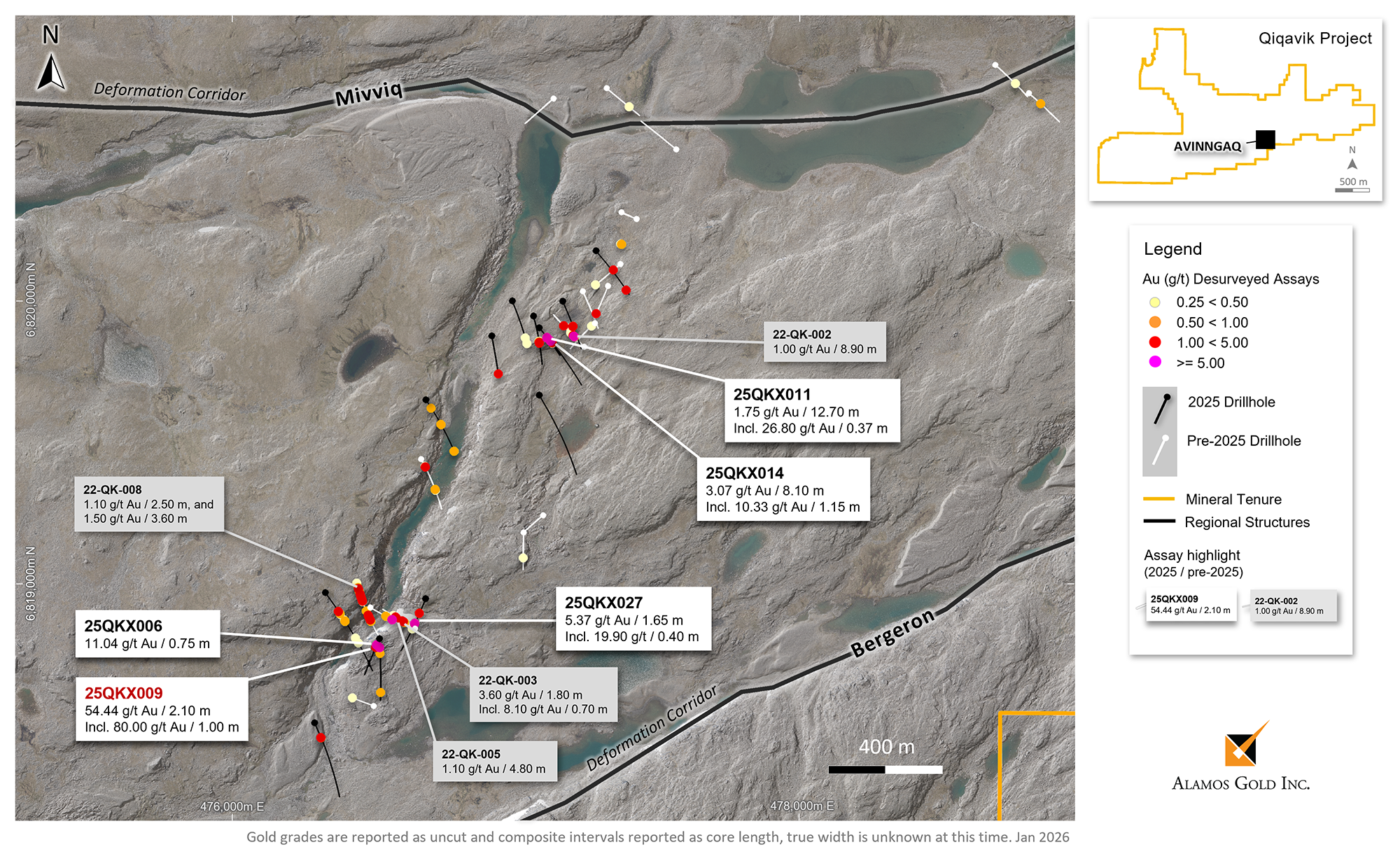
The Qiqavik Gold Project is a district-scale, greenfield exploration project covering 63,400 ha in the Cape Smith Greenstone Belt (“CSB”). The Property encompasses more than 40 km of strike length within the Parent Volcano‑Sedimentary Group (“Parent Group”) which is crosscut by several major crustal‑scale deformation corridors, including the Bergeron, Qiqavik, and Mivviq shear zones which are interpreted to be a primary control on the distribution of gold mineralization across the CSB (Figure 4).
Early‑stage exploration has indicated that clusters of high‑grade gold boulders are spatially associated with second and third structures proximal to the major shear zones and structural corridors, highlighting the potential for multiple prospective target areas across the property.
2025 Exploration Program
The 2025 drill program consisted of 29 drill holes totalling 8,736 m across five target areas (Figure 4). Drilling in all five target areas returned gold values, with 72% of all the 2025 holes drilled reporting gold grades above 1.0 g/t Au (Table 3).
Including the 2025 program, drilling completed on the Qiqavik Property now totals 19,687 m. Of this, 10,951 m were completed between 2018 and 2024, targeting gold mineralization. Prior to 2018, only 400 metres of drilling had been completed on the property by Falconbridge in 1996, testing a potential nickel target in the Gerfaut area. That drilling intersected gold mineralization, including 4.01 g/t Au over 3.85 metres. Gold mineralization was associated with sulphide stringers hosted within sheared ultramafic and mafic rocks.
The success of the early-stage greenfield drilling across five target areas further reinforces the strong gold endowment and district-scale potential of the Qiqavik Project. The 2025 program intersected gold mineralization associated with several high-grade gold boulder dispersal trends identified through prospecting from 2016 to 2024. Drilling confirmed the bedrock source areas of these dispersal trains, validating the interpretation of short glacial transport distances derived from recent Quaternary mapping on the property.
Avinngaq Target
At the Avinngaq target, 14 diamond drill holes totaling 4,218 m were completed in 2025. Drilling tested the area situated between the Bergeron and Mivviq structural corridors - two major, sub-parallel, east–west–striking, steeply north-dipping fault systems.
The Avinngaq Boulder Trend, defined through prospecting from 2019 to 2024, is an approximately 3 km long, 50 m wide corridor of high-grade boulders oriented north-northeast, subparallel to the dominant glacial transport direction. “Avinngaq-style” boulders are typically angular, up to 2.0 m in size, and characterized by smoky-grey quartz containing centimetre-scale veins of massive pyrite +/- arsenopyrite, sphalerite, and galena. Grab samples from the trend returned assays of up to 648.00 g/t Au.
The 2025 drill program successfully identified two distinct bedrock sources of Avinngaq-style gold mineralization. Holes 25QKX006 and 25QKX009 (Figures 4 to 6) successfully intersected high-grade gold mineralization 30 m and 40 m, respectively below a surface showing discovered in 2025. Hole 25QKX027 was drilled as a step-out hole, 200 m northeast from the surface showing, and also intersected gold mineralization. New highlights include:
- 54.44 g/t Au over 2.10 m (25QKX009) including;
- 80.00 g/t Au over 1.00 m.
- 11.04 g/t Au over 0.75 m (25QKX006); and
- 5.39 g/t Au over 1.65 m (25QKX027) including;
- 19.90 g/t Au over 0.40 m.
- 19.90 g/t Au over 0.40 m.
Approximately 1.25 km to the north, holes 25QKX011 and 25QKX014 were drilled as 75 m step outs to the west of a 2022 drill hole, 22-QK-002, which intersected 1.00 g/t over 8.90 m. New highlights include:
- 1.75 g/t Au over 12.70 m (25QKX011) including;
- 26.80 g/t Au over 0.37 m; and
- 3.07 g/t Au over 8.10m (25QKX014) including;
- 10.33 g/t Au over 1.15 m.
Further drilling is planned for 2026 to follow up on the results from the 2025 program, with a focus on defining the geometry and extent of the mineralized structures and determining the plunge of the mineralized shoots. Early-stage results across this large target area (0.7 km × 2.0 km) suggest the presence of a broader, potentially extensive gold system with multiple mineralized targets or shoots within the Avinngaq area.
Kuulti Target
The Kuulti Boulder Trend is approximately 700 m long and 50 m wide, characterized primarily by angular white quartz boulders, locally up to a metre in size. Many of these boulders contain visible gold and have returned assays exceeding 600 g/t Au.
The largest boulders are angular and tabular, indicating minimal transport and suggesting a proximal bedrock source. The up-ice termination of the boulder dispersal trend coincides with the northern margin of the Mivviq deformation corridor, which is up to approximately 800 m wide in this area. Fieldwork completed in 2025 significantly expanded the known width of the Kuulti boulder corridor from 50 m to 250 m, suggesting a potentially larger bedrock source for the boulders.
The 2025 drill program included six holes totaling 1,743 m (Table 3), designed to identify the bedrock source of the Kuulti boulders. Five of the six holes intersected gold mineralization, and two holes (25QKX018 and 25QKX020) intersected milky-white quartz veins containing visible gold and arsenopyrite. These veins share several mineralogical and textural characteristics with the Kuulti-style boulders; however, the lower grades and reduced abundance of visible gold in core suggest that a higher-grade portion of the system may lie nearby.
New highlights from holes 25QKX018 and 25QKX020 include:
- 2.06 g/t Au over 14.95 m (25QKX020) including;
- 11.35 g/t Au over 1.20 m; and
- 2.11 g/t Au over 4.05 m (25QKX020) including;
- 9.23 g/t Au over 0.30 m.
The 2026 program will focus on further testing the Mivviq deformation corridor and stepping out from the gold mineralization intersected in the 2025 program, with the objective of defining the bedrock source of the high-grade, metre-sized boulders identified within the Kuulti boulder dispersal train.
Focused Target
Within the Focused area, the primary target tested during the 2025 program was a high-grade quartz boulder train that was discovered during the 2024 field program. The boulder train is semi-continuous over a strike length of 400 m, and trends approximately east–west, which is at a high angle to the regional ice-flow direction. The quartz boulders are angular to subangular, generally less than 1.0 m in size, with variable visible gold, pyrite, +/- sphalerite, galena, and chalcopyrite. Assays from surface boulders returned values of up to 528 g/t Au.
Six diamond drill holes, totaling 1,851 m, were completed within the broader Focused target area in 2025 with the below holes specifically targeting the high-grade, quartz boulder train. Drilling successfully intersected high-grade gold mineralization in a quartz vein with visible gold, which is consistent with the characteristics of the boulders. New highlights include:
- 36.10 g/t Au over 0.65 m (25QKX004);
- 1.89 g/t Au over 1.35 m (25QKX005) including;
- 6.42 g/t Au over 0.30 m; and
- 2.38 g/t Au over 0.40 m (25QKX010).
These results confirm that the frost‑heaved boulder trend is proximal to the bedrock source, indicating the boulders are frost-heaved with limited glacial transport.
Gerfaut Target
Hole 25QKX026 was drilled as a 5 m step out on historical hole PAR96-01, which was completed by Falconbridge in 1996 to test a potential nickel target identified from an airborne EM conductor. Falconbridge’s PAR96-01 hole intersected 4.10 g/t Au over 3.85 m (93.35–97.2 m), including 16.7 g/t Au over 0.8 m, and 7.3 g/t Au over 1.95 m (127.45–129.4 m), including 13.55 g/t Au over 0.75 metres. No follow up drilling was completed at this target until 2025.
Drill hole 25QKX026 was successful in confirming the presence of the historically reported gold values. Gold mineralization is associated with sulphide stringers hosted within sheared ultramafic and mafic rocks.
New highlights include:
- 4.10 g/t Au over 3.85 m (25QKX026) including;
- 17.15 g/t Au over 0.80 m; and
- 2.10 g/t Au over 10.85 m (25QKX026) including;
- 12.80 g/t Au over 0.75 m.
Tasitigut Target
One hole, 25QKX029, was drilled at Tasitigut at the end of the 2025 program. Due to time constraints, the hole was stopped at 234 m and did not reach its planned 300-metre target depth within the Tasitigut shear zone. However, the hole did intersect shear-hosted quartz veins with gold mineralization, returning 1.03 g/t Au over 0.50 m, 1.18 g/t Au over 0.40 m, 0.89 g/t Au over 1.00 m, and 0.66 g/t Au over 0.35 m (Table 3). The hole is planned to be extended as part of the 2026 drill program to test the Tasitigut shear zone.
Quality Assurance and Quality Control
Alamos Gold maintains an internal Quality Assurance / Quality Control (QA/QC) program at the Qiqavik Project to ensure sampling and analysis of all exploration work is conducted in accordance with best practices.
Drill core is logged and sampled at Alamos’ core logging facilities under the supervision of a Qualified Geologist. A geologist marks the individual samples for analysis, and sample intervals, sample numbers, standards and blanks are entered into the database. Exploration core is cut in half using an electric core saw equipped with a diamond tipped blade. Individual samples are zip tied in a plastic sample bag, and samples are placed in rice bags.
For the Lynn Lake Project, core samples are transported to ALS in Winnipeg for preparation, followed by analysis in Vancouver. For the Qiqavik Project, sample shipments are sealed and shipped to ALS Laboratories, Rouyn-Noranda, Québec.
All gold assays reported were obtained by standard fire assay on 50-gram nominal weight with an atomic absorption spectroscopy finish or by gravimetric finish in the case of overlimit.
Gold is analyzed by a 50 gram fire assay with an Atomic Absorption (AA) finish. Samples greater than 5 g/t Au are re-analyzed using gravimetric finish methods. ALS is a certified laboratory and has internal quality control (“QC”) programs that include insertion of laboratory blanks, reference materials, and pulp duplicates.
The Corporation inserts QC samples (blanks and reference materials) at regular intervals to monitor laboratory performance. Cross check assays are completed on a regular basis in a secondary accredited laboratory.
Qualified Persons
Scott R.G. Parsons, P.Geo., FAusIMM, Alamos Gold’s Vice President, Exploration, has reviewed and approved the scientific and technical information contained in this news release. Scott R.G. Parsons is a “Qualified Person” as defined by Canadian Securities Administrators’ National Instrument 43-101 - Standards of Disclosure for Mineral Projects.
Exploration programs at Lynn Lake are directed and supervised by Carolyn Hudek, P.Geo, and Matthew Osborne, P.Geo., Exploration Superintendents at the Lynn Lake Project. Both Carolyn Hudek and Matthew Osborne are a “Qualified Person” as defined by Canadian Securities Administrators’ National Instrument 43-101 - Standards of Disclosure for Mineral Projects.
Exploration programs at the Qiqavik Project are supervised by Marie Letourneau, P.Geo., Senior Geologist for the Qiqavik Project. Marie Letourneau is a “Qualified Person” as defined by Canadian Securities Administrators’ National Instrument 43-101 - Standards of Disclosure for Mineral Projects.
About Alamos
Alamos is a Canadian-based intermediate gold producer with diversified production from three operations in North America. This includes the Island Gold District and Young-Davidson mine in northern Ontario, Canada, and the Mulatos District in Sonora State, Mexico. Additionally, the Company has a strong portfolio of growth projects, including the Phase 3+ Expansion at Island Gold, and the Lynn Lake project in Manitoba, Canada. Alamos employs more than 2,400 people and is committed to the highest standards of sustainable development. The Company’s shares are traded on the TSX and NYSE under the symbol “AGI”.
FOR FURTHER INFORMATION, PLEASE CONTACT:
Scott K. Parsons
Senior Vice President, Corporate Development & Investor Relations
(416) 368-9932 x 5439
Khalid Elhaj
Vice President, Business Development & Investor Relations
(416) 368-9932 x 5427
ir@alamosgold.com
The TSX and NYSE have not reviewed and do not accept responsibility for the adequacy or accuracy of this release.
Cautionary Note
This news release contains or incorporates by reference “forward-looking statements” and “forward-looking information” as defined under applicable Canadian and U.S. securities laws. All statements in this news release, other than statements of historical fact, which address events, results, outcomes or developments that the Company expects to occur are, or may be deemed to be, forward-looking statements and are generally, but not always, identified by the use of forward-looking terminology such as “future”, “expect”, “assume”, “anticipate”, “potential”, “proposed”, “plan”, “estimate”, “continue”, “evaluating”, “target”, “opportunity” or variations of such words and phrases and similar expressions or statements that certain actions, events or results “may”, “could”, “would”, “might” or “will” be taken, occur or be achieved or the negative connotation of such terms. Forward-looking statements contained in this news release are based on information, expectations, estimates and projections as of the date of this news release.
Forward-looking statements in this news release include, but may not be limited to, information as to the Company’s long-term growth strategy, plans, expectations or future financial or operating performance pertaining to, or anticipated to result from, the Qiqavik Gold Project and the Lynn Lake Project (including and the Burnt Timber, and Linkwood, MacLellan and Gordon Deposits), such as expectations, assumptions and estimations regarding: project economics, gold production; production potential; mining, processing, milling and production rates; gold grades; gold prices; foreign exchange rates; total cash costs, all-in sustaining costs, mine-site all-in sustaining costs, capital expenditures, total sustaining and growth capital, life of mine capital, reclamation capital, taxes, IRR, NPV; returns to stakeholders; mine plans; mine life; Mineral Reserve life; Mineral Reserves and Resources; Mineral Reserve growth; exploration potential, budgets, focuses, programs, targets and projected results; the potential for continued extension and definition of new gold mineralization at each of the Lynn Lake and Qiqavik Gold projects; the potential for underground Mineral Reserves at the MacLellan and Gordon Deposits at Lynn Lake, execution risk; construction activities, capital spending, planned infrastructure, intended method of mining the deposits and production with respect to the Lynn Lake project and the Burnt Timber and Linkwood deposits near the Lynn Lake project; additional upside opportunities; as well as other general information as to strategy, plans or future financial or operating performance, such as the Company’s expansion plans, project timelines, production plans and expected sustainable productivity increases, expected increases in mining activities and corresponding cost efficiencies, cost estimates, sufficiency of working capital for future commitments and other statements that express management’s expectations or estimates of future plans and performance.
Exploration results that include geophysics, sampling, and drill results on wide spacings may not be indicative of the occurrence of a mineral deposit. Such results do not provide assurance that further work will establish sufficient grade, continuity, metallurgical characteristics and economic potential to be classed as a category of Mineral Resource. A Mineral Resource that is classified as “Inferred” or “Indicated” has a great amount of uncertainty as to its existence and economic and legal feasibility. It cannot be assumed that any or part of an “Indicated Mineral Resource” or “Inferred Mineral Resource” will ever be upgraded to a higher category of Mineral Resource. Investors are cautioned not to assume that all or any part of mineral deposits in these categories will ever be converted into Proven and Probable Mineral Reserves.
The Company cautions that forward-looking statements are necessarily based upon several factors and assumptions that, while considered reasonable by management at the time of making such statements, are inherently subject to significant business, economic, technical, legal, political, and competitive uncertainties, and contingencies. Known and unknown factors could cause actual results to differ materially from those projected in the forward-looking statements, and undue reliance should not be placed on such statements and information.
Such factors include (without limitation): the actual results of current and future exploration activities; changes to current estimates of mineral reserves and mineral resources; conclusions of economic and geological evaluations; changes in project parameters as plans continue to be refined; the speculative nature of mineral exploration and development; risks in obtaining and maintaining necessary licenses, permits and authorizations for the Company’s development stage and operating assets; risk that required amendments to existing permits for the Lynn Lake project to accommodate the Burnt Timber and Linkwood Deposits may not be obtained; operations may be exposed to new illnesses, diseases, epidemics and pandemics, including any ongoing or future effects of COVID-19 (and any related ongoing or future regulatory or government responses) and its impact on the broader market and the trading price of the Company's shares; provincial and federal orders or mandates (including with respect to mining operations generally or auxiliary businesses or services required for operations) in Canada, Mexico, and the United States, all of which may affect many aspects of the Company's operations including the ability to transport personnel to and from site, contractor and supply availability and the ability to sell or deliver gold doré bars; changes in national and local government legislation, controls or regulations; failure to comply with environmental and health and safety laws and regulations; labour and contractor availability (and being able to secure the same on favourable terms); disruptions in the maintenance or provision of required infrastructure and information technology systems; fluctuations in the price of gold or certain other commodities such as, diesel fuel, natural gas, and electricity; operating or technical difficulties in connection with mining or development activities, including geotechnical challenges and changes to production estimates (which assume accuracy of projected ore grade, mining rates, recovery timing and recovery rate estimates and may be impacted by unscheduled maintenance); changes in foreign exchange rates (particularly the Canadian dollar, U.S. dollar, and Mexican peso); the impact of inflation; the potential impact of any tariffs, trade barriers and/or regulatory costs; employee and community relations; the impact of litigation and administrative proceedings and any interim or final court, arbitral and/or administrative decisions; disruptions affecting operations; availability of and increased costs associated with mining inputs and labour; delays in the construction and development of the Lynn Lake Project; changes with respect to the intended method of mining and processing ore from the Lynn Lake Project and the Burnt Timber and Linkwood Deposits; inherent risks and hazards associated with mining and mineral processing including environmental hazards, industrial accidents, unusual or unexpected formations, pressures and cave-ins; the risk that the Company’s mines may not perform as planned; uncertainty with the Company's ability to secure additional capital to execute its business plans; contests over title to properties; expropriation or nationalization of property; political or economic developments in Canada, Mexico, the United States, and other jurisdictions in which the Company may carry on business in the future; increased costs and risks related to the potential impact of climate change; the costs and timing of exploration, construction and development of new deposits; risk of loss due to sabotage, protests and other civil disturbances; the impact of global liquidity and credit availability and the values of assets and liabilities based on projected future cash flows; risks arising from holding derivative instruments; and business opportunities that may be pursued by the Company.
For a more detailed discussion of such risks and other risk factors that may affect the Company's ability to achieve the expectations set forth in the forward-looking statements contained in this news release, see the Company’s latest 40-F/Annual Information Form and Management’s Discussion and Analysis, each under the heading “Risk Factors” available on the SEDAR+ website at www.sedarplus.ca or on EDGAR at www.sec.gov. The foregoing should be reviewed in conjunction with the information, risk factors and assumptions found in this news release.
The Company disclaims any intention or obligation to update or revise any forward-looking statements whether as a result of new information, future events or otherwise, except as required by applicable law.
Cautionary Note to U.S. Investors
Alamos prepares its disclosure in accordance with the requirements of securities laws in effect in Canada. Unless otherwise indicated, all Mineral Resource and Mineral Reserve estimates included in this document have been prepared in accordance with Canadian National Instrument 43-101 - Standards of Disclosure for Mineral Projects (“NI 43-101”) and the Canadian Institute of Mining, Metallurgy and Petroleum (the “CIM”) - CIM Definition Standards on Mineral Resources and Mineral Reserves, adopted by the CIM Council, as amended (the “CIM Standards”). NI 43-101 is a rule developed by the Canadian Securities Administrators, which established standards for all public disclosure an issuer makes of scientific and technical information concerning mineral projects. Mining disclosure in the United States was previously required to comply with SEC Industry Guide 7 (“SEC Industry Guide 7”) under the United States Securities Exchange Act of 1934, as amended. The U.S. Securities and Exchange Commission (the “SEC”) has adopted final rules, to replace SEC Industry Guide 7 with new mining disclosure rules under sub-part 1300 of Regulation S-K of the U.S. Securities Act (“Regulation S-K 1300”) which became mandatory for U.S. reporting companies beginning with the first fiscal year commencing on or after January 1, 2021. Under Regulation S-K 1300, the SEC now recognizes estimates of “Measured Mineral Resources”, “Indicated Mineral Resources” and “Inferred Mineral Resources”. In addition, the SEC has amended its definitions of “Proven Mineral Reserves” and “Probable Mineral Reserves” to be substantially similar to international standards.
Investors are cautioned that while the above terms are “substantially similar” to CIM Definitions, there are differences in the definitions under Regulation S-K 1300 and the CIM Standards. Accordingly, there is no assurance any mineral reserves or mineral resources that the Company may report as “proven mineral reserves”, “probable mineral reserves”, “measured mineral resources”, “indicated mineral resources” and “inferred mineral resources” under NI 43-101 would be the same had the Company prepared the mineral reserve or mineral resource estimates under the standards adopted under Regulation S-K 1300. U.S. investors are also cautioned that while the SEC recognizes “measured mineral resources”, “indicated mineral resources” and “inferred mineral resources” under Regulation S-K 1300, investors should not assume that any part or all of the mineralization in these categories will ever be converted into a higher category of mineral resources or into mineral reserves. Mineralization described using these terms has a greater degree of uncertainty as to its existence and feasibility than mineralization that has been characterized as reserves. Accordingly, investors are cautioned not to assume that any measured mineral resources, indicated mineral resources, or inferred mineral resources that the Company reports are or will be economically or legally mineable.
| Table 1: Lynn Lake Project – Select Composite Intervals from 2025 Surface Exploration Drilling | |||||||||
| Primary composites are generated using a 0.5 g/t Au cut-off over ≥5.0 m core length. Select composite intervals reported are ≥10 g*m and do not include more than 5 m of internal waste. Drillhole composite intervals reported as “cut” include higher grade samples which have been cut to 40 g/t Au. | |||||||||
| Hole ID | Target | Including /and | From (m) | To (m) | Core Length (m) | True Thickness (m) | Au (g/t) | Capped Au (g/t) | Vertical Depth (m) |
| 25BTX073 | Burnt Timber | 95.00 | 111.10 | 16.10 | 13.04 | 2.77 | 2.77 | 64.4 | |
| Including | 96.25 | 98.10 | 1.85 | 1.30 | 8.04 | 8.04 | |||
| Including | 107.70 | 108.50 | 0.80 | 0.69 | 13.60 | 13.60 | |||
| 25BTX074 | Burnt Timber | 182.00 | 192.25 | 10.25 | 8.25 | 1.96 | 1.96 | 117.1 | |
| Including | 184.30 | 185.10 | 0.80 | 0.65 | 18.15 | 18.15 | |||
| 25BTX075 | Burnt Timber | 71.55 | 77.35 | 5.80 | 5.70 | 2.65 | 2.65 | 55.5 | |
| Including | 71.55 | 72.40 | 0.85 | 0.84 | 5.70 | 5.70 | |||
| Including | 75.00 | 75.70 | 0.70 | 0.69 | 8.31 | 8.31 | |||
| 25BTX079 | Burnt Timber | 153.95 | 169.45 | 15.50 | 14.99 | 1.11 | 1.11 | 127.0 | |
| 25BTX081 | Burnt Timber | 165.00 | 173.60 | 8.60 | 8.02 | 1.21 | 1.21 | 126.6 | |
| Including | 173.00 | 173.60 | 0.60 | 0.56 | 7.10 | 7.10 | |||
| 25BTX082 | Burnt Timber | 175.15 | 191.50 | 16.35 | 15.76 | 1.52 | 1.52 | 143.7 | |
| Including | 175.15 | 184.00 | 8.85 | 8.66 | 2.46 | 2.46 | |||
| and | 224.10 | 240.00 | 15.90 | 15.71 | 1.46 | 1.46 | 180.6 | ||
| Including | 235.35 | 236.00 | 0.65 | 0.64 | 6.86 | 6.86 | |||
| Including | 238.65 | 239.15 | 0.50 | 0.49 | 8.77 | 8.77 | |||
| and | 284.50 | 294.00 | 9.50 | 9.30 | 1.24 | 1.24 | 223.4 | ||
| 25LWX066 | Linkwood (East Foster) | 7.50 | 29.00 | 21.50 | 16.19 | 1.05 | 1.05 | 13.8 | |
| 25LWX070 | Linkwood (East Foster) | 81.00 | 87.50 | 6.50 | 6.26 | 27.68 | 3.38 | 70.3 | |
| Including | 82.50 | 83.00 | 0.50 | 0.48 | 356.00 | 40.00 | |||
| 25LWX072 | Linkwood (East Foster) | 67.75 | 73.00 | 5.25 | 5.12 | 3.19 | 3.19 | 57.4 | |
| Including | 70.00 | 71.00 | 1.00 | 0.98 | 16.45 | 16.45 | |||
| and | 89.00 | 94.15 | 5.15 | 4.99 | 2.17 | 2.17 | 74.6 | ||
| Including | 89.00 | 90.00 | 1.00 | 0.97 | 10.75 | 10.75 | |||
| 25LWX073 | Linkwood (East Foster) | 67.00 | 72.10 | 5.10 | 5.07 | 2.04 | 2.04 | 52.0 | |
| Including | 71.55 | 72.10 | 0.55 | 0.55 | 18.50 | 18.50 | |||
| 25LWX075 | Linkwood | 32.00 | 37.18 | 5.18 | 5.13 | 3.53 | 3.53 | 25.0 | |
| Including | 35.70 | 36.22 | 0.52 | 0.52 | 34.10 | 34.10 | |||
| 25LWX077 | Linkwood | 120.00 | 125.00 | 5.00 | 4.97 | 2.76 | 2.76 | 92.9 | |
| Including | 121.85 | 124.00 | 2.15 | 2.14 | 5.30 | 5.30 | |||
| 25LWX080 | Linkwood | 122.10 | 128.30 | 6.20 | 6.08 | 1.67 | 1.67 | 89.6 | |
| Including | 122.10 | 124.35 | 2.25 | 2.24 | 3.94 | 3.94 | |||
| 25LWX081 | Linkwood | 131.25 | 136.50 | 5.25 | 5.09 | 2.05 | 2.05 | 105.6 | |
| Including | 131.25 | 132.35 | 1.10 | 1.07 | 8.76 | 8.76 | |||
| and | 143.50 | 152.45 | 8.95 | 8.73 | 3.48 | 3.48 | 116.6 | ||
| Including | 144.50 | 147.00 | 2.50 | 2.47 | 3.71 | 3.71 | |||
| Including | 150.80 | 151.65 | 0.85 | 0.83 | 20.10 | 20.10 | |||
| and | 199.60 | 207.00 | 7.40 | 7.26 | 9.93 | 5.26 | 159.1 | ||
| Including | 203.10 | 203.90 | 0.80 | 0.78 | 83.20 | 40.00 | |||
| 25LWX082 | Linkwood | 305.00 | 310.35 | 5.35 | 5.25 | 21.70 | 3.85 | 248.0 | |
| Including | 307.20 | 307.70 | 0.50 | 0.48 | 231.00 | 40.00 | |||
| and | 322.80 | 331.15 | 8.35 | 8.07 | 1.25 | 1.25 | 263.6 | ||
| 25LWX083 | Linkwood | 241.50 | 250.60 | 9.10 | 8.92 | 1.14 | 1.14 | 208.0 | |
| Including | 247.40 | 248.00 | 0.60 | 0.59 | 6.53 | 6.53 | |||
| and | 270.44 | 275.75 | 5.31 | 0.64 | 5.21 | 5.21 | 229.8 | ||
| Including | 273.00 | 273.55 | 0.55 | 0.07 | 40.00 | 40.00 | |||
| and | 303.25 | 310.00 | 6.75 | 6.61 | 0.64 | 0.64 | 257.5 | ||
| and | 320.00 | 325.00 | 5.00 | 2.71 | 17.90 | 6.92 | 270.2 | ||
| Including | 321.95 | 322.55 | 0.60 | 0.32 | 131.50 | 40.00 | |||
| and | 327.00 | 338.00 | 11.00 | 2.79 | 4.71 | 4.71 | 278.2 | ||
| Including | 328.00 | 329.00 | 1.00 | 0.13 | 14.55 | 14.55 | |||
| Including | 334.00 | 335.00 | 1.00 | 0.25 | 17.95 | 17.95 | |||
| Including | 337.00 | 338.00 | 1.00 | 0.25 | 12.25 | 12.25 | |||
| 25LWX084 | Linkwood | 245.45 | 254.50 | 9.05 | 8.34 | 2.67 | 2.67 | 227.9 | |
| Including | 253.25 | 254.50 | 1.25 | 1.16 | 16.79 | 16.79 | |||
| 25LWX085 | Linkwood | 273.00 | 278.00 | 5.00 | 4.74 | 3.53 | 3.53 | 234.1 | |
| Including | 276.00 | 277.48 | 1.48 | 1.39 | 8.01 | 8.01 | |||
| 25LWX086 | Linkwood | 199.65 | 208.55 | 8.90 | 8.30 | 1.71 | 1.71 | 187.0 | |
| and | 260.00 | 277.25 | 17.25 | 15.62 | 1.57 | 1.57 | 245.2 | ||
| Including | 266.60 | 267.10 | 0.50 | 0.45 | 9.59 | 9.59 | |||
| and | 282.70 | 291.80 | 9.10 | 7.28 | 1.11 | 1.11 | 262.1 | ||
| Including | 288.95 | 289.50 | 0.55 | 0.45 | 6.89 | 6.89 | |||
| 25LWX087 | Linkwood | 237.60 | 244.00 | 6.40 | 5.83 | 7.86 | 6.00 | 222.4 | |
| Including | 238.20 | 238.50 | 0.30 | 0.27 | 17.60 | 17.60 | |||
| Including | 241.80 | 243.35 | 1.55 | 1.41 | 23.34 | 15.67 | |||
| and | 277.90 | 283.65 | 5.75 | 5.21 | 1.25 | 1.25 | 258.8 | ||
| 25LWX088 | Linkwood | 246.00 | 251.00 | 5.00 | 4.69 | 2.48 | 2.48 | 223.1 | |
| Including | 247.40 | 248.85 | 1.45 | 1.36 | 6.43 | 6.43 | |||
| Table 2: Lynn Lake Project – 2025 surface exploration drill holes; azimuth, dip, drilled length, and collar location at surface (UTM NAD83) | ||||||
| Hole ID | Azimuth (°) | Dip (°) | Drilled Length (m) | UTM Easting (m) | UTM Northing (m) | UTM Elevation (m) |
| 25BTX071 | 133 | -46 | 180.00 | 384727 | 6292068 | 336 |
| 25BTX072 | 175 | -45 | 111.00 | 383724 | 6291809 | 343 |
| 25BTX073 | 130 | -46 | 222.00 | 384731 | 6292109 | 336 |
| 25BTX074 | 115 | -45 | 234.00 | 384732 | 6292109 | 334 |
| 25BTX075 | 176 | -46 | 147.00 | 383689 | 6291853 | 343 |
| 25BTX076 | 179 | -50 | 246.00 | 384220 | 6292024 | 338 |
| 25BTX077 | 174 | -45 | 126.00 | 383653 | 6291820 | 345 |
| 25BTX078 | 175 | -51 | 129.00 | 383618 | 6291820 | 347 |
| 25BTX078A | 177 | -47 | 12.00 | 383618 | 6291819 | 347 |
| 25BTX079 | 179 | -51 | 213.00 | 384189 | 6291979 | 339 |
| 25BTX080 | 174 | -51 | 201.00 | 383613 | 6291906 | 345 |
| 25BTX081 | 179 | -49 | 192.00 | 384223 | 6291965 | 340 |
| 25BTX082 | 174 | -51 | 360.00 | 383682 | 6292080 | 340 |
| 25LWX065 | 179 | -45 | 126.00 | 379750 | 6291680 | 357 |
| 25LWX066 | 180 | -45 | 51.00 | 379757 | 6291574 | 361 |
| 25LWX067 | 181 | -55 | 111.00 | 379837 | 6291635 | 357 |
| 25LWX067A | 180 | -55 | 42.00 | 379837 | 6291636 | 358 |
| 25LWX068 | 179 | -45 | 126.00 | 379794 | 6291666 | 357 |
| 25LWX069 | 180 | -44 | 60.00 | 379892 | 6291569 | 360 |
| 25LWX070 | 180 | -55 | 147.00 | 379855 | 6291687 | 357 |
| 25LWX070A | 180 | -55 | 36.62 | 379855 | 6291689 | 357 |
| 25LWX071 | 181 | -47 | 126.00 | 379981 | 6291691 | 356 |
| 25LWX072 | 180 | -55 | 144.00 | 379900 | 6291690 | 357 |
| 25LWX073 | 181 | -48 | 159.00 | 379936 | 6291716 | 357 |
| 25LWX074 | 180 | -45 | 135.00 | 379943 | 6291672 | 357 |
| 25LWX075 | 180 | -45 | 171.00 | 380244 | 6292047 | 351 |
| 25LWX076 | 180 | -45 | 130.00 | 380115 | 6291985 | 354 |
| 25LWX077 | 180 | -46 | 150.00 | 380155 | 6292012 | 352 |
| 25LWX078 | 179 | -46 | 180.00 | 380302 | 6292042 | 352 |
| 25LWX078A | 183 | -46 | 15.00 | 380302 | 6292042 | 352 |
| 25LWX079 | 181 | -45 | 99.00 | 380350 | 6291943 | 350 |
| 25LWX080 | 179 | -45 | 141.00 | 380336 | 6291999 | 351 |
| 25LWX081 | 181 | -53 | 237.00 | 380596 | 6292076 | 350 |
| 25LWX082 | 181 | -55 | 365.50 | 380819 | 6292192 | 348 |
| 25LWX083 | 179 | -62 | 363.00 | 380911 | 6292188 | 349 |
| 25LWX083A | 181 | -61 | 36.00 | 380911 | 6292189 | 349 |
| 25LWX084 | 179 | -66 | 351.00 | 380866 | 6292156 | 348 |
| 25LWX085 | 180 | -61 | 381.00 | 380955 | 6292187 | 351 |
| 25LWX086 | 180 | -69 | 310.30 | 381047 | 6292095 | 351 |
| 25LWX087 | 179 | -70 | 342.00 | 381000 | 6292115 | 351 |
| 25LWX088 | 181 | -68 | 360.00 | 381046 | 6292146 | 353 |
| Table 3: Qiqavik Project – 2025 Surface Exploration Drilling Results | |||||||
| Composites grades are reported as uncut, and length is reported as core length. Gold composites are generated using a 0.5 g/t Au cut-off with no minimum core length applied. Higher grade intervals within the primary composite are reported as “Including” for any individual or consecutive samples. “NSV” = no significant values (<0.30 g/t Au). | |||||||
| Hole ID | Target Area | Including/and | From (m) | To (m) | Core Length (m) | Au Uncut (g/t) | Vertical Depth (m) |
| 25QKX001 | Avinngaq | NSV | |||||
| 25QKX002 | Focused | 128.20 | 129.00 | 0.80 | 0.44 | 92.3 | |
| and | 142.50 | 143.15 | 0.65 | 0.78 | 102.6 | ||
| and | 158.10 | 159.35 | 1.25 | 0.39 | 113.8 | ||
| 25QKX003 | Avinngaq | 84.20 | 85.40 | 1.20 | 1.07 | 63.1 | |
| and | 85.40 | 85.70 | 0.30 | 0.43 | 64.0 | ||
| 25QKX004 | Focused | 22.50 | 23.15 | 0.65 | 36.10 | 19.5 | |
| and | 116.80 | 117.40 | 0.60 | 0.38 | 101.2 | ||
| and | 120.50 | 121.30 | 0.80 | 0.80 | 104.4 | ||
| 25QKX005 | Focused | 41.00 | 42.35 | 1.35 | 1.89 | 28.8 | |
| including | 42.05 | 42.35 | 0.30 | 6.42 | 29.5 | ||
| and | 91.50 | 93.00 | 1.50 | 1.09 | 64.2 | ||
| and | 188.45 | 189.30 | 0.85 | 0.42 | 132.2 | ||
| and | 196.20 | 196.55 | 0.35 | 0.67 | 137.7 | ||
| 25QKX006 | Avinngaq | 43.10 | 43.85 | 0.75 | 11.04 | 30.6 | |
| 73.25 | 75.00 | 1.75 | 0.41 | 51.9 | |||
| and | 262.80 | 263.25 | 0.45 | 0.64 | 186.3 | ||
| 25QKX007 | Avinngaq | 116.00 | 116.50 | 0.50 | 1.99 | 85.1 | |
| and | 127.15 | 128.35 | 1.20 | 0.32 | 93.3 | ||
| and | 129.00 | 129.65 | 0.65 | 0.69 | 94.7 | ||
| and | 134.25 | 134.60 | 0.35 | 0.33 | 98.5 | ||
| and | 169.70 | 170.20 | 0.50 | 0.38 | 124.6 | ||
| and | 171.35 | 172.00 | 0.65 | 0.43 | 125.8 | ||
| and | 173.25 | 176.52 | 3.27 | 0.49 | 127.2 | ||
| and | 272.23 | 273.48 | 1.25 | 0.33 | 199.8 | ||
| 25QKX008 | Focused | 36.45 | 37.70 | 1.25 | 0.92 | 26.9 | |
| and | 65.30 | 66.20 | 0.90 | 0.52 | 48.2 | ||
| and | 87.00 | 88.00 | 1.00 | 1.21 | 64.3 | ||
| and | 162.00 | 162.35 | 0.35 | 0.57 | 119.7 | ||
| and | 316.55 | 318.05 | 1.50 | 0.33 | 233.8 | ||
| and | 366.35 | 367.85 | 1.50 | 1.15 | 270.6 | ||
| 25QKX009 | Avinngaq | 45.90 | 48.00 | 2.10 | 54.44 | 40.0 | |
| including | 47.00 | 48.00 | 1.00 | 80.00 | 40.9 | ||
| 66.30 | 67.00 | 0.70 | 1.03 | 57.8 | |||
| 25QKX010 | Focused | 24.75 | 25.15 | 0.40 | 2.38 | 17.3 | |
| and | 37.60 | 39.10 | 1.50 | 0.31 | 26.3 | ||
| and | 100.15 | 101.65 | 1.50 | 0.40 | 70.1 | ||
| and | 129.25 | 130.75 | 1.50 | 0.34 | 90.5 | ||
| 25QKX011 | Avinngaq | 85.15 | 97.85 | 12.70 | 1.75 | 59.7 | |
| including | 85.65 | 86.02 | 0.37 | 26.80 | 60.1 | ||
| and | 97.85 | 98.35 | 0.50 | 0.42 | 68.6 | ||
| 25QKX012 | Focused | 7.50 | 9.00 | 1.50 | 0.31 | 5.5 | |
| and | 179.60 | 181.00 | 1.40 | 0.33 | 127.4 | ||
| 25QKX013 | Kuulti | NSV | |||||
| 25QKX014 | Avinngaq | 97.75 | 105.85 | 8.10 | 3.07 | 88.5 | |
| including | 100.55 | 101.70 | 1.15 | 10.33 | 91.0 | ||
| 25QKX015 | Avinngaq | and | 130.20 | 130.50 | 0.30 | 1.78 | 91.1 |
| and | 128.60 | 129.50 | 0.90 | 0.31 | 89.7 | ||
| 25QKX016 | Avinngaq | 138.50 | 139.00 | 0.50 | 0.78 | 96.6 | |
| and | 161.00 | 161.95 | 0.95 | 0.52 | 112.3 | ||
| and | 187.80 | 189.30 | 1.50 | 4.69 | 131.0 | ||
| and | 207.50 | 209.00 | 1.50 | 0.63 | 144.8 | ||
| and | 213.20 | 214.70 | 1.50 | 1.02 | 148.8 | ||
| 25QKX017 | Avinngaq | 133.50 | 140.27 | 6.77 | 1.00 | 92.1 | |
| 25QKX018 | Kuulti | 18.70 | 19.50 | 0.80 | 0.46 | 13.3 | |
| and | 25.80 | 26.90 | 1.10 | 1.34 | 18.4 | ||
| 28.20 | 29.25 | 1.05 | 0.53 | 20.1 | |||
| 38.55 | 40.00 | 1.45 | 0.83 | 27.5 | |||
| and | 42.00 | 43.50 | 1.50 | 1.17 | 30.0 | ||
| and | 46.00 | 46.95 | 0.95 | 0.83 | 32.8 | ||
| and | 48.00 | 48.50 | 0.50 | 0.55 | 34.3 | ||
| and | 48.50 | 48.90 | 0.40 | 0.73 | 34.6 | ||
| 25QKX019 | Avinngaq | 192.18 | 192.95 | 0.77 | 0.36 | 134.0 | |
| and | 220.50 | 222.00 | 1.50 | 0.31 | 153.8 | ||
| 25QKX020 | Kuulti | 96.45 | 97.00 | 0.55 | 0.46 | 87.4 | |
| and | 116.70 | 131.65 | 14.95 | 2.06 | 105.8 | ||
| including | 118.80 | 120.00 | 1.20 | 11.35 | 107.7 | ||
| and | 133.05 | 133.75 | 0.70 | 0.39 | 120.6 | ||
| and | 148.35 | 152.40 | 4.05 | 2.11 | 134.5 | ||
| Including | 149.05 | 149.35 | 0.30 | 9.23 | 135.1 | ||
| and | 167.90 | 169.40 | 1.50 | 0.47 | 152.2 | ||
| and | 170.70 | 172.10 | 1.40 | 0.60 | 154.8 | ||
| and | 173.60 | 174.75 | 1.15 | 1.72 | 157.4 | ||
| 25QKX021 | Avinngaq | 193.00 | 194.00 | 1.00 | 1.96 | 134.9 | |
| 25QKX022 | Kuulti | NSV | |||||
| 25QKX023 | Avinngaq | 241.94 | 242.50 | 0.56 | 2.56 | 170.9 | |
| 25QKX024 | Kuulti | 121.55 | 121.95 | 0.40 | 3.50 | 86.0 | |
| 118.55 | 119.00 | 0.45 | 0.79 | 83.9 | |||
| and | 126.15 | 126.50 | 0.35 | 2.27 | 89.2 | ||
| 25QKX025 | Avinngaq | 47.45 | 48.17 | 0.72 | 0.59 | 32.7 | |
| and | 137.90 | 139.40 | 1.50 | 0.44 | 94.9 | ||
| and | 140.50 | 140.80 | 0.30 | 0.52 | 96.7 | ||
| and | 284.55 | 285.05 | 0.50 | 0.92 | 195.8 | ||
| 25QKX026 | Gerfaut | 93.35 | 97.20 | 3.85 | 4.10 | 73.2 | |
| including | 93.35 | 94.15 | 0.80 | 17.15 | 73.2 | ||
| and | 118.55 | 129.40 | 10.85 | 2.10 | 93.0 | ||
| including | 127.45 | 128.20 | 0.75 | 12.80 | 100.0 | ||
| and | 132.00 | 132.75 | 0.75 | 1.05 | 103.6 | ||
| and | 135.00 | 135.95 | 0.95 | 0.51 | 105.9 | ||
| 25QKX027 | Avinngaq | 84.00 | 84.50 | 0.50 | 0.65 | 60.7 | |
| and | 87.20 | 88.50 | 1.30 | 1.57 | 63.0 | ||
| and | 141.80 | 143.45 | 1.65 | 5.39 | 102.4 | ||
| including | 143.05 | 143.45 | 0.40 | 19.90 | 103.3 | ||
| and | 148.05 | 148.40 | 0.35 | 0.41 | 106.9 | ||
| and | 173.85 | 174.20 | 0.35 | 0.34 | 125.6 | ||
| 25QKX028 | Gerfaut | NSV | |||||
| 25QKX029 | Tasitigut | 107.30 | 108.30 | 1.00 | 0.89 | 78.3 | |
| and | 177.45 | 177.80 | 0.35 | 0.66 | 129.4 | ||
| and | 179.55 | 180.05 | 0.50 | 1.03 | 131.0 | ||
| and | 204.35 | 204.75 | 0.40 | 1.18 | 149.1 | ||
| Table 4: Qiqavik Project – Surface drill holes; azimuth, dip, drilled length, and collar location at surface (UTM Zone 18 NAD83) | ||||||
| Hole ID | Azimuth (°) | Dip (°) | Drilled Length (m) | UTM Easting (m) | UTM Northing (m) | UTM Elevation (m) |
| 25QKX001 | 149.39 | -45.96 | 435 | 477081 | 6819667 | 392.43 |
| 25QKX002 | 184.00 | -46.04 | 261 | 464925 | 6826373 | 380.98 |
| 25QKX003 | 155.39 | -48.58 | 381 | 476289 | 6818512 | 393.78 |
| 25QKX004 | 170.23 | -60.08 | 252 | 465194 | 6825685 | 436.1 |
| 25QKX005 | 169.47 | -44.56 | 261 | 465325 | 6825731 | 435.43 |
| 25QKX006 | 177.65 | -45.16 | 300 | 476518 | 6818809 | 401.5 |
| 25QKX007 | 144.84 | -47.22 | 438 | 476327 | 6818971 | 416.5 |
| 25QKX008 | 191.31 | -47.62 | 387 | 465955 | 6826176 | 430.02 |
| 25QKX009 | 204.84 | -60.59 | 267 | 476518 | 6818809 | 401.5 |
| 25QKX010 | 222.43 | -44.42 | 240 | 465158 | 6825668 | 436.24 |
| 25QKX011 | 139.33 | -44.53 | 351 | 477081 | 6819904 | 391.02 |
| 25QKX012 | 235.82 | -46.73 | 450 | 465098 | 6825508 | 429.77 |
| 25QKX013 | 220.55 | -45.17 | 372 | 482733 | 6822115 | 395.6 |
| 25QKX014 | 140.03 | -64.86 | 264 | 477081 | 6819904 | 391.02 |
| 25QKX015 | 156.06 | -44.41 | 243 | 477164 | 6819997 | 391.83 |
| 25QKX016 | 201.87 | -44.25 | 348 | 482758 | 6821578 | 387.46 |
| 25QKX017 | 164.99 | -43.65 | 249 | 477061 | 6819945 | 390.11 |
| 25QKX018 | 158.86 | -45.55 | 249 | 482522 | 6821742 | 387.23 |
| 25QKX019 | 158.61 | -44.21 | 228 | 476986 | 6819999 | 384.3 |
| 25QKX020 | 160.91 | -65.04 | 183 | 482522 | 6821742 | 387.23 |
| 25QKX021 | 169.67 | -44.35 | 201 | 476914 | 6819875 | 384.43 |
| 25QKX022 | 161.33 | -45.15 | 384 | 482620 | 6821893 | 387.99 |
| 25QKX023 | 139.84 | -44.93 | 267 | 477281 | 6820175 | 386.74 |
| 25QKX024 | 341.27 | -45.02 | 207 | 482620 | 6821645 | 386.83 |
| 25QKX025 | 145.06 | -43.48 | 303 | 476682 | 6819650 | 394.02 |
| 25QKX026 | 184.03 | -51.69 | 456 | 489248 | 6826297 | 382.34 |
| 25QKX027 | 202.41 | -46.25 | 291 | 476682 | 6818952 | 401.06 |
| 25QKX028 | 179.81 | -54.42 | 234 | 489638 | 6825282 | 380.71 |
| 25QKX029 | 190.54 | -46.84 | 234 | 476083 | 6823563 | 402.23 |
| Figure 1: Lynn Lake District Map |
| Figure 2: Plan View of Burnt Timber & Linkwood – 2024 Mineral Reserve Pits & 2025 Drilling |

| Figure 3: Linkwood Mineral Reserve Pit & Exploration Upside |
| Figure 4: Qiqavik Project – 2025 Target Areas & Highlights |

| Figure 5: Qiqavik Project – Avinngaq Target – 2025 Exploration Drilling |
| Figure 6: Qiqavik Project – Drill Core Photo of High-Grade Vein Intersected in Drill Hole 25QKX009 |

Photos accompanying this announcement are available at
https://www.globenewswire.com/NewsRoom/AttachmentNg/0aab75aa-676e-4a61-8b1c-2ee6986aef08
https://www.globenewswire.com/NewsRoom/AttachmentNg/90be2e23-505b-4a53-8cfd-d1290f8959aa
https://www.globenewswire.com/NewsRoom/AttachmentNg/7f709f36-f1ec-4bd7-ae8b-64701c52db5b
https://www.globenewswire.com/NewsRoom/AttachmentNg/24c71d7f-f027-41c8-96f5-2065fc660551
https://www.globenewswire.com/NewsRoom/AttachmentNg/12c814b3-8da4-4229-ab46-4d6f3085ee06
https://www.globenewswire.com/NewsRoom/AttachmentNg/30f38ad9-8c2c-4ca2-b6e2-9b636ed66e10

Mentioned In This Article
Latest News
| Oct-07 | |
| Sep-30 | |
| Sep-28 | |
| Sep-16 | |
| Sep-15 | |
| Sep-11 | |
| Sep-10 | |
| Sep-09 | |
| Sep-04 | |
| Sep-03 | |
| Aug-31 | |
| Aug-27 | |
| Aug-19 | |
| Aug-10 | |
| Aug-05 |
