Prosperity Bancshares (NYSE:PB) Posts Q4 CY2025 Sales In Line With Estimates But Stock Drops

Regional banking company Prosperity Bancshares (NYSE:PB) met Wall Streets revenue expectations in Q4 CY2025, with sales up 3.2% year on year to $317.7 million. Its GAAP profit of $1.49 per share was 4.4% above analysts’ consensus estimates.
Is now the time to buy Prosperity Bancshares? Find out by accessing our full research report, it’s free.
Prosperity Bancshares (PB) Q4 CY2025 Highlights:
- Net Interest Income: $275 million vs analyst estimates of $277 million (2.7% year-on-year growth, 0.7% miss)
- Net Interest Margin: 3.3% vs analyst estimates of 3.3% (in line)
- Revenue: $317.7 million vs analyst estimates of $318.6 million (3.2% year-on-year growth, in line)
- Efficiency Ratio: 43.7% vs analyst estimates of 44.2% (54.5 basis point beat)
- EPS (GAAP): $1.49 vs analyst estimates of $1.43 (4.4% beat)
- Tangible Book Value per Share: $43.64 vs analyst estimates of $43.61 (7.5% year-on-year growth, in line)
- Market Capitalization: $7.11 billion
"I am excited to announce that on January 1, 2026, Prosperity completed the merger with our new partner American and its wholly owned subsidiary American Bank, headquartered in Corpus Christi, Texas. In connection with that transaction, we are pleased that Patt Wallace, the daughter of one of the founding families of the bank, and Steve Rafaelle, the CEO of American Bank, have joined our Bank Board of Directors," said David Zalman, Prosperity's Senior Chairman and Chief Executive Officer.
Company Overview
With a network of banking centers spanning the Lone Star State and beyond, Prosperity Bancshares (NYSE:PB) operates full-service banking locations throughout Texas and Oklahoma, offering a wide range of financial products and services to businesses and consumers.
Sales Growth
In general, banks make money from two primary sources. The first is net interest income, which is interest earned on loans, mortgages, and investments in securities minus interest paid out on deposits. The second source is non-interest income, which can come from bank account, credit card, wealth management, investing banking, and trading fees. Over the last five years, Prosperity Bancshares grew its revenue at a weak 1.3% compounded annual growth rate. This was below our standards and is a tough starting point for our analysis.
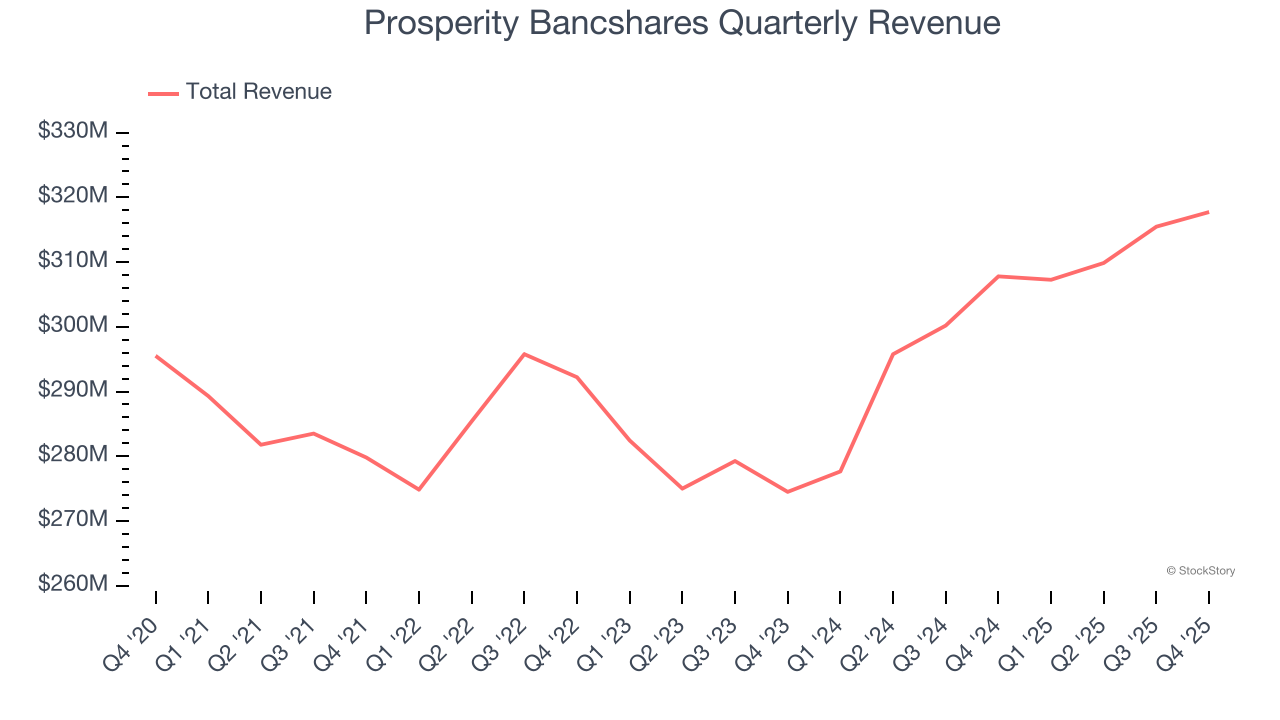
Long-term growth is the most important, but within financials, a half-decade historical view may miss recent interest rate changes and market returns. Prosperity Bancshares’s annualized revenue growth of 6.1% over the last two years is above its five-year trend, but we were still disappointed by the results.
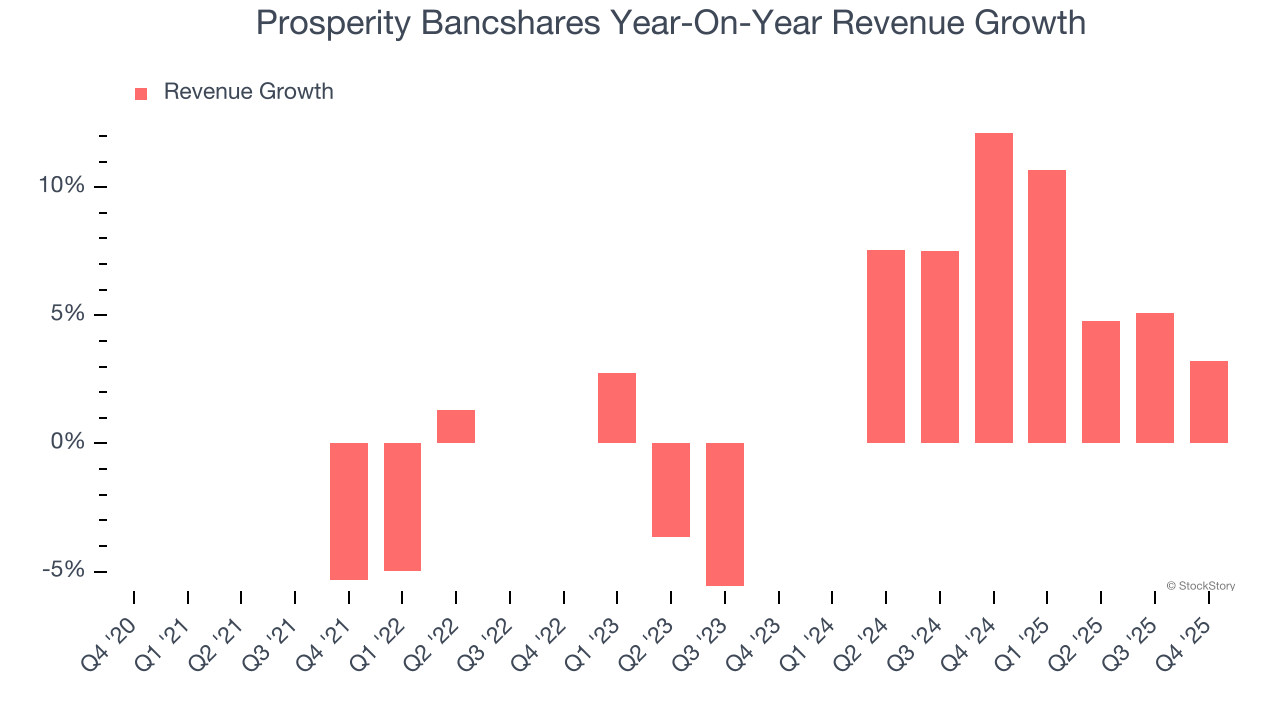
This quarter, Prosperity Bancshares grew its revenue by 3.2% year on year, and its $317.7 million of revenue was in line with Wall Street’s estimates.
Net interest income made up 86.9% of the company’s total revenue during the last five years, meaning Prosperity Bancshares barely relies on non-interest income to drive its overall growth.
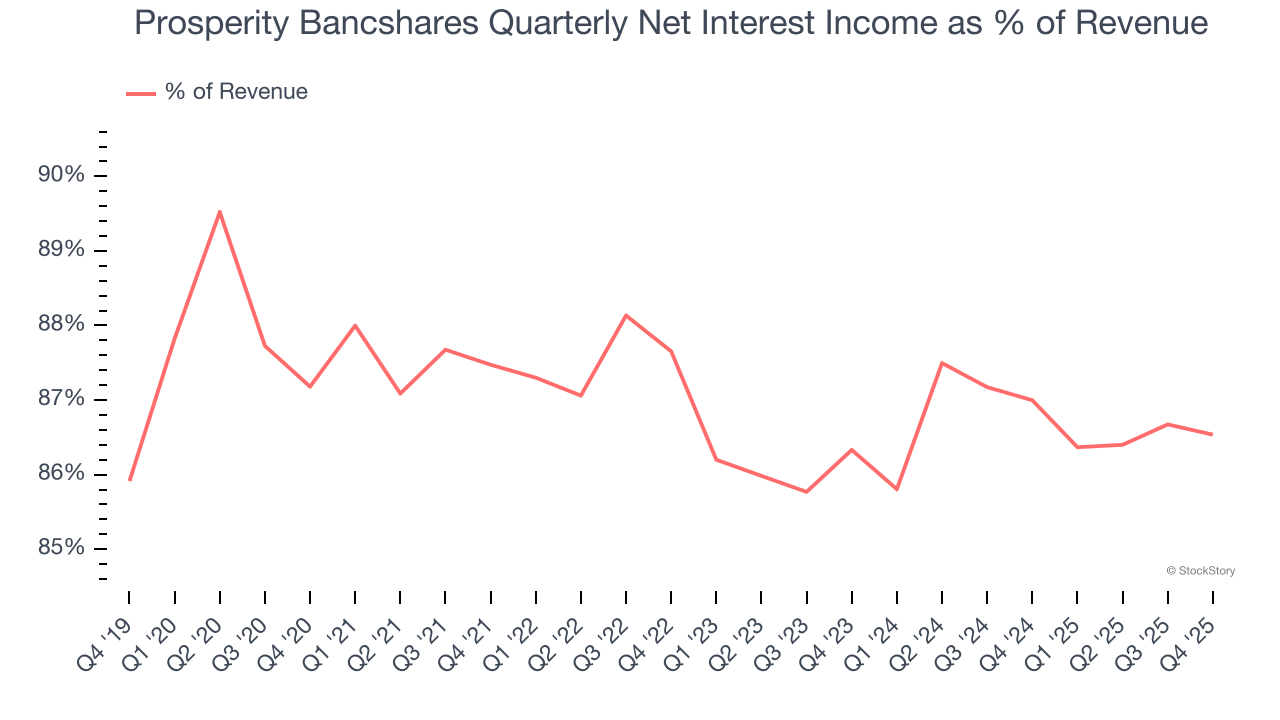
While banks generate revenue from multiple sources, investors view net interest income as the cornerstone - its predictable, recurring characteristics stand in sharp contrast to the volatility of non-interest income.
Software is eating the world and there is virtually no industry left that has been untouched by it. That drives increasing demand for tools helping software developers do their jobs, whether it be monitoring critical cloud infrastructure, integrating audio and video functionality, or ensuring smooth content streaming. Click here to access a free report on our 3 favorite stocks to play this generational megatrend.
Tangible Book Value Per Share (TBVPS)
Banks operate as balance sheet businesses, with profits generated through borrowing and lending activities. Valuations reflect this reality, emphasizing balance sheet strength and long-term book value compounding ability.
This is why we consider tangible book value per share (TBVPS) the most important metric to track for banks. TBVPS represents the real, liquid net worth per share of a bank, excluding intangible assets that have debatable value upon liquidation. Other (and more commonly known) per-share metrics like EPS can sometimes be murky due to M&A or accounting rules allowing for loan losses to be spread out.
Prosperity Bancshares’s TBVPS grew at an impressive 7.4% annual clip over the last five years. However, TBVPS growth has recently decelerated a bit to 6.3% annual growth over the last two years (from $38.62 to $43.64 per share).
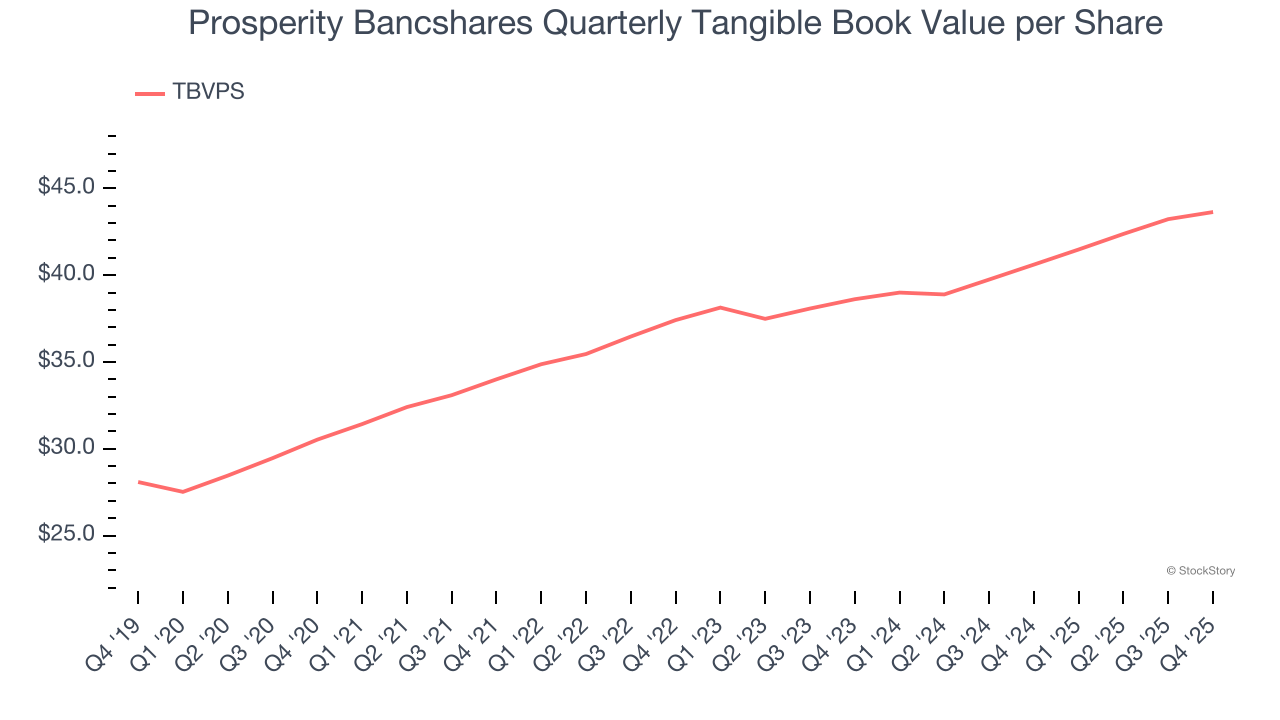
Over the next 12 months, Consensus estimates call for Prosperity Bancshares’s TBVPS to grow by 6.1% to $46.30, lousy growth rate.
Key Takeaways from Prosperity Bancshares’s Q4 Results
We struggled to find many positives in these results. Its net interest income slightly missed and its revenue was just in line with Wall Street’s estimates. Tangible book value per share also just met expectations. Overall, this was a quarter without too many positives to get excited about. The stock traded down 5.1% to $69.17 immediately after reporting.
Prosperity Bancshares’s latest earnings report disappointed. One quarter doesn’t define a company’s quality, so let’s explore whether the stock is a buy at the current price. We think that the latest quarter is only one piece of the longer-term business quality puzzle. Quality, when combined with valuation, can help determine if the stock is a buy. We cover that in our actionable full research report which you can read here (it’s free).
Mentioned In This Article
Latest News
| Sep-30 | |
| Sep-15 | |
| Jul-29 | |
| Jul-29 | |
| Jul-29 | |
| Jul-22 | |
| Jul-01 | |
| Jun-30 | |
| Jun-29 | |
| Apr-30 | |
| Apr-29 | |
| Apr-29 | |
| Apr-29 | |
| Apr-23 | |
| Apr-22 |
