AXIS Capital's (NYSE:AXS) Q4 CY2025 Sales Beat Estimates

Global specialty insurer AXIS Capital Holdings Limited (NYSE:AXS) reported Q4 CY2025 results exceeding the market’s revenue expectations, with sales up 9.8% year on year to $1.73 billion. Its non-GAAP profit of $3.25 per share was 4.2% above analysts’ consensus estimates.
Is now the time to buy AXIS Capital? Find out by accessing our full research report, it’s free.
AXIS Capital (AXS) Q4 CY2025 Highlights:
- Net Premiums Earned: $1.53 billion vs analyst estimates of $1.48 billion (11% year-on-year growth, 3% beat)
- Revenue: $1.73 billion vs analyst estimates of $1.69 billion (9.8% year-on-year growth, 2.7% beat)
- Combined Ratio: 93.9% vs analyst estimates of 91.1% (280 basis point miss)
- Adjusted EPS: $3.25 vs analyst estimates of $3.12 (4.2% beat)
- Book Value per Share: $77.20 vs analyst estimates of $76.74 (15.7% year-on-year growth, 0.6% beat)
- Market Capitalization: $7.90 billion
Company Overview
Founded in the aftermath of the 9/11 attacks when insurance capacity was scarce, AXIS Capital Holdings Limited (NYSE:AXS) is a global specialty insurer and reinsurer that provides coverage for complex risks across property, liability, professional lines, cyber, and other specialty markets.
Revenue Growth
Insurers earn revenue three ways. The core insurance business itself, often called underwriting and represented in the income statement as premiums earned, is one way. Investment income from investing the “float” (premiums collected upfront not yet paid out as claims) in assets such as fixed-income assets and equities is the second way. Fees from various sources such as policy administration, annuities, or other value-added services is the third. Over the last five years, AXIS Capital grew its revenue at a mediocre 6.7% compounded annual growth rate. This was below our standard for the insurance sector and is a rough starting point for our analysis.
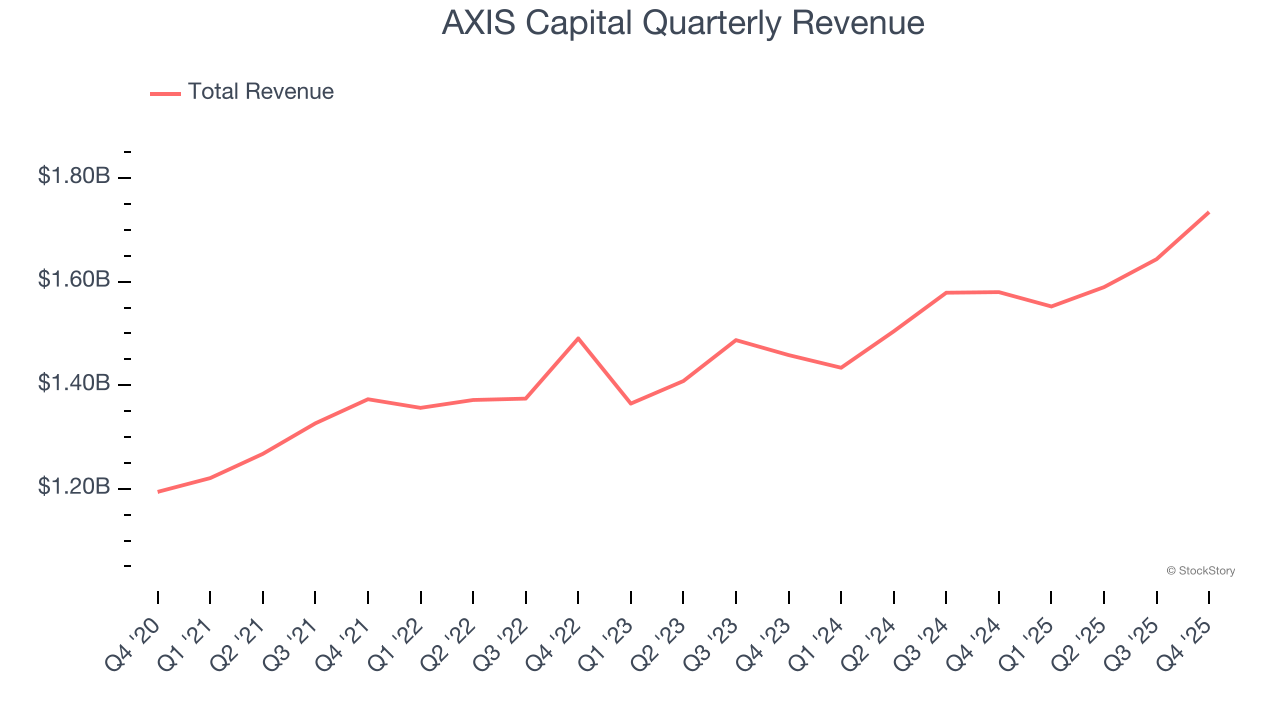
Long-term growth is the most important, but within financials, a half-decade historical view may miss recent interest rate changes and market returns. AXIS Capital’s annualized revenue growth of 6.8% over the last two years aligns with its five-year trend, suggesting its demand was consistently weak.
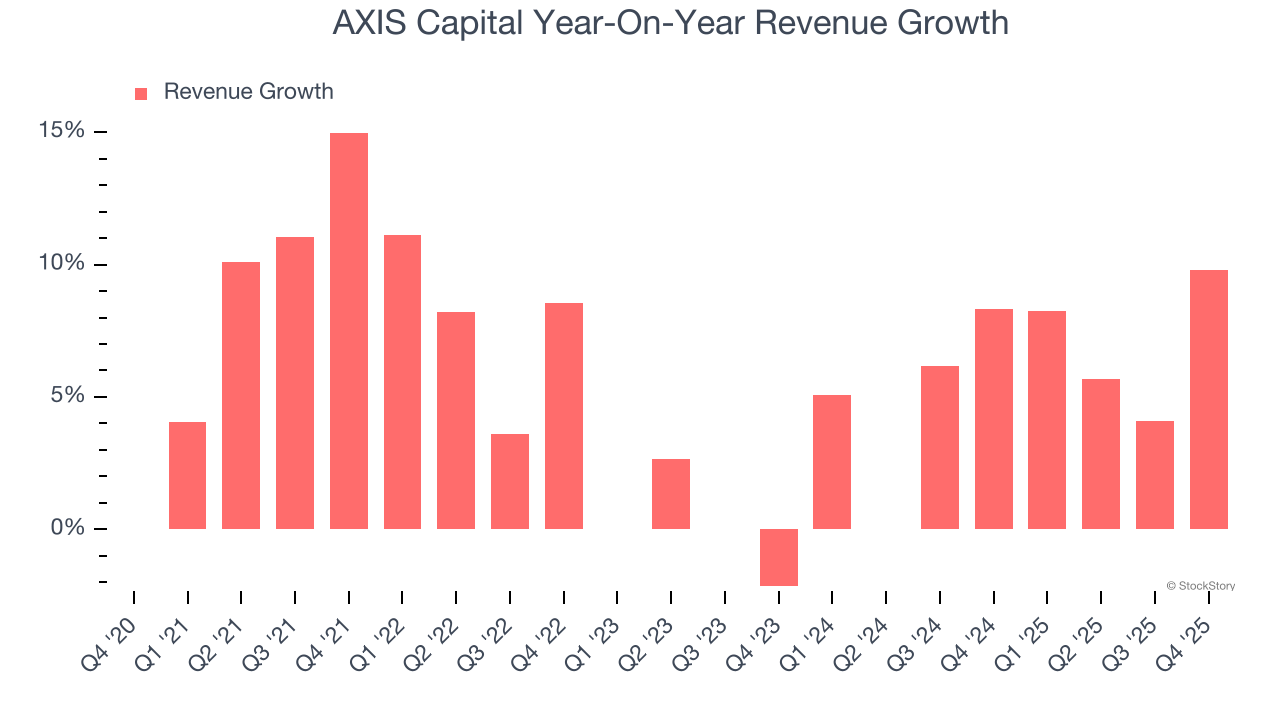
This quarter, AXIS Capital reported year-on-year revenue growth of 9.8%, and its $1.73 billion of revenue exceeded Wall Street’s estimates by 2.7%.
Net premiums earned made up 89.2% of the company’s total revenue during the last five years, meaning AXIS Capital barely relies on non-insurance activities to drive its overall growth.
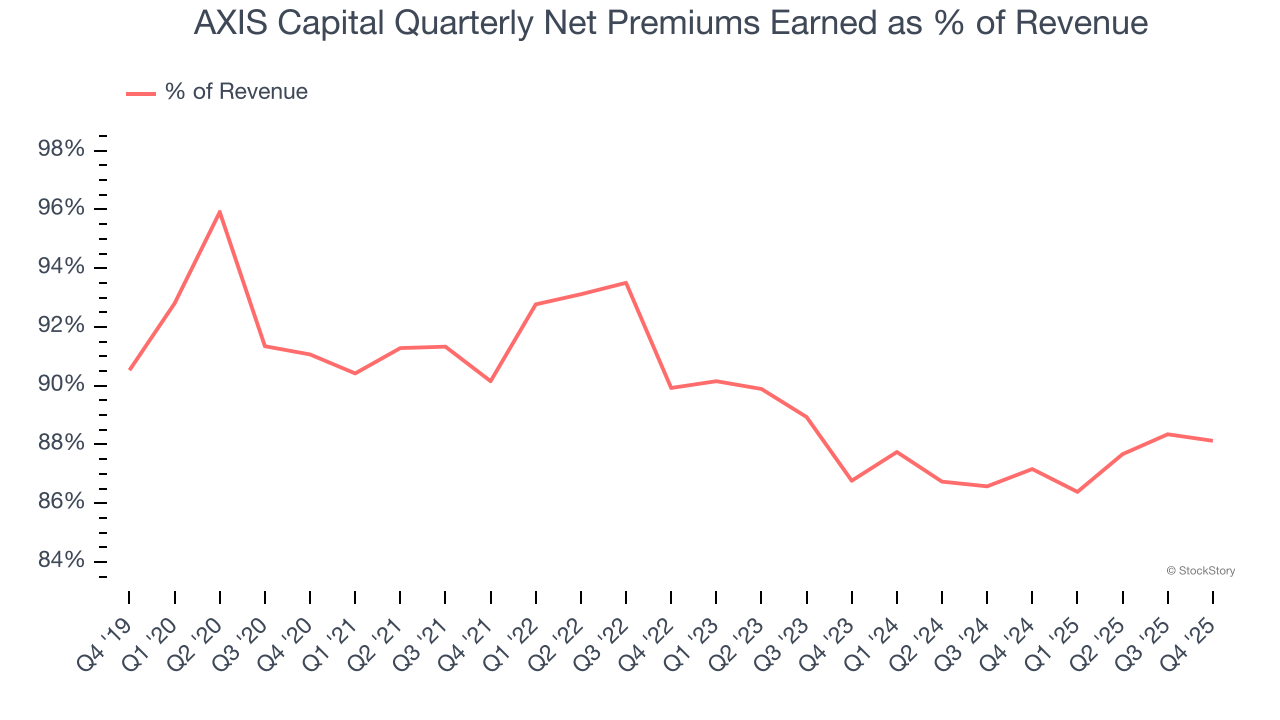
Markets consistently prioritize net premiums earned growth over investment and fee income, recognizing its superior quality as a core indicator of the company’s underwriting success and market penetration.
The 1999 book Gorilla Game predicted Microsoft and Apple would dominate tech before it happened. Its thesis? Identify the platform winners early. Today, enterprise software companies embedding generative AI are becoming the new gorillas. a profitable, fast-growing enterprise software stock that is already riding the automation wave and looking to catch the generative AI next.
Book Value Per Share (BVPS)
Insurers are balance sheet businesses, collecting premiums upfront and paying out claims over time. Premiums collected but not yet paid out, often referred to as the float, are invested and create an asset base supported by a liability structure. Book value per share (BVPS) captures this dynamic by measuring these assets (investment portfolio, cash, reinsurance recoverables) less liabilities (claim reserves, debt, future policy benefits). BVPS is essentially the residual value for shareholders.
We therefore consider BVPS very important to track for insurers and a metric that sheds light on business quality. While other (and more commonly known) per-share metrics like EPS can sometimes be lumpy due to reserve releases or one-time items and can be managed or skewed while still following accounting rules, BVPS reflects long-term capital growth and is harder to manipulate.
AXIS Capital’s BVPS grew at a mediocre 6.5% annual clip over the last five years. However, BVPS growth has accelerated recently, growing by 18.2% annually over the last two years from $55.26 to $77.20 per share.
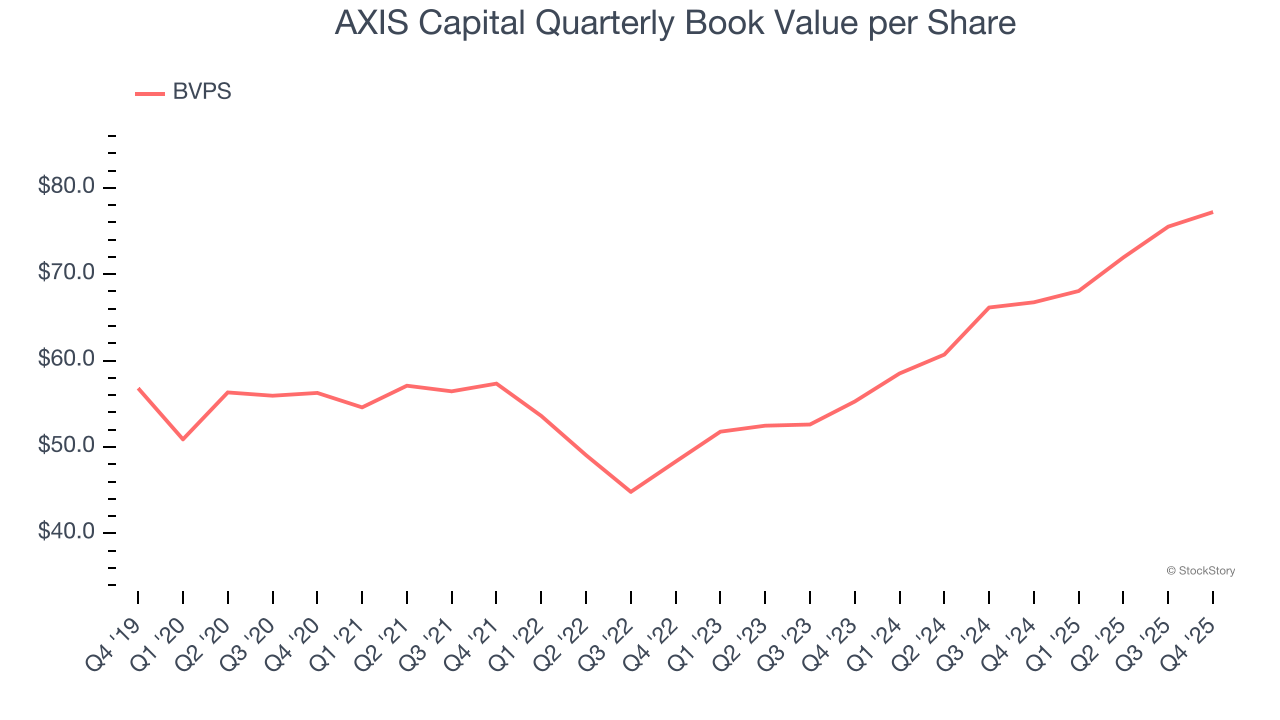
Over the next 12 months, Consensus estimates call for AXIS Capital’s BVPS to grow by 14% to $76.74, solid growth rate.
Key Takeaways from AXIS Capital’s Q4 Results
We were impressed by how significantly AXIS Capital blew past analysts’ net premiums earned expectations this quarter. We were also glad its revenue outperformed Wall Street’s estimates. Overall, we think this was a decent quarter with some key metrics above expectations. The stock remained flat at $103.78 immediately after reporting.
So do we think AXIS Capital is an attractive buy at the current price? If you’re making that decision, you should consider the bigger picture of valuation, business qualities, as well as the latest earnings. We cover that in our actionable full research report which you can read here (it’s free).
Mentioned In This Article
Latest News
| Oct-16 | |
| Oct-01 | |
| Sep-16 | |
| Sep-08 | |
| Aug-05 | |
| Jul-29 | |
| Jul-28 | |
| Jul-28 | |
| Jul-28 | |
| Jul-27 | |
| Jul-06 | |
| Jun-15 | |
| May-13 | |
| Apr-30 | |
| Apr-29 |
