Robinhood Soared by 204% in 2025, but Here's Another Financial Stock to Buy in 2026
Key Points
SoFi continues to add record numbers of customers to its platform.
It's growing much faster than the traditional, large banks.
Robinhood's platform has a high level of exposure to cryptocurrency trends.
2025 was definitely Robinhood Markets' (NASDAQ: HOOD) year. It ended 2025 up more than 200%, capping off a three-year gain of 1,000%.
However, after a hitting a high in October, it's been dropping, and it's down 23% over the past three months. Investors have several concerns, including the company's dependence on cryptocurrency and its high valuation, so now may not be the right time to buy shares.
Where to invest $1,000 right now? Our analyst team just revealed what they believe are the 10 best stocks to buy right now. Continue »
If you're looking for an excellent financial stock to buy in 2026, SoFi Technologies (NASDAQ: SOFI) is worth a look. Here's why.
SoFi hasn't been a slouch, either
SoFi reported robust growth last year, and it's becoming more profitable at scale. It created new records for customer add-ons for each of the first three quarters, with more than 900,000 new accounts in the 2025 third quarter.
These are primarily high-quality customers who are starting out as professionals and come with years of growth opportunities. Indeed, 90% of SoFi Money deposits are direct deposit, which means they're likely coming out of customer salary checks, and as this younger cohort moves in their careers, those deposits are likely to increase.
Consider SoFi's asset growth over the past five years versus the five largest U.S. banks by assets, which include JPMorgan Chase, Bank of America, Citigroup, Wells Fargo, and U.S. Bank:
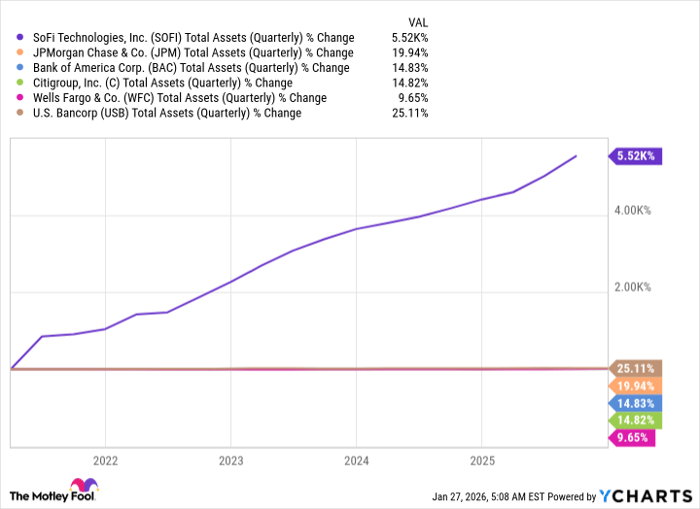
SOFI Total Assets (Quarterly) data by YCharts
And SoFi still has a fraction of these banks' assets, giving it a great growth runway.
Management is aiming to keep the momentum through a varied growth strategy that goes beyond attracting new customers. It's constantly adding new products and services to its platform, and it's hoping to cross-sell new products to its existing consumer base as customers age and their financial needs increase.
Why SoFi's trajectory is less risky
SoFi stock gained 70% in 2025. That's a strong gain that still outperformed the market, even if it weren't quite as superb as Robinhood stock. However, it's a safer gain because its model is less susceptible to market volatility, and it has less exposure to cryptocurrency.
SoFi's growth is coming from more reliable revenue streams, even though it also embraces innovation. It's much more than a trading platform, and it appeals to a much broader swath of the population: people who are looking for easy-to-use, digital financial services. That's why I recommend it as an excellent financial stock to buy in 2026.
Should you buy stock in SoFi Technologies right now?
Before you buy stock in SoFi Technologies, consider this:
The Motley Fool Stock Advisor analyst team just identified what they believe are the 10 best stocks for investors to buy now… and SoFi Technologies wasn’t one of them. The 10 stocks that made the cut could produce monster returns in the coming years.
Consider when Netflix made this list on December 17, 2004... if you invested $1,000 at the time of our recommendation, you’d have $461,527!* Or when Nvidia made this list on April 15, 2005... if you invested $1,000 at the time of our recommendation, you’d have $1,155,666!*
Now, it’s worth noting Stock Advisor’s total average return is 950% — a market-crushing outperformance compared to 197% for the S&P 500. Don't miss the latest top 10 list, available with Stock Advisor, and join an investing community built by individual investors for individual investors.
*Stock Advisor returns as of January 29, 2026.
Citigroup is an advertising partner of Motley Fool Money. JPMorgan Chase is an advertising partner of Motley Fool Money. Bank of America is an advertising partner of Motley Fool Money. Wells Fargo is an advertising partner of Motley Fool Money. Jennifer Saibil has positions in SoFi Technologies. The Motley Fool has positions in and recommends JPMorgan Chase and U.S. Bancorp. The Motley Fool has a disclosure policy.
Mentioned In This Article
Latest News
| Oct-10 | |
| Oct-10 | |
| Oct-09 |
At Robinhood's Mecca for Risk-Loving Traders, Everyone Has a Tale of Getting Rich
HOOD
The Wall Street Journal
|
| Oct-09 | |
| Oct-09 | |
| Oct-09 | |
| Oct-09 | |
| Oct-08 | |
| Oct-08 | |
| Oct-08 | |
| Oct-08 | |
| Oct-08 | |
| Oct-08 | |
| Oct-08 | |
| Oct-08 |
