Oshkosh (NYSE:OSK) Posts Better-Than-Expected Sales In Q4 CY2025

Specialty vehicles contractor Oshkosh (NYSE:OSK) reported Q4 CY2025 results exceeding the market’s revenue expectations, with sales up 2.5% year on year to $2.69 billion. The company’s full-year revenue guidance of $11 billion at the midpoint came in 0.7% above analysts’ estimates. Its non-GAAP profit of $2.26 per share was 2.2% below analysts’ consensus estimates.
Is now the time to buy Oshkosh? Find out by accessing our full research report, it’s free.
Oshkosh (OSK) Q4 CY2025 Highlights:
- Revenue: $2.69 billion vs analyst estimates of $2.62 billion (2.5% year-on-year growth, 2.6% beat)
- Adjusted EPS: $2.26 vs analyst expectations of $2.31 (2.2% miss)
- Adjusted EBITDA: $225.9 million vs analyst estimates of $281.5 million (8.4% margin, 19.7% miss)
- Adjusted EPS guidance for the upcoming financial year 2026 is $11.50 at the midpoint, missing analyst estimates by 6.7%
- Operating Margin: 7.9%, in line with the same quarter last year
- Free Cash Flow Margin: 20.1%, down from 26.8% in the same quarter last year
- Backlog: $14.18 billion at quarter end, in line with the same quarter last year
- Market Capitalization: $9.25 billion
“Oshkosh delivered a strong close to 2025 with fourth quarter results that were within our expectations driven by our people and innovative products, capping another year of solid execution across our portfolio,” said John Pfeifer, president and chief executive officer of Oshkosh Corporation.
Company Overview
Oshkosh (NYSE:OSK) manufactures specialty vehicles for the defense, fire, emergency, and commercial industry, operating various brand subsidiaries within each industry.
Revenue Growth
A company’s long-term sales performance is one signal of its overall quality. Any business can put up a good quarter or two, but many enduring ones grow for years. Over the last five years, Oshkosh grew its sales at a solid 9.1% compounded annual growth rate. Its growth beat the average industrials company and shows its offerings resonate with customers.
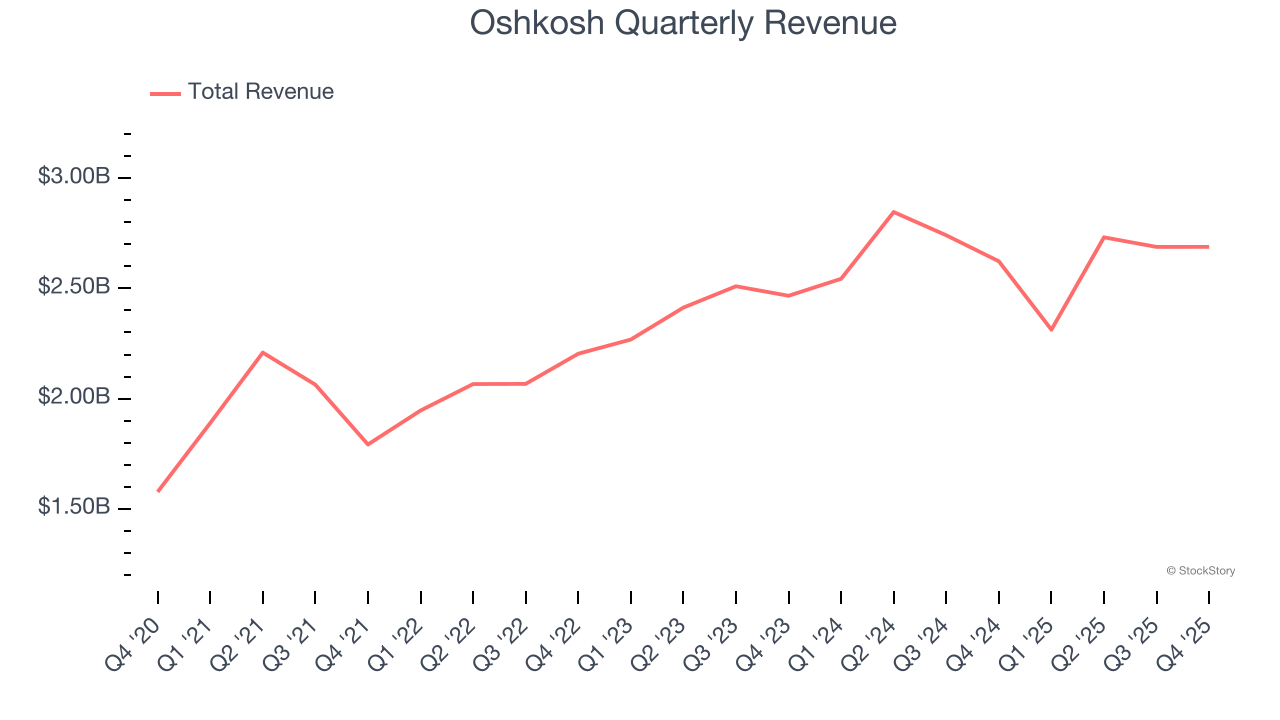
We at StockStory place the most emphasis on long-term growth, but within industrials, a half-decade historical view may miss cycles, industry trends, or a company capitalizing on catalysts such as a new contract win or a successful product line. Oshkosh’s recent performance shows its demand has slowed as its annualized revenue growth of 3.9% over the last two years was below its five-year trend. We also note many other Heavy Transportation Equipment businesses have faced declining sales because of cyclical headwinds. While Oshkosh grew slower than we’d like, it did do better than its peers.
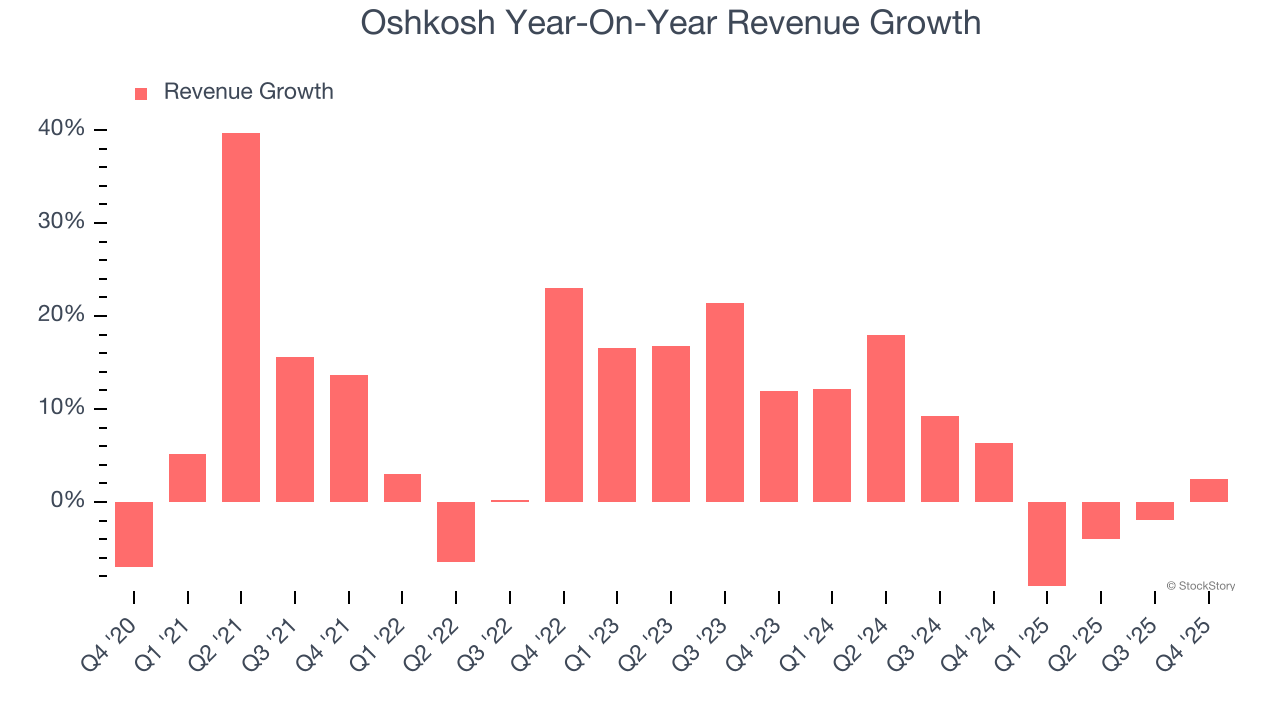
Oshkosh also reports its backlog, or the value of its outstanding orders that have not yet been executed or delivered. Oshkosh’s backlog reached $14.18 billion in the latest quarter and averaged 4.3% year-on-year declines over the last two years. Because this number is lower than its revenue growth, we can see the company hasn’t secured enough new orders to maintain its growth rate in the future.
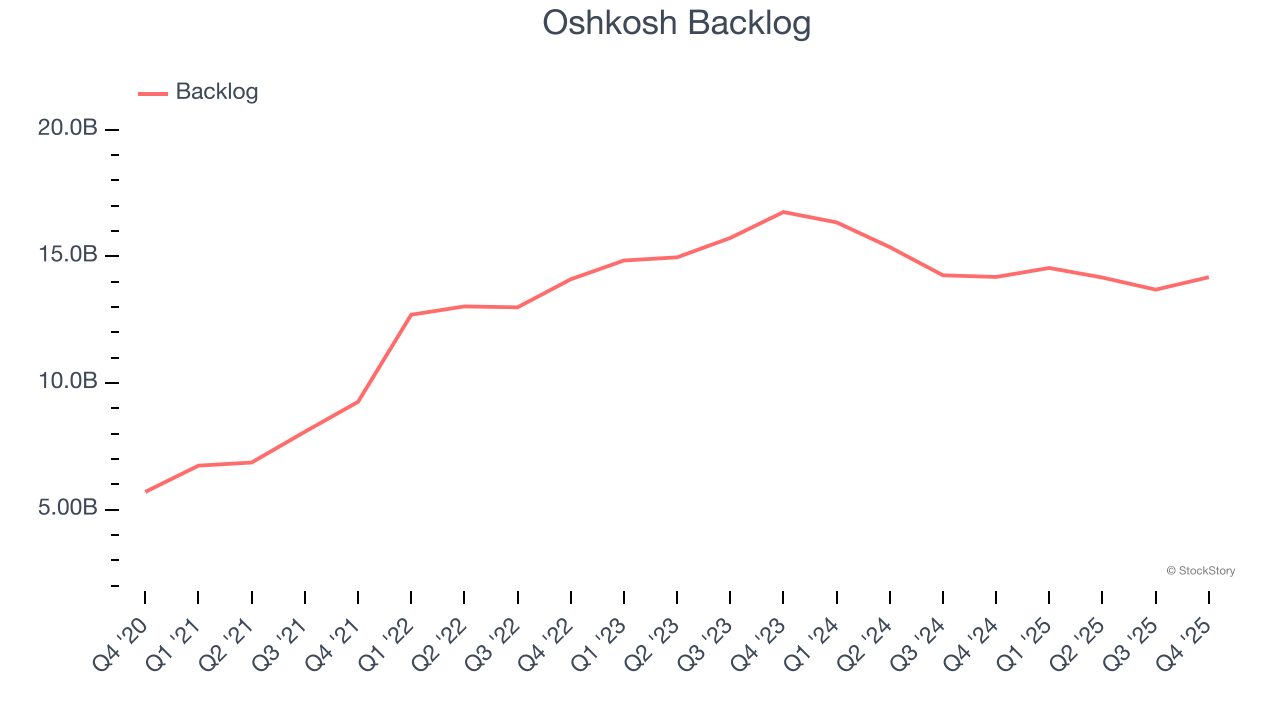
This quarter, Oshkosh reported modest year-on-year revenue growth of 2.5% but beat Wall Street’s estimates by 2.6%.
Looking ahead, sell-side analysts expect revenue to grow 5.6% over the next 12 months. While this projection suggests its newer products and services will spur better top-line performance, it is still below average for the sector.
The 1999 book Gorilla Game predicted Microsoft and Apple would dominate tech before it happened. Its thesis? Identify the platform winners early. Today, enterprise software companies embedding generative AI are becoming the new gorillas. a profitable, fast-growing enterprise software stock that is already riding the automation wave and looking to catch the generative AI next.
Operating Margin
Oshkosh was profitable over the last five years but held back by its large cost base. Its average operating margin of 7.8% was weak for an industrials business. This result isn’t too surprising given its low gross margin as a starting point.
On the plus side, Oshkosh’s operating margin rose by 2.5 percentage points over the last five years, as its sales growth gave it operating leverage.
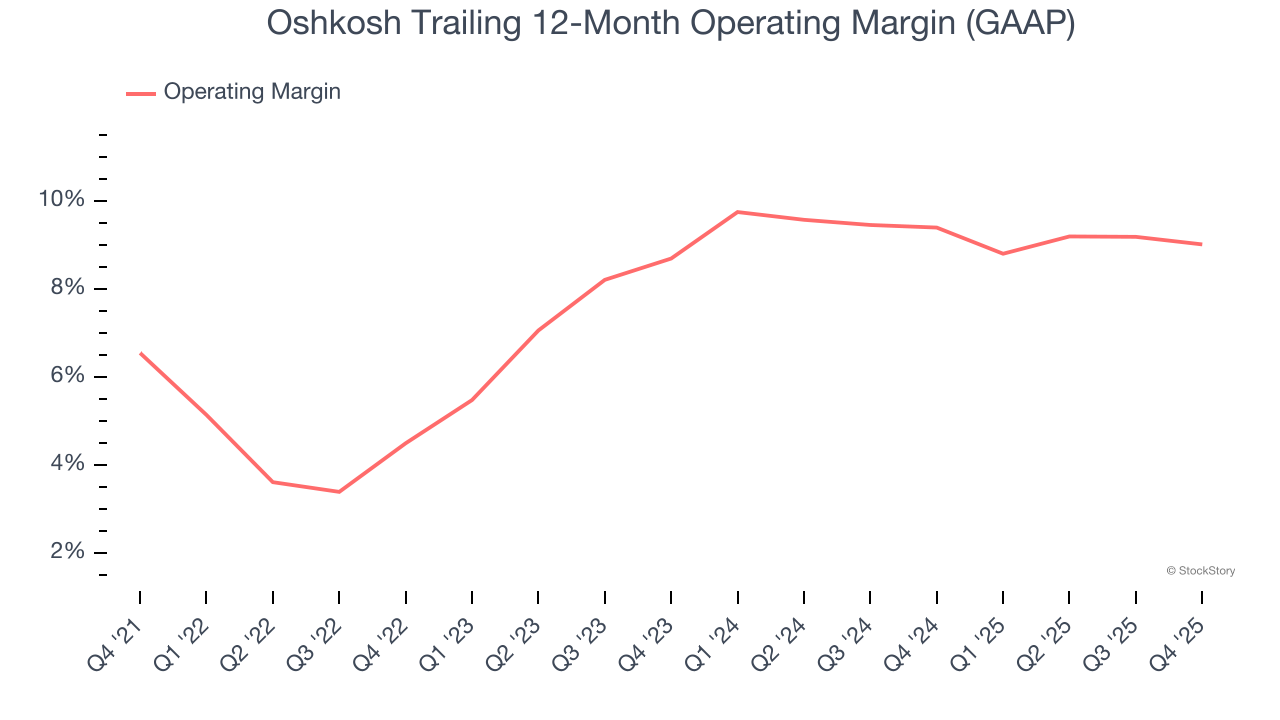
In Q4, Oshkosh generated an operating margin profit margin of 7.9%, in line with the same quarter last year. This indicates the company’s cost structure has recently been stable.
Earnings Per Share
Revenue trends explain a company’s historical growth, but the long-term change in earnings per share (EPS) points to the profitability of that growth – for example, a company could inflate its sales through excessive spending on advertising and promotions.
Oshkosh’s EPS grew at a spectacular 16.8% compounded annual growth rate over the last five years, higher than its 9.1% annualized revenue growth. This tells us the company became more profitable on a per-share basis as it expanded.
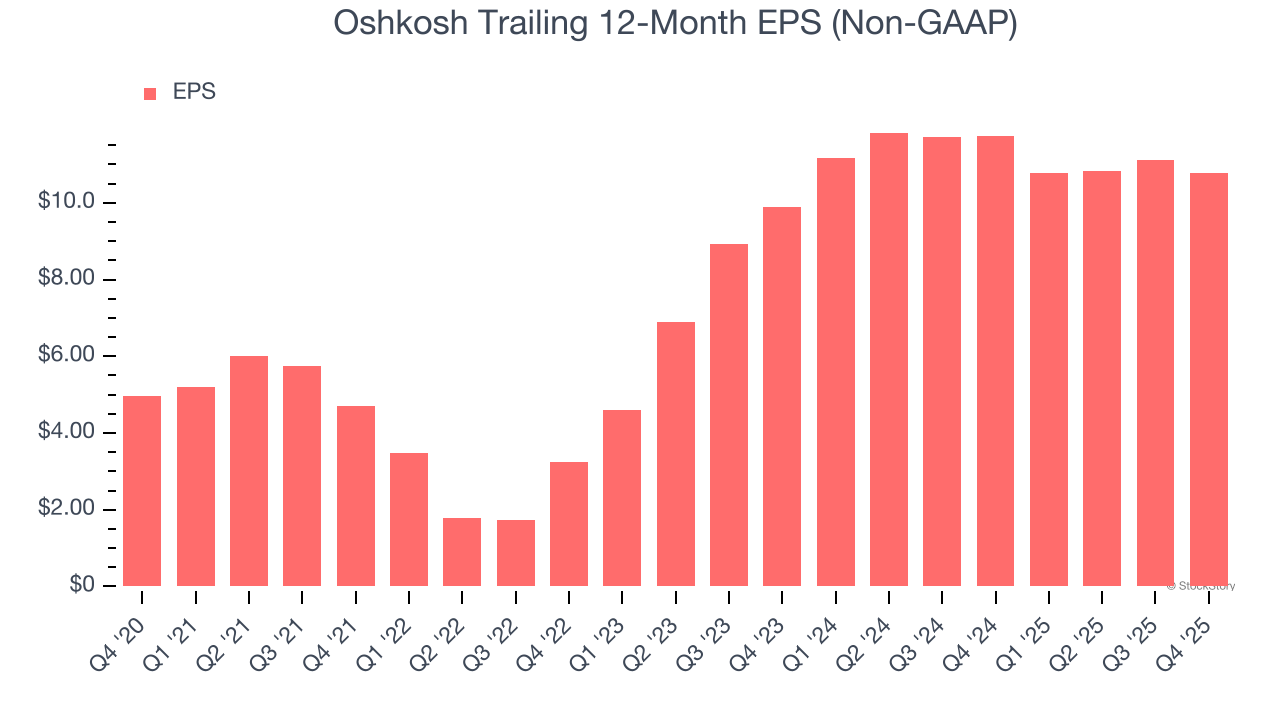
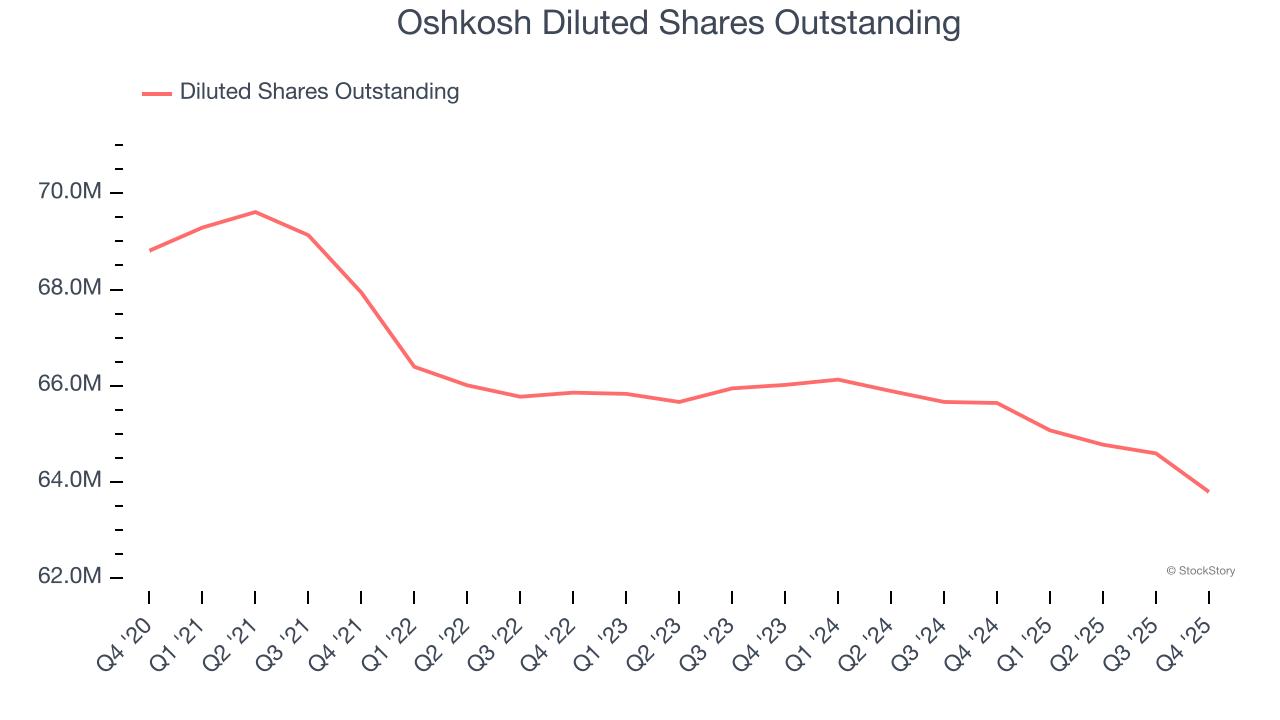
We can take a deeper look into Oshkosh’s earnings to better understand the drivers of its performance. As we mentioned earlier, Oshkosh’s operating margin was flat this quarter but expanded by 2.5 percentage points over the last five years. On top of that, its share count shrank by 7.3%. These are positive signs for shareholders because improving profitability and share buybacks turbocharge EPS growth relative to revenue growth.
Like with revenue, we analyze EPS over a shorter period to see if we are missing a change in the business.
For Oshkosh, its two-year annual EPS growth of 4.5% was lower than its five-year trend. We hope its growth can accelerate in the future.
In Q4, Oshkosh reported adjusted EPS of $2.26, down from $2.58 in the same quarter last year. This print missed analysts’ estimates, but we care more about long-term adjusted EPS growth than short-term movements. Over the next 12 months, Wall Street expects Oshkosh’s full-year EPS of $10.79 to grow 15.4%.
Key Takeaways from Oshkosh’s Q4 Results
We enjoyed seeing Oshkosh beat analysts’ revenue expectations this quarter. We were also glad its backlog outperformed Wall Street’s estimates. On the other hand, its full-year EPS guidance missed and its EBITDA fell short of Wall Street’s estimates. Overall, this quarter could have been better. The stock traded down 2.5% to $142.49 immediately following the results.
Is Oshkosh an attractive investment opportunity right now? When making that decision, it’s important to consider its valuation, business qualities, as well as what has happened in the latest quarter. We cover that in our actionable full research report which you can read here (it’s free).
Mentioned In This Article
Latest News
| Oct-06 | |
| Oct-05 | |
| Oct-02 | |
| Sep-30 | |
| Sep-29 | |
| Sep-28 | |
| Sep-24 | |
| Sep-18 | |
| Sep-16 | |
| Sep-15 | |
| Sep-14 | |
| Sep-11 | |
| Sep-09 | |
| Sep-04 | |
| Sep-03 |
