Forget Intel: This Smartphone and Auto Chip Giant Is Quietly Building the Better Long-Term AI Story
Key Points
Despite a $9 billion investment from Uncle Sam, Intel's decline is continuing unabated.
Broadcom is a rising star in the AI hardware industry with 50% of its most recent quarter's revenue coming from AI companies.
With an operating margin of 40.8% and 24% revenue growth year over year, Broadcom looks to be the stronger chip play by far.
The U.S. government made headlines last year when it invested $8.9 billion into Intel and the announcement caused Intel's shares to grow through the last four months of 2025. But did the government bet on the wrong horse in the artificial intelligence (AI) hardware race?
Lots of people piled into Intel when the government announced its investment, but I don't think Intel is the best American semiconductor play, even after an almost $9 billion lifeline from Washington.
Where to invest $1,000 right now? Our analyst team just revealed what they believe are the 10 best stocks to buy right now. Continue »
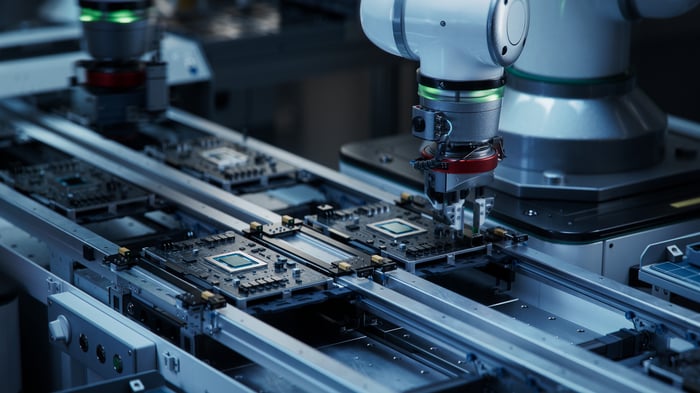
Image source: Getty Images.
Intel has been on the decline for years with its annual revenue dropping every year since 2021 and more losses projected for the first quarter of 2026. It's also projecting earnings per share (EPS) of $0 for the first quarter of 2026, which isn't an auspicious start to the year.
What's more, the company's big reinvestment in American semiconductor production is struggling. Intel's proposed $28 billion factory in Ohio was originally meant to start production last year. But now Intel isn't projecting it will open until 2030 at the earliest, potentially even 2031.
Intel may once have led America's and the world's semiconductor industry, but America's semiconductor renaissance will likely fall to another company.
I've written before about Alphabet's (NASDAQ: GOOG) (NASDAQ: GOOGL) emergence as a serious contender in the generative AI to the point where it has nearly displaced OpenAI in the enterprise large language model (LLM) market.
But what I haven't talked about is the hardware that Alphabet is running its Gemini AI program on. Because, after all, Alphabet is primarily a software company, not a hardware one.
And the company Alphabet works with on its Tensor Processing Unit (TPU), which stole headlines late last year, stands to be an even bigger winner of Alphabet's AI investment.
Broadcom (NASDAQ: AVGO) is one of Alphabet's major partners and it has been working behind the scenes to make Alphabet into a threat to the current king of AI hardware.
It helped Alphabet design and continues to help it manufacture its TPU chips as a leading designer and producer of application-specific integrate circuit (ASIC) chips. And to put it very mildly, it's doing much better than Intel.
California dreamin'
Based in Palo Alto, California, Broadcom and Alphabet are basically neighbors. Broadcom is already a major producer of automotive and mobile phone chips and components but AI has rapidly become one of the biggest segments of its business.
In its fiscal fourth-quarter and full-year 2025 results (for the period ended Nov. 2, 2025) the company revealed that 50% of its semiconductor revenue now comes from AI-related buyers like Alphabet.
Other things worth noting from those results are that Broadcom saw its Q4 revenue grow 28% year over year, its net income grew 39%, and its earnings per share (EPS) shot up 37%. For the full year its revenue was up 24% over 2024, its net income was up 42%, and its EPS was up 40% year over year.
For Q4 2025 Broadcom also grew its free cash flow (FCF) by 36.2% to $7.47 billion and its operating cash flow was up 37%. The company is also sitting on a gross margin of 67.7% and an operating margin of 40.8%.
The company's debt is high at $65 billion relative to $16 billion in cash, but with growth figures like Broadcom is demonstrating and the considerable likelihood of further growth I don't think that will be as much of a problem as it sounds on paper.
And that's because Alphabet is not Broadcom's only customer and, thanks to the success of Alphabet's TPU, Broadcom ought to be able to sell its ASIC design expertise at a premium.
The king slayer?
Alphabet's TPU AI chip has rendered the company one of Nvidia's biggest threats overnight. At present Nvidia controls about 85% of the AI chip market with its graphics processing unit (GPU) chips. Because of this dominance, other big tech companies like Alphabet are seeking to reduce their dependence on Nvidia's hardware.
And Alphabet's Gemini AI program is optimized to run on the company's Broadcom co-developed TPU, which the two companies have been working on since 2016. If big tech companies like Alphabet stop using Nvidia hardware or severely reduce their dependence on it, there goes Nvidia's whole business.
I would imagine Nvidia's C-suite was a little alarmed when Alphabet and Anthropic, the AI start-up behind Claude and current Enterprise LLM market leader, announced they would expand their collaboration in October 2025. Anthropic aimed then to have 1 million TPU chips deployed by 2026.
I expect the TPU partnership will continue to be lucrative for Broadcom and, given its success already, I would not be surprised if other big tech AI players using Nvidia hardware start looking for ways to scale back their reliance on Nvidia. And if they do, the obvious partner will be Broadcom.
So, not only is Broadcom growing while Intel is shrinking, it's also cracking Nvidia's iron grip on the AI hardware market. That makes it worth a look by my reckoning.
Should you buy stock in Broadcom right now?
Before you buy stock in Broadcom, consider this:
The Motley Fool Stock Advisor analyst team just identified what they believe are the 10 best stocks for investors to buy now… and Broadcom wasn’t one of them. The 10 stocks that made the cut could produce monster returns in the coming years.
Consider when Netflix made this list on December 17, 2004... if you invested $1,000 at the time of our recommendation, you’d have $450,256!* Or when Nvidia made this list on April 15, 2005... if you invested $1,000 at the time of our recommendation, you’d have $1,171,666!*
Now, it’s worth noting Stock Advisor’s total average return is 942% — a market-crushing outperformance compared to 196% for the S&P 500. Don't miss the latest top 10 list, available with Stock Advisor, and join an investing community built by individual investors for individual investors.
*Stock Advisor returns as of February 2, 2026.
James Hires has positions in Alphabet. The Motley Fool has positions in and recommends Alphabet, Intel, and Nvidia. The Motley Fool recommends Broadcom. The Motley Fool has a disclosure policy.
Mentioned In This Article
Latest News
| 11 min | |
| 13 min | |
| 1 hour | |
| 1 hour | |
| 2 hours | |
| 7 hours | |
| Oct-14 | |
| Oct-14 | |
| Oct-14 | |
| Oct-14 | |
| Oct-14 | |
| Oct-14 | |
| Oct-13 | |
| Oct-13 | |
| Oct-13 |
