Options Corner: Walmart Calls Are Surprisingly Cheap Despite Robust Performance
Walmart Inc (NYSE:WMT) has been one of the market's bright spots, with the security gaining roughly 11% on a year-to-date basis. Although there's no single positive catalyst that explains the rise of WMT stock, it appears that the big-box retailer's expanding dominance in durable segments — such as groceries and healthcare — has helped buoy sentiment. Still, that leaves concerns about WMT being overheated.
Fundamentally, it's difficult to overlook Walmart's relevance. At a time when artificial intelligence is disrupting the labor market and tariffs are applying economic pressure on the American public, discretionary spending faces a credibility challenge. On the other hand, elements such as groceries and especially healthcare represent necessities. As such, Walmart's health push in particular communicates that the company can survive — and likely thrive — in inclement conditions.
Of course, WMT stock isn't known for its kinetic prowess. As such, its recent performance does raise eyebrows. For example, in the past year, WMT has gained nearly 24%. During the same period, the benchmark S&P 500 is up less than 17%. If we're comparing, the big-box retailer has also beat the tech-centric Nasdaq Composite's performance of 22% up.
Unsurprisingly, volatility skew — which identifies implied volatility (IV) or a stock's potential kinetic output across the strike price spectrum of a specific options chain — for near-term expiration dates reveal a prioritization of downside volatility insurance. For example, for the Feb. 20 expiration date, put-side IV stands higher than calls on both ends of the strike price spectrum.
Colloquially, this setup indicates that smart money traders are paying extra "insurance money" to protect against downward movements. The transactions involve both protection against tail risk (sharp downside movements) and mechanical short positions that would help cushion the blow of more modest volatility.
Still, what's fascinating for high-level contrarians is that because the focus is on downside protection, the expression of upside through call options is relatively cheap on a volatility basis. If there was justification for believing that WMT stock could march a bit further, Walmart could strangely be considered a discount.
Second-Order Analysis Helps Pave The Way Forward For WMT Stock
While we may have an understanding of the general sentiment among smart money traders, we still don't know how this translates to kinetic output. To get a better feel for WMT stock's kinetic potential, we can turn to the Black-Scholes-derived expected move calculator. For the Feb. 20 options chain, the model anticipates that WMT will land between $116.72 and $130.18. This range represents a high-low spread of 5.45% relative to the current spot price.
Where did this dispersion come from? Under Black-Scholes, stock market returns are assumed to be lognormally distributed. Using this framework, if Walmart stock were to symmetrically fall one standard deviation away from spot (while accounting for volatility and days to expiration), it would be expected to land between roughly $117 and $130.
This calculation isn't controversial because what the math is really saying is that in 68% of cases, WMT stock would trade within a standard deviation from where it currently stands. As a blue chip, I think that's a very reasonable assumption. Even with its upcoming earnings report — scheduled for Feb. 19 — the disclosure probably wouldn't lead to an explosive swing.
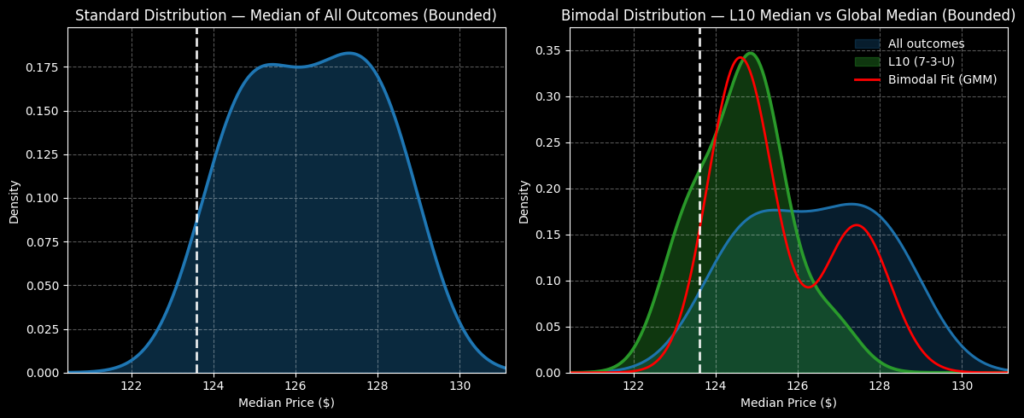
Still, as debit-side traders, we can't afford to always cover the entirety of the dispersion, which clocks in at roughly 12% peak to trough. Instead, we need to narrow the dispersion so that we're dealing with a list of probabilities instead of possibilities. For that, we can turn to a second-order inductive analysis using the Markov property.
Under Markov, the future state of a system depends entirely on the current state. In other words, forward probabilities should not be calculated independently but rather assessed under context. To use a simple sports analogy, a 20-yard field goal is an easy chip shot. Add snow, wind and playoff pressure and these odds may change quite dramatically.
In the last 10 weeks, WMT stock has printed seven up weeks, leading to an overall upward slope. Under this 7-3-U setup, WMT's forward 10-week returns would be expected to land between $121 and $129, with most of its probability mass concentrated north of the spot price. Over the next five weeks, the projected range would likely be between $121 and $127.
Peak probability density would likely materialize between $124.50 and $125.30, providing a much narrower target to aim at.
Calculating An Aggressive But Rational Options Strategy
With the market intelligence above, the most aggressive but rational trade may be the 124/126 bull call spread expiring Feb. 20, 2026. This wager involves two simultaneous transactions on a single execution: buy the $124 call and sell the $126 call, for a net debit paid of $106 (the most that can be lost).
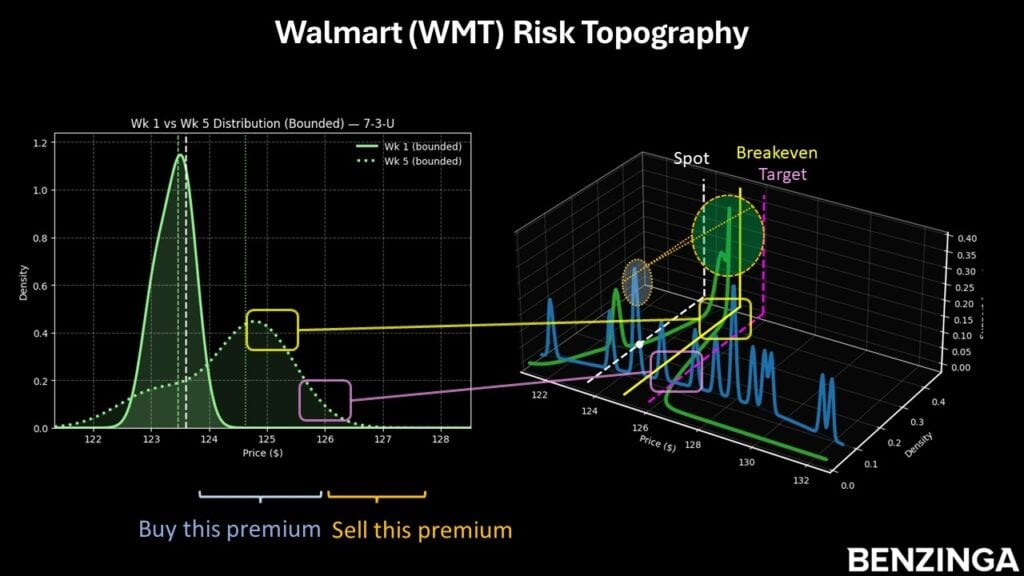
Should WMT stock rise through the second-leg strike ($126) at expiration, the maximum profit would be $94, a payout of almost 89%. Breakeven lands at $125.06, which sits near projected peak probability density.
Primarily, the idea here is to anticipate that WMT stock grinds higher going into earnings. Generally, I don't like betting on earnings outcomes based on their unpredictable nature. Therefore, if you are profitable, you may consider exiting early just before the earnings disclosure.
The opinions and views expressed in this content are those of the individual author and do not necessarily reflect the views of Benzinga. Benzinga is not responsible for the accuracy or reliability of any information provided herein. This content is for informational purposes only and should not be misconstrued as investment advice or a recommendation to buy or sell any security. Readers are asked not to rely on the opinions or information herein, and encouraged to do their own due diligence before making investing decisions.
Image: Shutterstock
Mentioned In This Article
Latest News
| 8 hours | |
| Oct-16 | |
| Oct-16 | |
| Oct-16 | |
| Oct-16 | |
| Oct-16 | |
| Oct-15 | |
| Oct-15 | |
| Oct-15 | |
| Oct-15 | |
| Oct-15 | |
| Oct-15 | |
| Oct-15 | |
| Oct-15 |
Target, Walmart, Other Discounters Make Bullish Moves Amid Plunging Yields, AI Exodus
WMT
Investor's Business Daily
|
| Oct-15 |
