2026's Most Violent Market Rotation: Buy Energy, Sell Software
For over a decade, the trade was simple: buy the infinite scalability of software companies and ignore the structural decline of fossil energy.
But in the opening weeks of 2026, that script hasn’t just been flipped—it's been shredded.
The Great Market Inflection: OIH vs. IGV
After nearly two decades of underperformance following the 2008 financial crisis, energy stocks are staging a sharp reversal against tech.
The Energy Select Sector SPDR Fund (NYSE:XLE) has already outperformed the Technology Select Sector SPDR Fund (NYSE:XLK) by 19 percentage points year-to-date through Feb 3.
Energy dominated the S&P 500 leaderboard in January, gaining 14.4%, followed by materials at 8.8%.
Bank of America's analyst Nigel Tupper highlights that surging crude prices effectively offset rising geopolitical flares in Venezuela, Iran, and Greenland.
Yet, the most extreme performance gap is found under the hood.
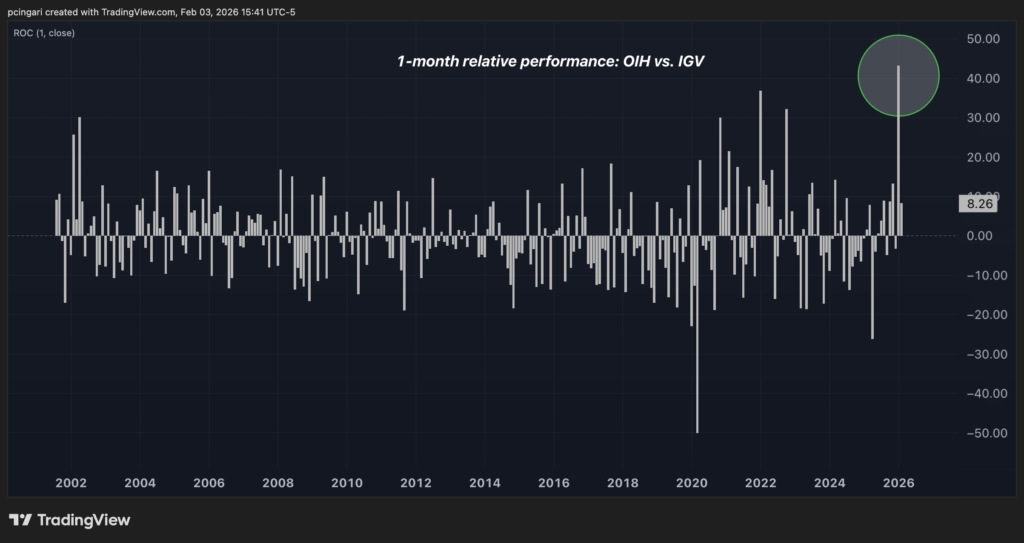
Year-to-date, the VanEck Oil Services ETF (NYSE:OIH) has crushed the iShares Expanded Tech-Software Sector ETF (NYSE:IGV) by more than 50 percentage points. The divergence was fueled by a historic January performance gap of 40ppt.
Why The Great Rotation From Tech To Energy
“Software is dead,” macro strategist Andreas Steno Larsen declared in a Tuesday social media post.
Larsen, the founder of Steno Research, indicates that the undisputed market darling of the last decade is facing a fundamental reckoning.
“The ‘Golden Child’ of the last decade is facing a brutal reality check. For years, Private Equity and Credit treated software as an infinite money printer. Today, those 24x multiples are being vaporized by AI-driven commoditization,” he added.
Larsen's thesis is simple: we are transitioning from a “virtual” economy to a “physical” one.
He contends that AI is no longer just a software tool—it is a software killer. By allowing companies to “insource” functionality via AI agents and Python setups, the need for expensive, seat-based SaaS subscriptions is evaporating.
Jordi Visser, head of AI Macro Nexus Research at 22V Research, likened this software collapse to the appetite suppression seen in GLP-1 weight-loss drugs.
“When software can be generated, modified, and orchestrated by agents at near-zero marginal cost, the entire buy-side market isn’t just disrupted—it’s suppressed,” Visser wrote.
In this framework, the “Great Deflation” occurs when the market realizes that demand for high-value software was actually inflated by the very inefficiencies AI now solves.
The New Paradigm: Atoms Over Bits
While code is becoming cheap and abundant, the physical infrastructure required to run it—power grids, data centers, copper, and specialized hardware—has reached a hard ceiling in scarcity.
“We are transitioning from an era where we paid for the process to one where we only pay for the result,” Larsen said.
In this new paradigm, the margin is shifting away from the code and toward the tangible implementations that actually “build stuff.”
The message for 2026 is clear: Position for the physical.
Photo: Shutterstock
Mentioned In This Article
Latest News
| 5 hours | |
| 6 hours | |
| Oct-13 | |
| Oct-12 | |
| Oct-12 | |
| Oct-11 | |
| Oct-10 | |
| Oct-08 | |
| Oct-08 | |
| Oct-08 | |
| Oct-07 | |
| Oct-07 | |
| Oct-07 | |
| Oct-05 | |
| Oct-05 |
