AMD Stock At $221: Bulls Vs. Bears On Knife's Edge
Advanced Micro Devices Inc (NASDAQ:AMD) rolled into earnings like an AI rocket and came out looking more like a weathered jet searching for its runway.
Despite a fourth-quarter earnings beat, the stock slid about 8% after hours on Tuesday and another 7% premarket Wednesday. Guidance and gravity, it appears, matter more than headline profits.
- Track AMD stock here.
AMD’s $221 Fault Line
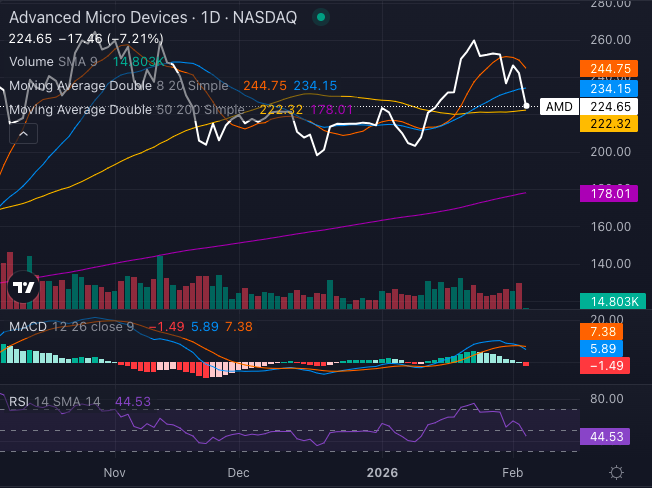
Trading near $224.65, AMD is hovering just above its 50-day moving average — clustered in the $221–$222 zone — the most important line on the chart.
For three months, this level acted as resistance; bulls now have to flip it into support. Just overhead sits a clean gap near $223.60, turning this band into a true tug-of-war between dip buyers and momentum sellers.
A daily close below $221 would effectively crack the cup-and-handle setup that traders have been defending since late last year.
Stock Momentum Cooling, Not Collapsing
The technical picture is bruised but not broken. The RSI (relative strength index) at 44.5 sits in neutral territory — far from panic — while the MACD (moving average convergence/divergence) indicator at 5.89 shows fading yet still positive momentum.
The long-term trend remains intact above the 200-DMA at $178, but the short-term damage is obvious: AMD is well below its 8-DMA at $244.75 and 20-DMA at $234.15, which explains why every bounce feels heavy and short-lived.
Why This Matters Now
The selloff reflects a harsher reality check: data-center growth is slowing year over year, China demand is lagging as MI325 waits for regulatory clearance, and the long-promised CPU surge hasn't materialized.
That's why this isn't just another dip — it's a credibility test for the AI narrative. If bulls defend the $221–$222 zone, the chart could stabilize quickly. Lose it, and the knife-edge tilts toward a deeper reset.
Investor takeaway: The next few sessions will decide whether AMD stays an AI momentum story — or turns into a "show-me" stock.
Image: Shutterstock
Mentioned In This Article
Latest News
| 3 hours | |
| 3 hours | |
| 4 hours | |
| 4 hours | |
| 5 hours | |
| 5 hours | |
| 6 hours | |
| 11 hours | |
| Oct-08 | |
| Oct-08 | |
| Oct-08 | |
| Oct-08 | |
| Oct-08 | |
| Oct-08 | |
| Oct-08 |
