Proto Labs (NYSE:PRLB) Reports Upbeat Q4 CY2025, Stock Jumps 14.7%

Manufacturing services provider Proto Labs (NYSE:PRLB) reported Q4 CY2025 results topping the market’s revenue expectations, with sales up 12.1% year on year to $136.5 million. Guidance for next quarter’s revenue was better than expected at $134 million at the midpoint, 1.8% above analysts’ estimates. Its non-GAAP profit of $0.44 per share was 27.9% above analysts’ consensus estimates.
Is now the time to buy Proto Labs? Find out by accessing our full research report, it’s free.
Proto Labs (PRLB) Q4 CY2025 Highlights:
- Revenue: $136.5 million vs analyst estimates of $129.5 million (12.1% year-on-year growth, 5.4% beat)
- Adjusted EPS: $0.44 vs analyst estimates of $0.34 (27.9% beat)
- Adjusted EBITDA: $19.94 million vs analyst estimates of $16.99 million (14.6% margin, 17.4% beat)
- Revenue Guidance for Q1 CY2026 is $134 million at the midpoint, above analyst estimates of $131.7 million
- Adjusted EPS guidance for Q1 CY2026 is $0.40 at the midpoint, above analyst estimates of $0.35
- Operating Margin: 5%, up from -1.2% in the same quarter last year
- Free Cash Flow Margin: 6.2%, down from 13.5% in the same quarter last year
- Market Capitalization: $1.24 billion
"Protolabs closed 2025 with strong momentum, delivering accelerated growth, record revenue, and solid earnings in the fourth quarter," said President and Chief Executive Officer Suresh Krishna.
Company Overview
Pioneering the concept of online quoting and manufacturing for custom prototypes and low-volume production parts, Proto Labs (NYSE:PRLB) offers injection molding, 3D printing, and sheet metal fabrication for manufacturers in various industries.
Revenue Growth
Reviewing a company’s long-term sales performance reveals insights into its quality. Any business can have short-term success, but a top-tier one grows for years. Regrettably, Proto Labs’s sales grew at a sluggish 4.2% compounded annual growth rate over the last five years. This fell short of our benchmark for the industrials sector and is a rough starting point for our analysis.
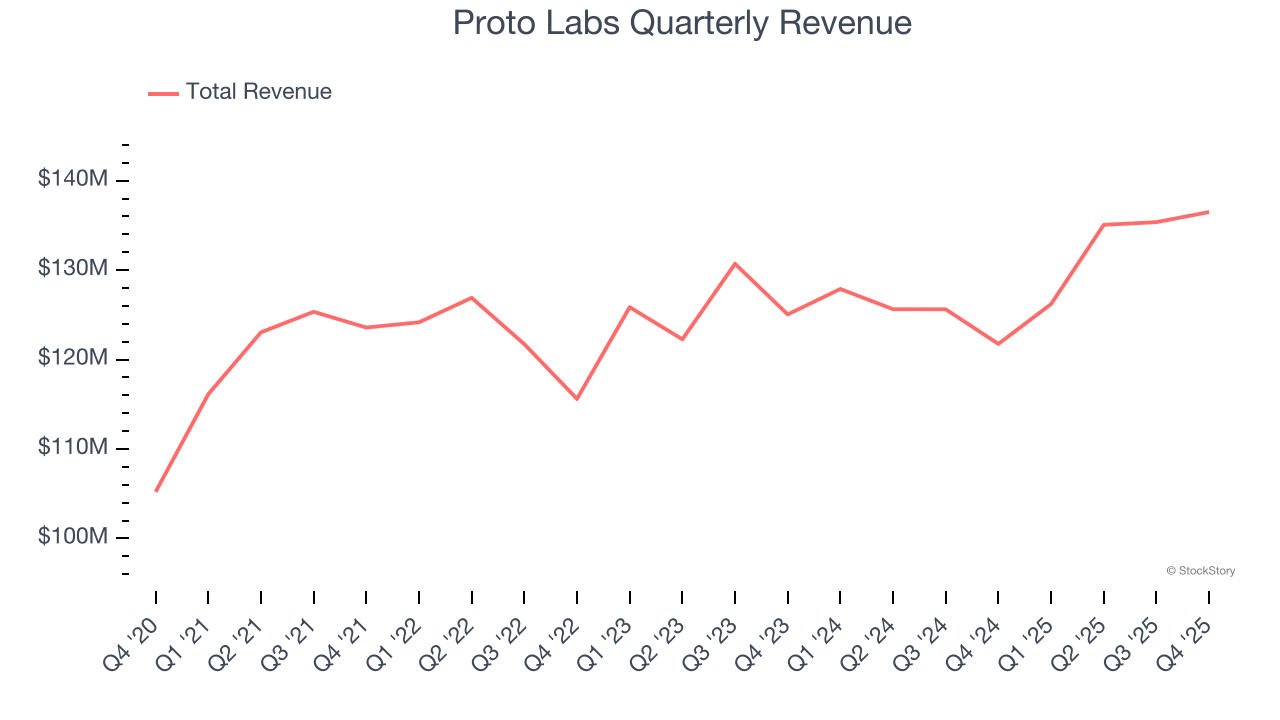
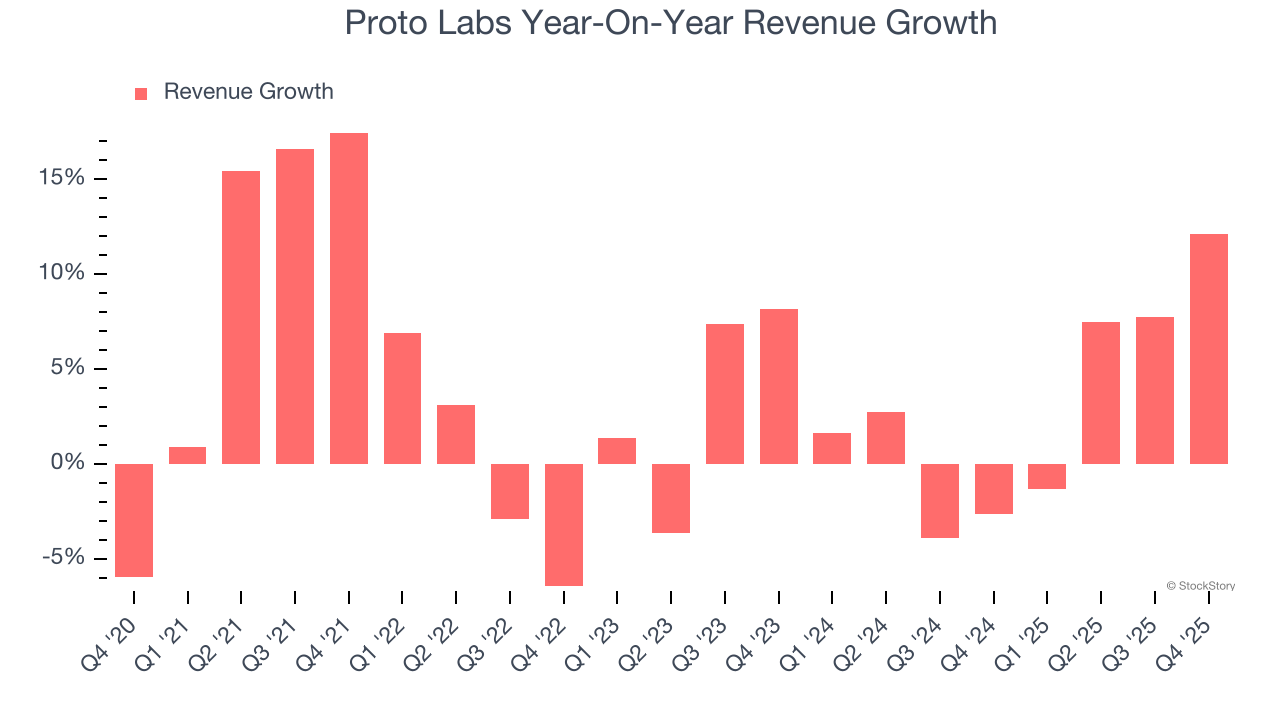
Long-term growth is the most important, but within industrials, a half-decade historical view may miss new industry trends or demand cycles. Proto Labs’s recent performance shows its demand has slowed as its annualized revenue growth of 2.9% over the last two years was below its five-year trend.
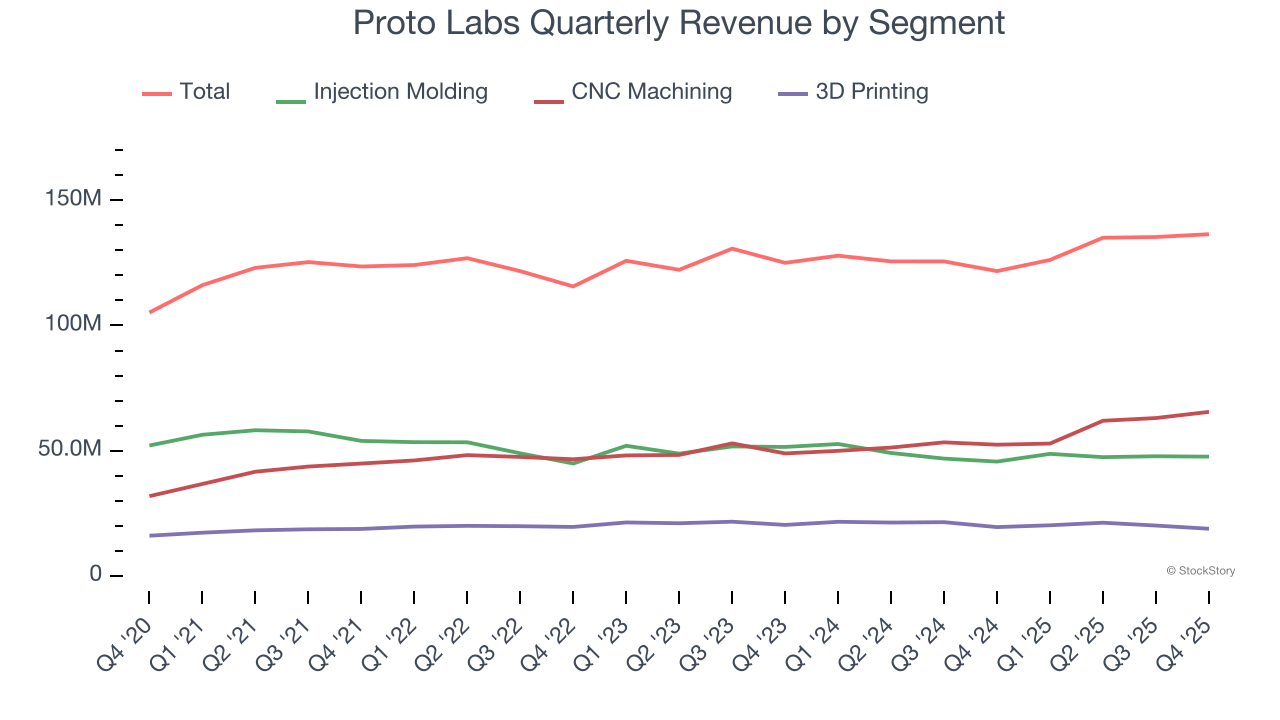
We can better understand the company’s revenue dynamics by analyzing its three most important segments: Injection Molding , CNC Machining , and 3D Printing, which are 34.9%, 48%, and 13.8% of revenue. Over the last two years, Proto Labs’s CNC Machining revenue (custom CNC-machined parts) averaged 11% year-on-year growth while its Injection Molding (injection molds and parts) and 3D Printing (custom 3D-printed parts) revenues averaged 2.9% and 2.4% declines.
This quarter, Proto Labs reported year-on-year revenue growth of 12.1%, and its $136.5 million of revenue exceeded Wall Street’s estimates by 5.4%. Company management is currently guiding for a 6.2% year-on-year increase in sales next quarter.
Looking further ahead, sell-side analysts expect revenue to grow 3.2% over the next 12 months, similar to its two-year rate. This projection doesn't excite us and indicates its newer products and services will not lead to better top-line performance yet.
Software is eating the world and there is virtually no industry left that has been untouched by it. That drives increasing demand for tools helping software developers do their jobs, whether it be monitoring critical cloud infrastructure, integrating audio and video functionality, or ensuring smooth content streaming. Click here to access a free report on our 3 favorite stocks to play this generational megatrend.
Operating Margin
Operating margin is a key measure of profitability. Think of it as net income - the bottom line - excluding the impact of taxes and interest on debt, which are less connected to business fundamentals.
Proto Labs was roughly breakeven when averaging the last five years of quarterly operating profits, inadequate for an industrials business. This result is surprising given its high gross margin as a starting point.
Analyzing the trend in its profitability, Proto Labs’s operating margin decreased by 3.6 percentage points over the last five years. This raises questions about the company’s expense base because its revenue growth should have given it leverage on its fixed costs, resulting in better economies of scale and profitability. Proto Labs’s performance was poor no matter how you look at it - it shows that costs were rising and it couldn’t pass them onto its customers.
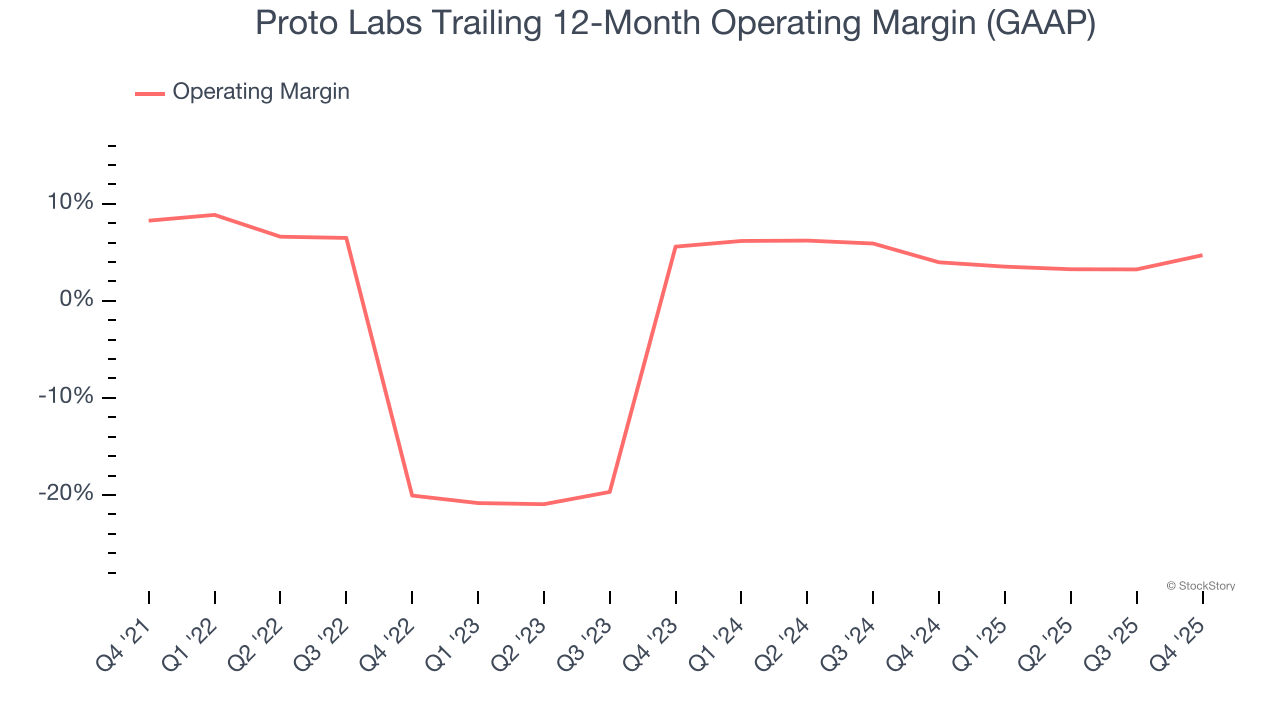
This quarter, Proto Labs generated an operating margin profit margin of 5%, up 6.2 percentage points year on year. The increase was solid, and because its operating margin rose more than its gross margin, we can infer it was more efficient with expenses such as marketing, R&D, and administrative overhead.
Earnings Per Share
Revenue trends explain a company’s historical growth, but the long-term change in earnings per share (EPS) points to the profitability of that growth – for example, a company could inflate its sales through excessive spending on advertising and promotions.
Sadly for Proto Labs, its EPS declined by 7% annually over the last five years while its revenue grew by 4.2%. This tells us the company became less profitable on a per-share basis as it expanded due to non-fundamental factors such as interest expenses and taxes.
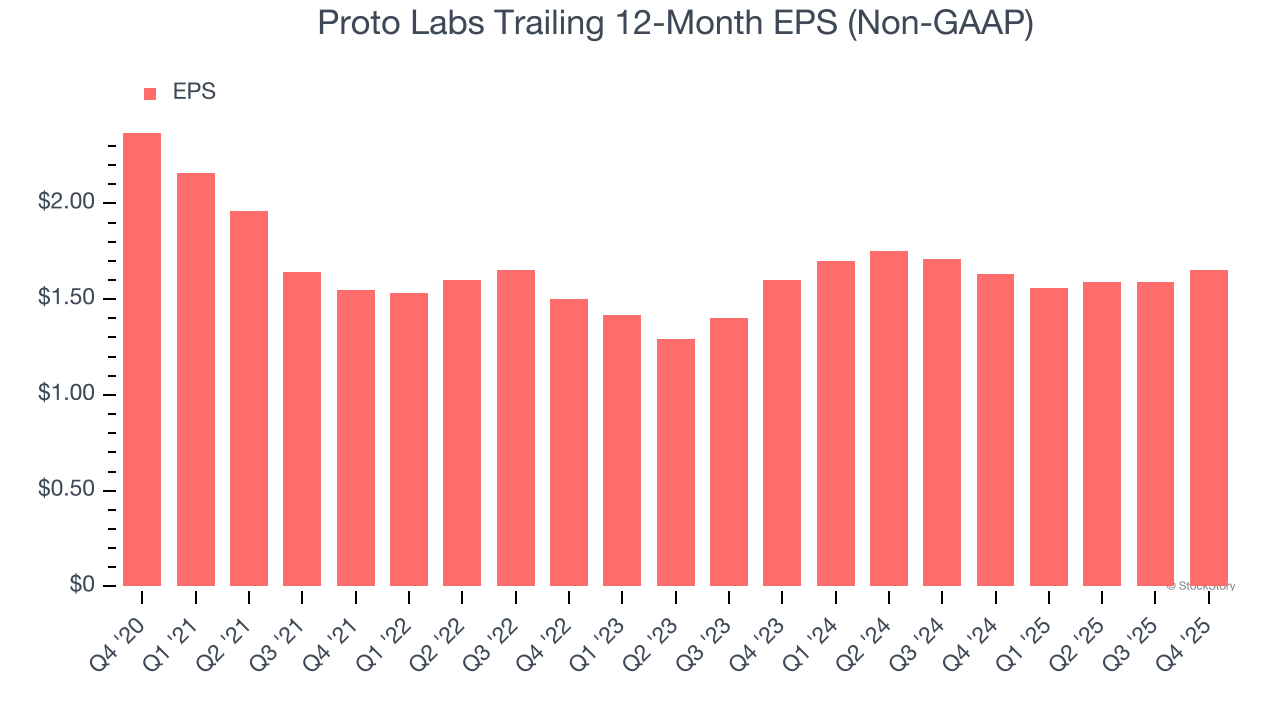
We can take a deeper look into Proto Labs’s earnings to better understand the drivers of its performance. As we mentioned earlier, Proto Labs’s operating margin expanded this quarter but declined by 3.6 percentage points over the last five years. This was the most relevant factor (aside from the revenue impact) behind its lower earnings; interest expenses and taxes can also affect EPS but don’t tell us as much about a company’s fundamentals.
Like with revenue, we analyze EPS over a more recent period because it can provide insight into an emerging theme or development for the business.
For Proto Labs, its two-year annual EPS growth of 1.6% was higher than its five-year trend. Accelerating earnings growth is almost always an encouraging data point.
In Q4, Proto Labs reported adjusted EPS of $0.44, up from $0.38 in the same quarter last year. This print easily cleared analysts’ estimates, and shareholders should be content with the results. Over the next 12 months, Wall Street expects Proto Labs’s full-year EPS of $1.65 to stay about the same.
Key Takeaways from Proto Labs’s Q4 Results
We were impressed by Proto Labs’s optimistic revenue and EPS guidance for next quarter, which exceeded analysts’ expectations. We were also glad its revenue and EPS in the quarter outperformed Wall Street’s estimates. Zooming out, we think this was a good print with some key areas of upside. The stock traded up 14.7% to $60.21 immediately after reporting.
Proto Labs had an encouraging quarter, but one earnings result doesn’t necessarily make the stock a buy. Let’s see if this is a good investment. When making that decision, it’s important to consider its valuation, business qualities, as well as what has happened in the latest quarter. We cover that in our actionable full research report which you can read here (it’s free).
Mentioned In This Article
Latest News
| Oct-21 | |
| Oct-21 | |
| Oct-09 | |
| Sep-23 | |
| Sep-04 | |
| Aug-24 | |
| Aug-13 | |
| Jul-31 | |
| Jul-31 | |
| Jul-31 | |
| Jul-10 | |
| Jul-10 | |
| Jul-07 | |
| May-07 | |
| May-02 |
