BBAI Stock Down 23% in a Month: Value Trap or AI Reset?
Shares of BigBear.ai Holdings, Inc. BBAI have come under renewed pressure, sliding roughly 22.8% over the past month and materially underperforming the Zacks Computers - IT Services industry and the broader Zacks Computer and Technology sector. The selloff has pulled the stock down to about $4.87 as of Feb. 9, lower than its 52-week high of $10.36, and has reignited investor debate around whether the decline reflects deeper structural issues or a reset in expectations tied to execution timing.
BBAI’s 1-Month Share Price Performance

Image Source: Zacks Investment Research
Technical Weakness Reinforces Negative Sentiment
The recent price action has also weakened BigBear.ai’s technical setup. The stock is now trading below both its 50-day and 200-day simple moving averages, which stand near $5.89 and $5.77, respectively, according to the chart shown below. This breakdown below key long-term trend lines suggests that the recent decline is not merely a short-term fluctuation but reflects sustained selling pressure.
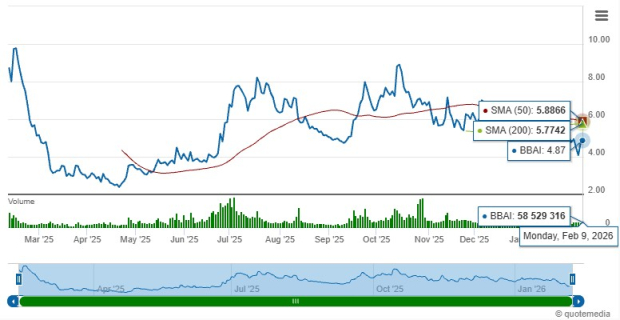
Image Source: Zacks Investment Research
BBAI Stock’s Valuation Looks Cheaper but Not Yet Compelling
At the current level, BigBear.ai trades at about 12.29X forward 12-month price-to-sales, a modest discount to the Zacks Computers – IT Services industry average of 13.85X. This multiple remains well above the company’s three-year median of 2.36X, highlighting how much growth optimism is still embedded in the stock despite the recent correction.
The wide historical valuation range underscores the market’s uneven confidence in BigBear.ai’s ability to convert its AI positioning into durable, profitable growth. The recent technical breakdown suggests investors are waiting for clearer operational evidence before assigning a higher multiple again.
BBAI's Valuation - P/S (F12M)

Image Source: Zacks Investment Research
BigBear.ai’s Q3 Results Added to the Reset Narrative
Operational performance in the third quarter of 2025 contributed to the stock’s loss of momentum. Revenues declined 20% year over year to $33.1 million, mainly due to lower volumes on certain Army programs. Gross margin compressed to 22.4%, and adjusted EBITDA swung to a loss of $9.4 million as selling, general and administrative expenses increased to support strategic initiatives.
Although management emphasized that the revenue softness reflected program timing and government funding delays rather than demand erosion, the results reinforced near-term uncertainty. For a stock already trading below key moving averages, the lack of immediate financial catalysts made it harder for sentiment to stabilize.
Long-Term AI Strategy Remains Intact for BigBear.ai
Despite near-term volatility, BigBear.ai’s long-term AI strategy remains intact and increasingly defined. Management is deliberately repositioning the company away from episodic, services-heavy analytics work toward platform-level, mission-ready AI that can scale across defense, intelligence and regulated commercial markets. The cornerstone of this shift is the completed $250 million acquisition of Ask Sage, a secure, model-agnostic generative AI platform purpose-built for government and highly regulated environments.
Ask Sage materially strengthens BigBear.ai’s position in agentic AI by enabling secure orchestration, deployment, and governance of large language models across classified and unclassified domains. The platform already supports tens of thousands of users across thousands of government teams and is embedded in live mission workflows, not pilot programs. Ask Sage brings a recurring revenue profile that contrasts with BigBear.ai’s historically project-driven mix, improving long-term revenue visibility.
Beyond Ask Sage, the company continues to expand its AI footprint through targeted acquisitions and partnerships focused on border security, customs automation and global trade intelligence. Initiatives such as the CargoSeer technology acquisition and strategic collaborations in the Middle East reinforce BigBear.ai’s dual-use AI vision, where national security and commercial trade applications share a common platform foundation.
While execution risk remains, the strategic direction is clearer, more scalable and better aligned with where government AI spending is headed.
Execution & Visibility Remain the Key Risks for BBAI Stock
For now, the gap between strategy and financial outcomes remains the central risk. Loss expectations for 2026 have not improved over the past two months, limiting support from estimate revisions. From a market perspective, the stock’s position below its 50-day and 200-day moving averages reflects skepticism that the AI transition will translate into near-term operating leverage.
BBAI's Estimates

Image Source: Zacks Investment Research
Until BigBear.ai demonstrates steadier revenue conversion from its expanded platform and clearer margin progression, technical resistance levels are likely to cap upside, even if the long-term narrative remains appealing.
How Competition Frames the Debate
Competition plays a central role in how investors are framing BigBear.ai’s reset. Palantir Technologies PLTR remains the most direct reference point. Palantir benefits from deep, long-standing relationships across defense and intelligence agencies, along with a proven ability to scale platforms into large, multi-year programs of record. Its stronger margins and consistent cash generation highlight the execution gap BigBear.ai still needs to close. As Palantir continues expanding its AIP platform, comparisons on operating leverage and contract durability remain unavoidable.
C3.ai AI frames the debate from a different angle. C3.ai focuses on enterprise AI applications spanning defense, energy and industrial markets. While it has faced its growth and sales-cycle challenges, C3.ai’s platform-centric model and emphasis on subscription revenues mirror BigBear.ai’s pivot toward recurring AI software. Investors increasingly compare BigBear.ai’s Ask Sage trajectory with how C3.ai monetizes enterprise AI at scale.
Booz Allen Hamilton BAH represents a more entrenched competitive force. Booz Allen Hamilton combines deep consulting relationships with expanding AI capabilities embedded directly into federal workflows. Its scale, balance sheet strength and procurement access raise the bar for BigBear.ai as Booz Allen Hamilton continues integrating AI into long-term government modernization programs.
Together, Palantir Technologies, C3.ai and Booz Allen Hamilton define the competitive framework shaping investor expectations for BigBear.ai’s next phase.
Value Trap or AI Reset?
The sharp decline and technical breakdown suggest the market is reassessing BigBear.ai’s timeline rather than abandoning the AI thesis altogether. The stock appears to be in an AI reset phase, where expectations are being recalibrated to reflect execution risk, contract timing and margin pressure.
With the shares trading below key moving averages and estimate trends flat, caution is warranted. At the same time, the strengthened balance sheet, expanding AI platform and growing backlog argue against writing off the story entirely. This balance of risk and opportunity supports the Zacks Rank #3 (Hold) company, positioning the stock as one to monitor rather than chase until both fundamentals and technical signals improve. You can see the complete list of today’s Zacks #1 Rank (Strong Buy) stocks here.
Want the latest recommendations from Zacks Investment Research? Today, you can download 7 Best Stocks for the Next 30 Days. Click to get this free report
C3.ai, Inc. (AI): Free Stock Analysis Report
Booz Allen Hamilton Holding Corporation (BAH): Free Stock Analysis Report
Palantir Technologies Inc. (PLTR): Free Stock Analysis Report
BigBear.ai Holdings, Inc. (BBAI): Free Stock Analysis Report
This article originally published on Zacks Investment Research (zacks.com).
Mentioned In This Article
Latest News
| 3 hours | |
| Oct-07 | |
| Oct-07 | |
| Oct-07 | |
| Oct-06 | |
| Oct-06 | |
| Oct-06 |
Michael Burry's Bearish View. The Market Is In 'Denial' About The End Of The AI Trade.
PLTR
Investor's Business Daily
|
| Oct-06 | |
| Oct-06 | |
| Oct-06 | |
| Oct-05 | |
| Oct-02 | |
| Oct-02 | |
| Oct-02 | |
| Oct-02 |
