Will BMY's Legacy Portfolio Decline Weigh on Its 2026 Top Line?
Bristol Myers’ BMY legacy portfolio — comprising Eliquis, Revlimid, Pomalyst, Sprycel and Abraxane — continues to face significant erosion from generic competition.
Fourth-quarter legacy portfolio revenues declined 15% year over year to $5.1 billion (results reported last week), primarily due to generics for Revlimid, Pomalyst, Sprycel and Abraxane.
For full-year 2025, revenues from the legacy portfolio fell 15% to $21.8 billion, representing 45% of Bristol Myers’ total revenues of $48.2 billion. Management expects this segment to decline a further 12-16% in 2026, as reflected in the company’s 2026 revenue guidance of $46.0-$47.5 billion (down from $48.2 billion generated in 2025).
The legacy portfolio includes Eliquis, the blood thinner co-developed and co-commercialized globally with Pfizer PFE. While Eliquis continues to benefit from strong global demand, its growth is offset by ongoing generic pressure across the rest of the portfolio and higher government-channel rebates in the United States.
Eliquis sales in 2025 totaled $14.4 billion, up 8% year over year.
The company expects Eliquis sales to grow 10-15% in 2026, supported by sustained global demand. Guidance incorporates the impact of the recent price reduction, which is expected to expand patient access while eliminating the inflation penalty. Sales are anticipated to be weighted toward the second half of the year.
However, Eliquis faces a decline thereafter, with sales projected to step down in the range of $1.5-$2 billion in 2027.
Competition for BMY’s Key Drugs
BMY’s growth portfolio primarily comprises Opdivo, Orencia, Yervoy, Reblozyl, Opdualag, Abecma, Zeposia, Breyanzi, Camzyos, Sotyku, Krazati and others.
Oncology is a key therapeutic area of focus for Bristol Myers, which is developing and delivering transformational medicines in this space. However, BMY faces competition from large pharma companies like Merck MRK and Pfizer.
The immuno-oncology space is dominated by pharma giant MRK’s blockbuster drug Keytruda (pembrolizumab).
Keytruda is approved for several types of cancer and alone accounts for around 50% of MRK’s pharmaceutical sales. Merck is currently working on different strategies to drive the long-term growth of Keytruda.
Developing bispecific antibodies that target two proteins, namely PD-1 and VEGF, has lately been one of the lucrative areas in cancer treatment.
In 2024, Merck received an exclusive global license to develop, manufacture and commercialize LM-299, a novel investigational PD-1/VEGF bispecific antibody from LaNova. Merck’s oncology portfolio boasts a blockbuster PD-L1 inhibitor, Keytruda, and the company is looking to build a diversified oncology pipeline spanning differentiated mechanisms and multiple modalities.
Pfizer is one of the largest and most successful drugmakers in the field of oncology. It has an innovative oncology product portfolio of antibody-drug conjugates (ADCs), small molecules, bispecifics and other immunotherapies that treat a wide range of cancers, including certain types of breast cancer, genitourinary cancer and hematologic malignancies, as well as certain types of melanoma, gastrointestinal, gynecological and lung cancer. Pfizer also has oncology biosimilars in its portfolio.
PFE inked a licensing agreement with 3SBio for the development, manufacturing and commercialization of SSGJ-707, a bispecific antibody targeting PD-1 and VEGF, outside China.
BMY’s Price Performance, Valuation & Estimates
Shares of Bristol Myers have gained 32.3% over the past six months compared with the industry’s growth of 26.7%.

Image Source: Zacks Investment Research
From a valuation standpoint, BMY is trading at a discount to the large-cap pharma industry. Going by the price/earnings ratio, shares currently trade at 9.96x forward earnings, higher than its mean of 8.42x but lower than the large-cap pharma industry’s 18.76x.
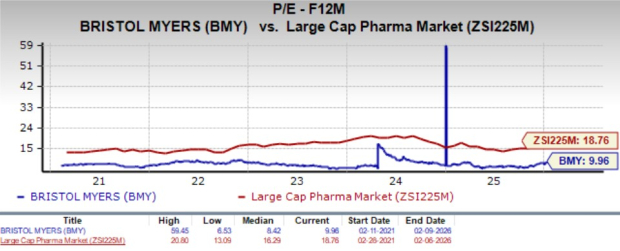
Image Source: Zacks Investment Research
The Zacks Consensus Estimate for 2026 EPS has moved north to $6.13 from $6.08 in the past seven days, while that for 2027 has inched up to $5.92 in the same time frame.

Image Source: Zacks Investment Research
BMY currently carries a Zacks Rank #3 (Hold). You can see the complete list of today’s Zacks #1 Rank (Strong Buy) stocks here.
Want the latest recommendations from Zacks Investment Research? Today, you can download 7 Best Stocks for the Next 30 Days. Click to get this free report
Bristol Myers Squibb Company (BMY): Free Stock Analysis Report
Pfizer Inc. (PFE): Free Stock Analysis Report
Merck & Co., Inc. (MRK): Free Stock Analysis Report
This article originally published on Zacks Investment Research (zacks.com).
Mentioned In This Article
Latest News
| Oct-09 | |
| Oct-09 | |
| Oct-09 | |
| Oct-09 | |
| Oct-09 | |
| Oct-09 | |
| Oct-09 | |
| Oct-08 | |
| Oct-08 | |
| Oct-08 | |
| Oct-08 | |
| Oct-08 | |
| Oct-08 | |
| Oct-08 | |
| Oct-08 |
FDA approves Pfizer's Tukysa regimen for metastatic breast cancer
PFE
Pharmaceutical Business Review
|
