SoFi's 2026 Outlook: Margin Expansion Strengthens Further
The defining takeaway from SoFi Technologies’ SOFI 2026 outlook is not just growth, but margin expansion at scale. While revenue and membership gains remain impressive, the real inflection lies in how efficiently that growth is translating into profits.
Management’s projections indicate another year of roughly 30% top-line expansion, supported by continued traction in lending, financial services and its broader platform ecosystem. Member growth is expected to remain robust, signaling sustained demand and strong customer engagement. However, revenue growth alone does not differentiate fintech platforms in today’s market. Profit durability does.
What stands out is the expected operating leverage. EBITDA margins are guided into the mid-30% range, while net income margins are projected to approach the high teens. Those signals are improving cost absorption, disciplined expense control, and a more mature revenue mix. Earnings per share are also set to rise meaningfully, reinforcing that incremental revenue is increasingly falling to the bottom line.
Importantly, first-quarter expectations suggest stability rather than volatility, implying that momentum exiting 2025 is carrying forward without relying on unusually favorable conditions.
In essence, 2026 appears positioned as a year where SoFi transitions from a rapid-growth fintech to a scaled, margin-driven operator. If execution matches guidance, margin strength, not just revenue expansion, could become the primary valuation driver.
Peer Comparison
Upstart UPST serves as a useful comparison because Upstart remains focused on AI-driven lending but continues to face inconsistent loan volume tied to funding availability. This makes Upstart less predictable in converting growth into sustained profitability. The contrast highlights SoFi’s advantage in operating with a stronger balance sheet.
LendingClub LC is another relevant peer. It follows a marketplace-bank hybrid model and emphasizes credit discipline and deposit stability. However, LendingClub has not matched SoFi’s momentum in member expansion or fee-income scale. With a narrower product set and slower diversification, LendingClub reflects the challenges of achieving the same degree of operating leverage that SoFi is beginning to demonstrate.
SOFI’s Price Performance, Valuation and Estimates
The stock has gained 43% over the past year against the industry’s 21% decline.
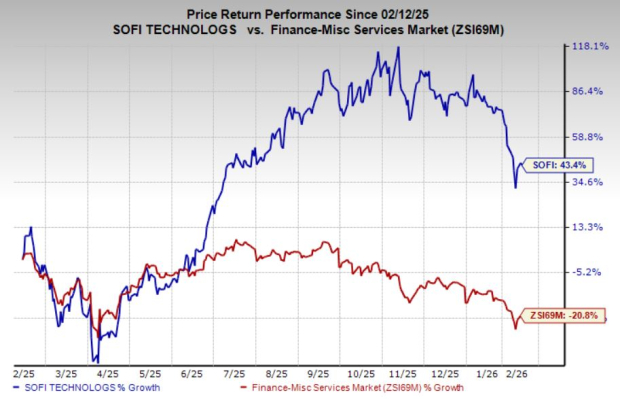
From a valuation standpoint, SOFI trades at a forward price-to-earnings ratio of 34X, well above the industry’s 14X. It carries a Value Score of F.
The Zacks Consensus Estimate for SOFI’s 2025 earnings has been on the rise over the past 60 days.
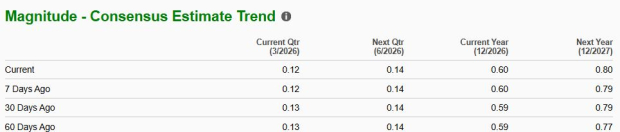
SOFI stock currently carries a Zacks Rank #3 (Hold). You can see the complete list of today’s Zacks #1 Rank (Strong Buy) stocks here.
Want the latest recommendations from Zacks Investment Research? Today, you can download 7 Best Stocks for the Next 30 Days. Click to get this free report
LendingClub Corporation (LC): Free Stock Analysis Report
Upstart Holdings, Inc. (UPST): Free Stock Analysis Report
SoFi Technologies, Inc. (SOFI): Free Stock Analysis Report
This article originally published on Zacks Investment Research (zacks.com).
Mentioned In This Article
Latest News
| Oct-22 | |
| Oct-22 | |
| Oct-22 | |
| Oct-22 |
SoFi partners with Prudential to offer term life insurance in its app
SOFI
Life Insurance International
|
| Oct-22 | |
| Oct-22 | |
| Oct-22 | |
| Oct-21 | |
| Oct-21 | |
| Oct-21 | |
| Oct-16 | |
| Oct-16 | |
| Oct-16 | |
| Oct-16 | |
| Oct-16 |
