Is it Too Late to Buy WDC Stock After 305% Explosive Rally in a Year?
Western Digital Corporation’s WDC shares have jumped a whopping 305.2% over the past year, far outpacing the 134.3% rally of the Zacks Computer-Storage Devices industry. The stock has also outperformed the Zacks Computer & Technology sector and the S&P 500’s growth of 21.6% and 15.7%, respectively. A major driver behind Western Digital’s rally is soaring demand for data storage from AI and cloud workloads.

Image Source: Zacks Investment Research
The company has outdone its cut-throat rival in the HDD business, Seagate Technology Holdings plc STX, and competitors in the broader storage space, such as Pure Storage PSTG, with STX and PSTG rising 301.3% and 12.6%, respectively, during the period. WDC has underperformed Sandisk Corporation SNDK, which climbed 1133.2% in a year.
Seagate is a leading data storage company, with hard disk drives as its core product. Pure Storage, with its all-flash FlashArray and FlashBlade systems, targets high-performance workloads. Growing data demand continues to drive strong prospects for both PSTG and WDC in the expanding storage landscape. In February 2025, WDC split its HDD and Flash businesses into two public companies, with the new SanDisk positioned to leverage its storage expertise to capitalize on AI-driven opportunities.
WDC has a 52-week high of $296.5. Following a strong rally, investors may wonder whether WDC still has meaningful upside or whether expectations have outpaced fundamentals. Let’s break down the pros and cons to assess the road ahead.
WDC Reinvents the Hard Drive at Innovation Day 2026
At its Innovation Day 2026, Western Digital, now rebranded as WD, emphasized that the hard drive is far from obsolete. Instead, it is being reinvented as a foundational pillar of AI infrastructure. It introduced a refreshed three-five year financial model and unveiled updated branding aligned with its data center–centric identity. The rapid expansion of AI workloads is driving unprecedented demand for high-capacity, reliable storage as models generate massive volumes of training data, logs, checkpoints and inference datasets.
In response, Western Digital has outlined a clear, forward-looking roadmap: a 40TB UltraSMR ePMR HDD currently in qualification with two hyperscalers and slated for volume production in the second half of 2026, HAMR-based drives already in qualification with a production ramp expected in 2027, a 60TB ePMR extension that leverages HAMR innovations without increasing power requirements and a 100TB HAMR HDD targeted by 2029. Rather than pushing customers toward a single technology transition, WD is executing a dual-path strategy—maintaining leadership in both ePMR and HAMR to provide flexibility, scalability and a lower-risk migration path as storage demands continue to accelerate.
WDC is narrowing the performance gap between HDDs and QLC flash with two industry-first innovations aimed at AI workloads. High Bandwidth Drive technology enables simultaneous multi-head, multi-track read/write operations, delivering up to 2x bandwidth today with a roadmap to 8x without increasing power, and is already in customer validation. Dual Pivot Technology introduces independently operating actuators within a standard 3.5-inch drive, providing up to 2x sequential I/O gains without sacrificing capacity or requiring software changes. It is expected to be available in 2028. Together, these advancements can deliver up to 4x sequential I/O performance, supporting 100TB HDDs while maintaining current IO-per-TB ratios and reducing the need for additional SSD deployment.
It is also set to expand its Platforms business in 2027 with the introduction of an intelligent software layer and open API designed to streamline large-scale storage deployments. The platform aims to extend hyperscale storage economics to customers managing 200+ petabytes, while reducing qualification risk and accelerating time-to-production. By simplifying the adoption of UltraSMR, ePMR, HAMR and flash solutions, the initiative is expected to lower infrastructure complexity and enhance operational efficiency across enterprise environments.
Improved Fundamentals Power WDC’s Momentum Amid the AI Boom
Western Digital is benefiting from secular growth trends while delivering earnings beats and expanding profitability. For the fiscal second quarter, Western Digital generated $3.02 billion in revenue, up 25% year over year, driven primarily by strong data center demand and increased adoption of high-capacity HDDs. Cloud revenues have become the backbone of WDC’s business, accounting for a hefty and growing share of total sales. It reported a non-GAAP gross margin of 46.1%, up 770 basis points year over year. The upside resulted from a steady transition to higher-capacity drives and rigorous cost management across production facilities and the supply chain.
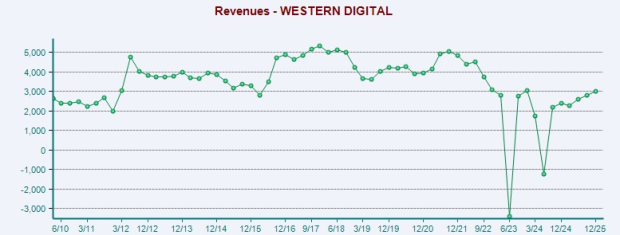
Image Source: Zacks Investment Research
WDC has used capital return strategies to attract investors. In addition to strong operating performance, the company declared a quarterly dividend of 12.5 cents per share, reinforcing its commitment to shareholder returns and disciplined capital allocation. In the fiscal second quarter, the company returned more than 100% of free cash flow to shareholders through $615 million in share repurchases and $48 million in dividends during the quarter.
Since launching its capital return program in 2025, it has returned $1.4 billion via buybacks and dividends, highlighting the strength of its cash-generation profile. Recently, its board authorized an additional $4 billion for share repurchases, with approximately $484 million remaining under the previous authorization as of Feb. 2, 2026.
However, it faces mounting near-term risks from macroeconomic instability, including tariffs and escalating trade tensions that could trigger unpredictable demand swings across enterprise and retail channels. The AI-driven storage boom, while supportive of long-term demand, is also straining operations as higher-capacity drives add manufacturing complexity and lengthen production cycles. Elevated debt levels restrict financial flexibility, limiting the company’s ability to pursue strategic acquisitions or invest aggressively in growth. As of Jan. 2, 2026, cash and cash equivalents were $2 billion, while long-term debt (including the current portion) was $4.7 billion.
Estimate Revision Trend of WDC
WDC’s estimates revisions are on an upward trajectory currently. The Zacks Consensus Estimate for WDC’s earnings for fiscal 2026 has been revised north 17.4% to $8.96 over the past 60 days, while the same for fiscal 2027 has gone up 54.3% to $15.19.

Image Source: Zacks Investment Research
Key Valuation Metric of WDC
Going by the price/earnings ratio, the company’s shares currently trade at 21.64 forward earnings compared with 19.1 for the industry.

Image Source: Zacks Investment Research
Final Take: Bet on WDC Now
In short, the explosion of AI-generated data is driving massive storage demand, positioning Western Digital to benefit significantly. Its competitive outlook through 2026–27 will hinge on the execution of next-generation technologies like HAMR, which could either accelerate growth or create challenges if missteps occur. As agentic AI adoption broadens, storage needs are expected to expand rapidly, supporting long-term demand. Meanwhile, ongoing share buybacks reflect management’s confidence in sustained cash flow.
Investors should balance long-term technology tailwinds with near-term market risks when making decisions. Flaunting a Zacks Rank #1 (Strong Buy) at present, WDC seems to be a good buy. You can see the complete list of today’s Zacks #1 Rank stocks here.
Want the latest recommendations from Zacks Investment Research? Today, you can download 7 Best Stocks for the Next 30 Days. Click to get this free report
Western Digital Corporation (WDC): Free Stock Analysis Report
Seagate Technology Holdings PLC (STX): Free Stock Analysis Report
Sandisk Corporation (SNDK): Free Stock Analysis Report
Pure Storage, Inc. (PSTG): Free Stock Analysis Report
This article originally published on Zacks Investment Research (zacks.com).
Mentioned In This Article
Latest News
| Oct-19 | |
| Oct-19 | |
| Oct-19 | |
| Oct-19 | |
| Oct-19 | |
| Oct-19 |
Sandisk, Datadog, Amazon Lead S&P 500 As AI Stocks Rebound
WDC +6.09% SNDK +5.53%
Investor's Business Daily
|
| Oct-19 | |
| Oct-19 | |
| Oct-19 | |
| Oct-19 | |
| Oct-19 | |
| Oct-19 | |
| Oct-19 | |
| Oct-19 | |
| Oct-19 |
