DTE's Stargate Deal Turns Power Into Profits
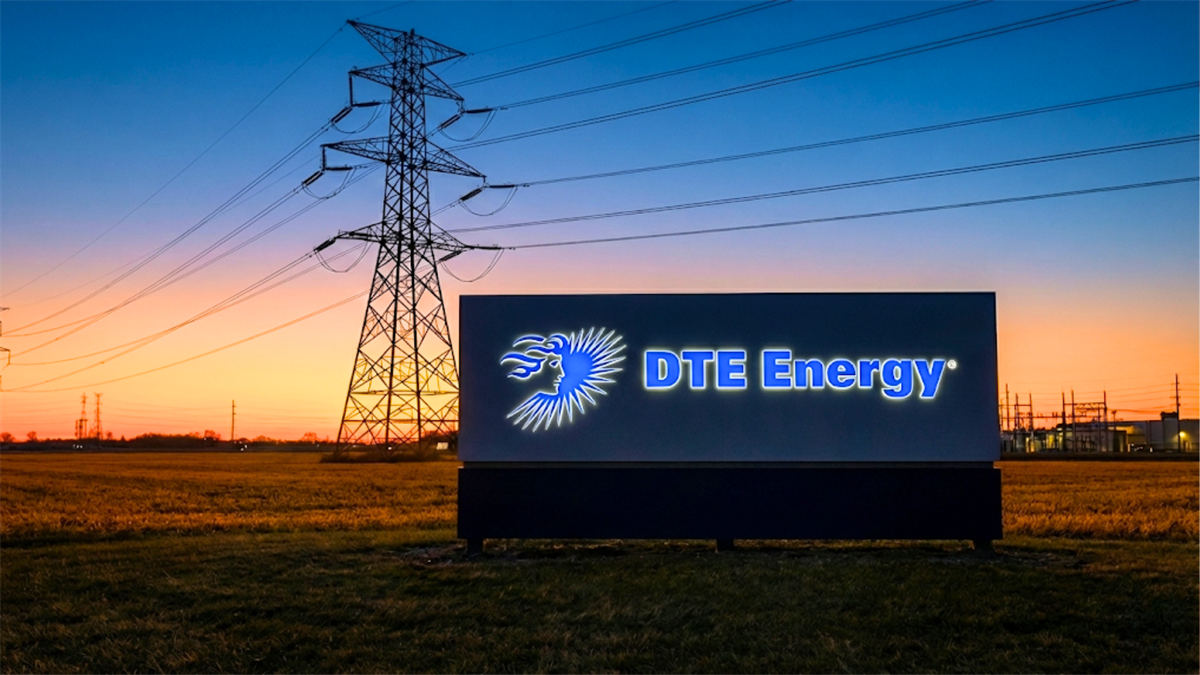
The financial landscape of early 2026 has been defined by a singular, violent theme: rotation. As investors flee the speculative froth of the technology sector, capital is finding a new home in the tangible economy. While Silicon Valley worries about software efficiency driving down margins, the physical reality remains unchanged: Artificial intelligence (AI) requires massive amounts of electricity. In this turbulent environment, DTE Energy (NYSE: DTE) has emerged as a defensive shelter that is a critical infrastructure partner for the digital age.
On Feb. 17, 2026, the Detroit-based utility company delivered a beat-and-raise performance that silenced skeptics. DTE reported fourth-quarter operating earnings of $1.65 per share, comfortably beating the analyst consensus of $1.52. Revenue surged to $4.43 billion, beating expectations of $3.39 billion. The market responded immediately, sending shares up approximately 2.8% on a day when the tech-heavy Nasdaq struggled. For investors tired of the volatility in chip stocks, DTE offers a compelling signal: the smartest way to play AI right now might be through the power grid.
Project Stargate: 1.4 Gigawatts of Guaranteed Growth
The centerpiece of the bullish thesis for DTE is the confirmation of a landmark agreement to power 100% of the Stargate OpenAI data center campus in Saline Township, Michigan. This is not a standard commercial contract; it is a partnership with industry titans Oracle (NYSE: ORCL) and OpenAI. The facility requires 1.4 gigawatts (GW) of power, an immense load roughly equivalent to the output of a nuclear reactor or enough to power approximately one million homes. This single customer represents a staggering 25% increase in DTE’s total electric load.
For investors, the specific economics of this deal are more important than the engineering. The agreement is structured with minimum monthly charges that cover 80% of the billing demand. This take-or-pay feature is crucial. It means DTE gets paid for the capacity, whether the AI servers are running at full speed or sitting idle. It effectively functions as a royalty on the AI economy, stripped of the execution risk associated with picking the winning software model.
Furthermore, the physical build-out of this campus highlights the scale of the Physical AI trade. Developed by Related Digital, the site will utilize advanced closed-loop cooling systems to minimize water usage and is projected to create over 2,500 union construction jobs.
Management also noted they are in advanced discussions for an additional 3 GW of load, suggesting Stargate is just the opening act of a much larger transformation. Unlike its peer CMS Energy (NYSE: CMS), which is pursuing a broader strategy of pursuing tariffs for smaller data centers, DTE is whale-hunting, securing massive, singular projects that move the needle immediately.
Dividends, Earnings, and $36 Billion in Spending
DTE’s recent financial updates provide the visibility that uncertain markets crave. Management issued robust guidance for 2026, projecting operating earnings per share (EPS) of $7.59 to $7.73. This represents a 6% to 8% growth rate over the previous year, a trajectory that sits at the upper echelon of the utility sector. Executives signaled confidence in hitting the high end of this range, supported by tax credits from their Renewable Natural Gas (RNG) business.
To support the massive infrastructure build-out required by Stargate and the broader energy transition, DTE announced a $6.5 billion increase to its five-year capital investment plan, bringing the total to $36.5 billion through 2030. In the utility business model, capital expenditure is the engine of profit. Because utilities are regulated monopolies, they are authorized to earn a specific return on equity (ROE) on every dollar they invest in the grid. Therefore, a $36.5 billion spending plan is effectively a roadmap for guaranteed profit growth. By upgrading the grid to handle AI loads, DTE is increasing the rate base used to calculate its earnings.
Income-focused investors also have reason to stay. The company declared a quarterly dividend of $1.165 per share, equating to an annualized payout of $4.66. With a yield of approximately 3.2% and a track record of 16 consecutive years of dividend increases, DTE offers an inflation-protected income stream that speculative tech stocks simply cannot match.
The Wall of Worry: Risks and Reality
No investment is without risk, and DTE faces specific challenges that prospective shareholders must weigh. The most immediate headwind is regulatory friction. Michigan Attorney General Dana Nessel recently filed a motion to reopen the approval case for the Stargate data center contracts. Her objection centers on a subtle but critical change in contract language: DTE changed a guarantee that payments from the data center would cover costs to aggregate revenues.
Nessel argues that this loophole allows DTE to run a deficit in the early years of the contract, effectively forcing residential ratepayers to subsidize the infrastructure costs for Oracle and OpenAI, with the promise that the data center will repay them in later years. While this creates political noise and potential delays, DTE argues the project will eventually lower costs for all customers by $300 million.
Additionally, a federal judge recently ordered DTE to pay a $100 million civil penalty regarding environmental violations at its Zug Island facility. While a nine-figure fine grabs headlines, it must be viewed in context. DTE generates approximately $1.5 billion in annual operating earnings. The fine represents a manageable, one-time hit to liquidity rather than a structural threat to the business model.
Finally, the company is racing against the clock. The One Big Beautiful Bill Act (OBBBA), signed in 2025, requires wind and solar projects to begin construction by July 4, 2026, to qualify for key tax credits. This hard deadline forces DTE to execute its construction plans perfectly, but it also accelerates asset growth.
A Physical Toll Booth on the Digital Highway
DTE Energy currently trades at a price-to-earnings ratio (P/E) of approximately 21x. While this is a premium compared to slower-growing utilities (typically 16x-18x), it represents a massive discount relative to the AI hardware and software stocks it powers, which often trade at multiples of 30x or higher.
The stock offers a rare hybrid profile for the current market environment. It provides the downside protection of a regulated monopoly with a secure dividend, while simultaneously offering the upside torque of the largest technological shift in history. As the market rotates away from the intangible promises of software and toward the hard assets required to run it, DTE Energy stands as the adult in the room. For investors seeking exposure to AI without the vertigo of high valuations, the power grid is the ultimate physical hedge.
Where Should You Invest $1,000 Right Now?
Before you make your next trade, you'll want to hear this.
MarketBeat keeps track of Wall Street's top-rated and best performing research analysts and the stocks they recommend to their clients on a daily basis.
Our team has identified the five stocks that top analysts are quietly whispering to their clients to buy now before the broader market catches on... and none of the big name stocks were on the list.
They believe these five stocks are the five best companies for investors to buy now...
The article "DTE’s Stargate Deal Turns Power Into Profits" first appeared on MarketBeat.
Mentioned In This Article
Latest News
| 29 min | |
| 30 min | |
| 31 min | |
| 32 min | |
| 33 min | |
| 34 min | |
| 35 min | |
| 36 min | |
| 37 min | |
| 38 min | |
| 2 hours | |
| Oct-25 | |
| Oct-25 | |
| Oct-25 | |
| Oct-24 |
