Morgan Stanley or Evercore: Which is a Smarter Bet Amid M&A Upcycle?
Morgan Stanley MS and Evercore Inc. EVR represent two distinct, top-tier investment banking (IB) models. Morgan Stanley pairs advisory and capital markets strength with sizable wealth and asset management platforms that diversify earnings. Evercore is a leading independent advisory boutique, built around high-margin M&A and restructuring advice with a leaner balance sheet profile.
Both have shown resilience as M&A and IPO activity recovered in 2024-2025. With the IB outlook turning brighter, the main question is which stock offers the better risk-reward from here: Morgan Stanley or Evercore?
The Case for Morgan Stanley
Given the industry-wide turnaround in the IB business, Morgan Stanley’s performance has been impressive. The company’s IB fees soared 23% in 2025 and 35% in 2024 after plunging in 2023 and 2022. The year 2025 began on an optimistic note, but market sentiment cooled after Trump’s tariff policies launched on 'Liberation Day', casting a shadow over deal-making. The momentum has rebounded, as deal-making activity started picking up. Going ahead, a healthy global IB pipeline, an active M&A market, “reopening of the IPO market,” and the company’s leadership position will aid it amid the changing macro situation.
Moreover, Morgan Stanley’s trading business performance has been stellar over the past several quarters, given the uncertainty surrounding the tariffs and macroeconomic headwinds. As market volatility and client activity are expected to remain decent, the company’s trading business will likely continue to grow.
Morgan Stanley’s partnership with Japan’s Mitsubishi UFJ Financial Group, Inc. keeps supporting profitability. In 2023, the companies announced plans to deepen their 15-year alliance by merging certain operations within their Japanese brokerage joint ventures. These efforts have solidified the company’s position in Japan’s market. The company’s Asia region revenues surged 23% year over year to $9.42 billion in 2025.
Although Morgan Stanley leans heavily into the IB business, it has diversified into more stable, revenue-generating sources, such as asset and wealth management businesses, creating a more balanced revenue stream across economic cycles. The aggregate contribution of the wealth and asset management segments to total net revenues increased to nearly 54% in 2025 from 26% in 2010. As of Dec. 31, 2025, total client assets across both segments reached $9.3 trillion, bringing the company closer to its longstanding $10 trillion asset management target set by former CEO James Gorman.
The Case for Evercore
Evercore, though small in size, has established itself as a significant player in the IB space. The company generates most of its revenues from the Investment Banking and Equities business (which constituted 97% of total revenues in 2025). After subdued activity in 2022 and 2023, global M&As improved in 2024 and 2025 as both deal value and volume rose.
In 2025, M&A activity opened on an optimistic note, though sentiment briefly cooled, but rebounded as the year progressed. Looking ahead, transaction activity is expected to strengthen, supported by lower borrowing costs and increased focus on scale and AI integration. Investment Banking and Equities business witnessed a compound annual growth rate (CAGR) of 10.7% over the past five years (2020-2025).
Evercore is strengthening its IB business footprint by actively increasing staff. As of Dec. 31, 2025, the company employed more than 200 senior managing directors in the Investment Banking & Equities business. In February, the company acquired U.K.-based independent advisory firm, Robey Warshaw. This will bolster the company’s presence across EMEA and broaden its sector and product coverage.
EVR’s efforts to boost its client base in advisory solutions, diversify revenue sources and expand geographically will likely support IB revenue growth.
A small portion of Evercore’s business is wealth management. Though the division’s profitability has been hurt in recent years due to the disposal and restructuring of several related units, decent inflows, upbeat market performance and higher fees from clients are expected offer some support.
MS & EVR: Price Performance, Valuation & Other Comparisons
Over the past year, shares of Morgan Stanley have risen 28.7%, while Evercore gained 26.9%.
1-Year Price Performance

Image Source: Zacks Investment Research
Both have outperformed the Zacks Investment Bank industry. Hence, in terms of investor sentiments, Morgan Stanley has the edge.
In terms of valuation, Evercore is currently trading at a 12-month forward price-to-earnings (P/E) of 15.88X. MS stock is currently trading at a 12-month forward P/E of 14.89X.
P/E F12M

Image Source: Zacks Investment Research
Therefore, Morgan Stanley is inexpensive compared to EVR.
EVR’s return on equity (ROE) of 32.01% is above Morgan Stanley’s 16.79%. This reflects that Evercore is more efficient in the use of shareholder funds to generate profits than MS.
ROE
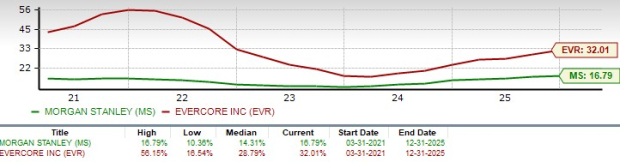
Image Source: Zacks Investment Research
How Do Estimates Compare for Evercore & Morgan Stanley?
The Zacks Consensus Estimate for MS’ 2026 and 2027 revenues suggests a year-over-year increase of 6% and 4.8%, respectively.
Also, the consensus estimate for earnings implies 8.6% and 7% growth for 2026 and 2027, respectively. Earnings estimates for both years have been revised north over the past month.
MS Estimate Revision

Image Source: Zacks Investment Research
On the contrary, analysts are more bullish on Evercore’s prospects. The Zacks Consensus Estimate for EVR’s 2026 and 2027 revenues indicates a year-over-year rise of 22.2% and 12.5%, respectively.
Further, the consensus estimate for 2026 earnings indicates a 27.2% jump, while the same is anticipated to increase 25.5% for 2027. Earnings estimates for 2026 have been revised upward, while those for 2027 moved lower over the past 30 days.
EVR Estimate Revision

Image Source: Zacks Investment Research
MS or EVR: Which Stock Has More Upside Right Now?
While Evercore offers a faster projected growth, Morgan Stanley looks like the sturdier, higher-quality way to ride the reopening of capital markets. MS’ rebounding IB engine with a consistently strong trading franchise tends to benefit when volatility and client activity stay elevated.
Morgan Stanley’s wealth and asset-management platform (now contributing about half of net revenues) adds durability across cycles and supports steadier capital returns. Hence, the company can still deliver if deal sentiment turns choppy. The company’s Japan expansion through the MUFG alliance is another underappreciated lever, evidenced by the sharp jump in Asia revenues in 2025. For investors prioritizing resilience plus upside, Morgan Stanley is the better bet.
At present, Morgan Stanley and Evercore carry a Zacks Rank #2 (Buy). You can see the complete list of today’s Zacks #1 Rank (Strong Buy) stocks here.
Want the latest recommendations from Zacks Investment Research? Today, you can download 7 Best Stocks for the Next 30 Days. Click to get this free report
Morgan Stanley (MS): Free Stock Analysis Report
Evercore Inc (EVR): Free Stock Analysis Report
This article originally published on Zacks Investment Research (zacks.com).
Mentioned In This Article
Latest News
| 3 hours | |
| 4 hours | |
| 4 hours | |
| 5 hours | |
| 5 hours | |
| 6 hours | |
| 7 hours | |
| 8 hours | |
| 8 hours | |
| 9 hours | |
| 10 hours | |
| 10 hours | |
| 11 hours | |
| 12 hours | |
| 12 hours |
