Rio Tinto vs. BHP Group: Which Mining Stock is the Better Buy Now?
Rio Tinto Group RIO and BHP Group Limited BHP are both familiar names operating in the Zacks Mining - Miscellaneous industry. As rivals, the companies are focused on the extraction of minerals including copper, zinc and iron, etc., and expanding operations through exploration activities, mine expansions and strategic partnerships.
Both firms operate in capital-intensive mining businesses with long project timelines, regulatory requirements and heavy investment in infrastructure and technology. Let’s take a closer look at their fundamentals, growth prospects and risks.
The Case for RIO
Rio Tinto is benefiting from rising copper production, driven by strong operational performance across its assets. The company’s consolidated copper output increased 5% year over year in the fourth quarter of 2025.
RIO is making steady progress across its growth pipeline. In December 2025, the company achieved its first copper production at the Johnson Camp mine in Arizona using its proprietary Nuton technology. This marks a significant milestone, as Nuton enables cleaner, faster and more efficient copper recovery at an industrial scale.
The Johnson Camp deployment includes the design and delivery of a heap leach technology package, targeting approximately 30,000 tons of refined copper over a four-year demonstration period. RIO plans to use Nuton technology to produce copper at this site with the lowest carbon emissions in the US.
Also, the company is actively collaborating with U.S. customers to strengthen the domestic copper supply. Its total copper production reached 883 kilotonne (kt) in 2025, up 11% on a year-over-year basis.
In the fourth quarter, RIO’s iron ore operations in the Pilbara facility showed improvement, with shipments rising 7% from the previous year. The aluminum production also delivered encouraging results. RIO’s aluminum output rose 2% in the quarter on a year-over-year basis, as refinery and smelter operations improved.
Also, in January 2026, Rio Tinto and Aluminum Corporation of China Limited (Chalco) inked a deal to acquire Votorantim’s controlling stake in Brazilian aluminium company CBA through a joint venture. The joint venture will be owned 33% by Rio Tinto and 67% by Chalco. The deal will help RIO to expand its green aluminium footprint and strengthen its supply chain.
Several major growth projects of the company are progressing as well. In December 2025, RIO’s Rhodes Ridge joint venture approved a $191 million feasibility study to develop one of the world’s major undeveloped iron ore deposits in Western Australia, aiming for an initial annual production of 40-50 million tons. The study is expected to conclude in 2029. In October 2025, at the Simandou iron ore project in Guinea, the first ore was loaded and transported, marking the start of commissioning across the mine, rail and port infrastructure.
Despite the overall solid performance, the company faced some challenges during the quarter. Weather-related disruptions earlier in 2025 affected iron ore volumes. Planned maintenance activities at some copper mining projects temporarily reduced output, while cost pressures from inflation and higher sustaining capital spending impacted margins.
The Case for BHP Group
BHP continues to reshape its portfolio toward commodities such as copper and potash, allocating nearly 70% of its medium-term capital expenditure to these areas. This strategy positions the company to benefit from decarbonization, electrification, population growth and rising living standards in emerging markets.
Copper production reached 984 kt in the first half of fiscal 2026. Escondida achieved record concentrator throughput and improved recoveries, aided by operational enhancements. Copper SA delivered a record amount of material mined.
Fiscal 2026 copper output is targeted at 1,900-2,000 kt (raised from 1,800-2,000 kt). BHP Group’s project pipeline could add two Mtpa of attributable copper output by the 2030s.
BHP is also advancing the Jansen Stage 1 potash project, a large-scale, low-cost, high-grade resource with a mine life exceeding 100 years. It is 75% completed and BHP is working toward its first production by mid-2027. Once operational, Jansen Stage 1 is expected to produce 4.35 million tons of potash annually. Stage 2 of the project has been 14% completed and is expected to deliver its first production in fiscal 2031.
These investments will transform Jansen into one of the world’s largest potash mines, doubling production capacity to 8.5 million tons per year, positioning BHP as a major global producer of potash by the end of the decade.
BHP produced 133.8 Mt of iron ore in the first half of fiscal 2026, up 2% year over year. Production at Western Australia Iron Ore (WAIO) was a record 129.8 Mt (146.6 Mt on a 100% basis). It is already halfway through the expected production for fiscal 2026 and is poised to offset the impact of a typically wet third quarter. Also, WAIO has been the lowest-cost iron ore producer globally for more than four years.
For fiscal 2026, BHP expects iron ore production of 258-269 Mt, with WAIO contribution at 251-262 Mt (284-296 Mt on a 100% basis). This factors in the planned renewal of Car Dumper 3 (CD3) and the ongoing tie-in activities for Rail Technology Program 1 (RTP1).
Over the medium term, WAIO production is expected to exceed 305 Mt annually, supported by expanded rail operation capacity unlocked by RTP1 and the Western Ridge Crusher Project, which will replace production from the depleting orebodies around Newman with first production in the first quarter of fiscal 2027. BHP is investing in a sixth car dumper and related infrastructure at Port Hedland.
Despite strong operational performance, BHP faces several challenges. Ongoing geotechnical issues at its Broadmeadow coal mine have constrained production. Planned maintenance and lower ore grades at some copper operations temporarily affected output, while weather-related disruptions continue to pose risks across its iron ore and coal assets.
How Does the Zacks Consensus Estimate Compare for RIO & BHP?
The Zacks Consensus Estimate for RIO’s 2026 earnings per share (EPS) indicates growth of 20.2%. The company’s EPS estimates have increased 12.4% over the past 60 days for 2026.

Image Source: Zacks Investment Research
The Zacks Consensus Estimate for BHP’s fiscal 2026 EPS implies year-over-year growth of 31.6%. The company’s EPS estimates for fiscal 2026 have increased 6.9% over the past 60 days.

Image Source: Zacks Investment Research
Price Performance and Valuation of RIO & BHP
In the past six months, RIO’s shares have risen 56.7%, while BHP stock has surged 39.9%.
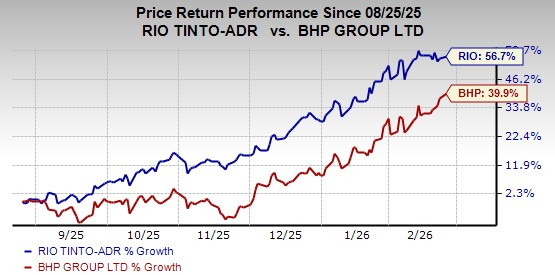
Image Source: Zacks Investment Research
Rio Tinto is trading at a forward 12-month price-to-earnings ratio of 11.98X while BHP Group’s forward earnings multiple sits at 16.14X.

Image Source: Zacks Investment Research
Final Take
Rio Tinto and BHP Group are poised to benefit from strong momentum in the copper market, supported by strong asset bases and expanding production pipelines. RIO’s near-to-midterm outlook is strengthened by rising copper output, progress at the Nuton-led Johnson Camp project and diversified exposure across iron ore and aluminum. BHP’s long-term growth is driven by the strong performance of Escondida and the development of the Jansen Stage 1 potash project.
However, Rio Tinto’s strong earnings estimates, price performance and an attractive valuation make it a better pick for investors than BHP currently. Both the stocks sport a Zacks Rank #1 (Strong Buy).
You can see the complete list of today’s Zacks #1 Rank stocks here.
Want the latest recommendations from Zacks Investment Research? Today, you can download 7 Best Stocks for the Next 30 Days. Click to get this free report
BHP Group Limited Sponsored ADR (BHP): Free Stock Analysis Report
Rio Tinto PLC (RIO): Free Stock Analysis Report
This article originally published on Zacks Investment Research (zacks.com).
Mentioned In This Article
Latest News
| Oct-08 | |
| Oct-08 | |
| Oct-07 | |
| Oct-07 | |
| Oct-06 | |
| Oct-05 | |
| Oct-01 | |
| Oct-01 | |
| Oct-01 | |
| Sep-28 | |
| Sep-24 | |
| Sep-23 | |
| Sep-23 | |
| Sep-18 | |
| Sep-16 |
